Department of Medicine, McMaster University, Hamilton, ON, Canada.
Department of Health Research Methods, Evidence, and Impact, Faculty of Health Sciences, McMaster University, Hamilton, ON, Canada.
BMC Med. 2021 Nov 26;19(1):292. doi: 10.1186/s12916-021-02162-7.
Defining the metabolic syndrome (MetS) in children remains challenging. Furthermore, a dichotomous MetS diagnosis can limit the power to study associations. We sought to characterize the serum metabolite signature of the MetS in early childhood using high-throughput metabolomic technologies that allow comprehensive profiling of metabolic status from a biospecimen.
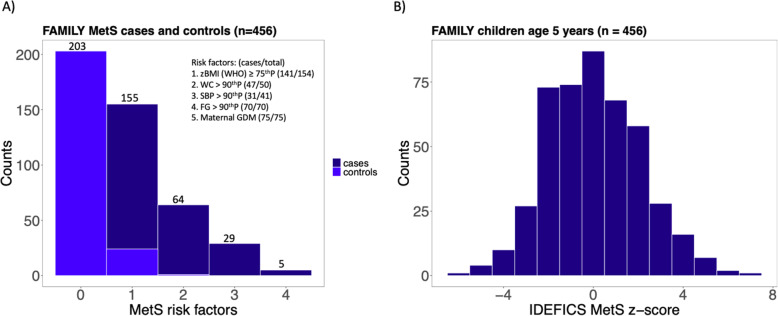
In the Family Atherosclerosis Monitoring In earLY life (FAMILY) prospective birth cohort study, we selected 228 cases of MetS and 228 matched controls among children age 5 years. In addition, a continuous MetS risk score was calculated for all 456 participants. Comprehensive metabolite profiling was performed on fasting serum samples using multisegment injection-capillary electrophoresis-mass spectrometry. Multivariable regression models were applied to test metabolite associations with MetS adjusting for covariates of screen time, diet quality, physical activity, night sleep, socioeconomic status, age, and sex.
Compared to controls, thirteen serum metabolites were identified in MetS cases when using multivariable regression models, and using the quantitative MetS score, an additional eight metabolites were identified. These included metabolites associated with gluconeogenesis (glucose (odds ratio (OR) 1.55 [95% CI 1.25-1.93]) and glutamine/glutamate ratio (OR 0.82 [95% CI 0.67-1.00])) and the alanine-glucose cycle (alanine (OR 1.41 [95% CI 1.16-1.73])), amino acids metabolism (tyrosine (OR 1.33 [95% CI 1.10-1.63]), threonine (OR 1.24 [95% CI 1.02-1.51]), monomethylarginine (OR 1.33 [95% CI 1.09-1.64]) and lysine (OR 1.23 [95% CI 1.01-1.50])), tryptophan metabolism (tryptophan (OR 0.78 [95% CI 0.64-0.95])), and fatty acids metabolism (carnitine (OR 1.24 [95% CI 1.02-1.51])). The quantitative MetS risk score was more powerful than the dichotomous outcome in consistently detecting this metabolite signature.
A distinct metabolite signature of pediatric MetS is detectable in children as young as 5 years old and may improve risk assessment at early stages of development.
儿童代谢综合征(MetS)的定义仍然具有挑战性。此外,二项式 MetS 诊断可能会限制研究关联的能力。我们试图使用高通量代谢组学技术来描述儿童早期 MetS 的血清代谢物特征,这些技术允许从生物样本中全面分析代谢状态。
在家族动脉粥样硬化监测早期生活(FAMILY)前瞻性出生队列研究中,我们在 5 岁儿童中选择了 228 例 MetS 病例和 228 例匹配对照。此外,还为所有 456 名参与者计算了连续的 MetS 风险评分。使用多段注射毛细管电泳 - 质谱法对空腹血清样本进行全面代谢物分析。应用多变量回归模型来测试代谢物与 MetS 的关联,调整屏幕时间、饮食质量、身体活动、夜间睡眠、社会经济地位、年龄和性别等混杂因素。
与对照组相比,使用多变量回归模型在 MetS 病例中鉴定出 13 种血清代谢物,使用定量 MetS 评分,又鉴定出 8 种代谢物。这些代谢物包括与糖异生相关的代谢物(葡萄糖(比值比(OR)1.55[95%CI 1.25-1.93])和谷氨酰胺/谷氨酸比值(OR 0.82[95%CI 0.67-1.00]))和丙氨酸 - 葡萄糖循环(丙氨酸(OR 1.41[95%CI 1.16-1.73])),氨基酸代谢(酪氨酸(OR 1.33[95%CI 1.10-1.63])、苏氨酸(OR 1.24[95%CI 1.02-1.51])、单甲基精氨酸(OR 1.33[95%CI 1.09-1.64])和赖氨酸(OR 1.23[95%CI 1.01-1.50]))、色氨酸代谢(色氨酸(OR 0.78[95%CI 0.64-0.95]))和脂肪酸代谢(肉碱(OR 1.24[95%CI 1.02-1.51]))。定量 MetS 风险评分比二项式结果更能一致地检测到这种代谢物特征,具有更高的效力。
在年仅 5 岁的儿童中,可以检测到儿童代谢综合征的独特代谢物特征,这可能有助于在发育早期进行风险评估。