Division of Advanced Medical Research in Pulmonary Hypertension, Division of Pulmonary Circulation, Dept of Cardiovascular Medicine, National Cerebral and Cardiovascular Centre, Suita, Japan
Dept of Cardiology, National Hospital Organization Okayama Medical Centre, Okayama, Japan.
Eur Respir J. 2022 Jul 7;60(1). doi: 10.1183/13993003.01694-2021. Print 2022 Jul.
Treatment options for inoperable chronic thromboembolic pulmonary hypertension (CTEPH) remain limited. Selexipag, an oral selective IP prostacyclin receptor agonist approved for pulmonary arterial hypertension, is a potential treatment option for CTEPH.
In this multicentre, randomised, double-blind, placebo-controlled study, 78 Japanese patients with inoperable CTEPH or persistent/recurrent pulmonary hypertension after pulmonary endarterectomy and/or balloon pulmonary angioplasty were randomly assigned to receive placebo or selexipag. The primary end-point was the change in pulmonary vascular resistance (PVR) from baseline to week 20. Secondary end-points were changes in other haemodynamic parameters: 6-min walk distance (6MWD), Borg dyspnoea scale score, World Health Organization (WHO) functional class, EuroQol five-dimension five-level tool and N-terminal pro-brain natriuretic peptide.
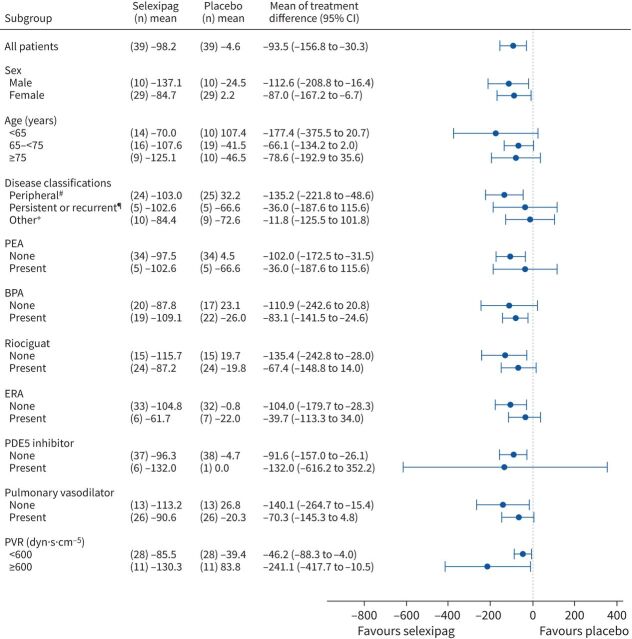
The change in PVR was -98.2±111.3 dyn·s·cm and -4.6±163.6 dyn·s·cm in the selexipag and placebo groups, respectively (mean difference -93.5 dyn·s·cm; 95% CI -156.8 to -30.3; p=0.006). The changes in cardiac index (p<0.001) and Borg dyspnoea scale score (p=0.036) were also significantly improved over placebo. 6MWD and WHO functional class were not significantly improved. The common adverse events in the selexipag group corresponded to those generally observed following administration of a prostacyclin analogue.
Selexipag significantly improved PVR and other haemodynamic variables in patients with CTEPH, although exercise capacity remained unchanged. Further large-scale investigation is necessary to prove the role of selexipag in CTEPH.
对于不能手术的慢性血栓栓塞性肺动脉高压(CTEPH),治疗选择仍然有限。塞来昔帕,一种口服的选择性 IP 前列环素受体激动剂,已被批准用于肺动脉高压,是 CTEPH 的潜在治疗选择。
在这项多中心、随机、双盲、安慰剂对照研究中,78 例不能手术的 CTEPH 或肺血管成形术后持续性/复发性肺动脉高压的日本患者随机分为安慰剂组或塞来昔帕组。主要终点是从基线到第 20 周时肺血管阻力(PVR)的变化。次要终点是其他血流动力学参数的变化:6 分钟步行距离(6MWD)、Borg 呼吸困难量表评分、世界卫生组织(WHO)功能分级、欧洲五维健康量表和 N 端脑利钠肽前体。
塞来昔帕组和安慰剂组的 PVR 变化分别为-98.2±111.3 dyn·s·cm 和-4.6±163.6 dyn·s·cm(平均差异-93.5 dyn·s·cm;95%CI-156.8 至-30.3;p=0.006)。心指数(p<0.001)和 Borg 呼吸困难量表评分(p=0.036)的变化也明显优于安慰剂。6MWD 和 WHO 功能分级没有显著改善。塞来昔帕组的常见不良反应与一般情况下使用前列环素类似物相似。
塞来昔帕显著改善了 CTEPH 患者的 PVR 和其他血流动力学变量,尽管运动能力没有变化。需要进一步的大规模研究来证明塞来昔帕在 CTEPH 中的作用。