Clark-Ginsberg Aaron, Easton-Calabria Lena C, Patel Sonny S, Balagna Jay, Payne Leslie A
RAND Corporation, 1200 S Hayes St, Arlington, VA 22202, USA.
Department of Global Health and Population, Harvard T.H. Chan School of Public Health, 655 Huntington Ave, Boston, MA 02115, USA.
Disaster Prev Manag. 2021 Oct 25;30(4-5):447-461. doi: 10.1108/DPM-03-2021-0067. Epub 2021 Sep 28.
Disaster management agencies are mandated to reduce risk for the populations that they serve. Yet, inequities in how they function may result in their activities creating disaster risk, particularly for already vulnerable and marginalized populations. In this article, how disaster management agencies create disaster risk for vulnerable and marginalized groups is examined, seeking to show the ways existing policies affect communities, and provide recommendations on policy and future research.
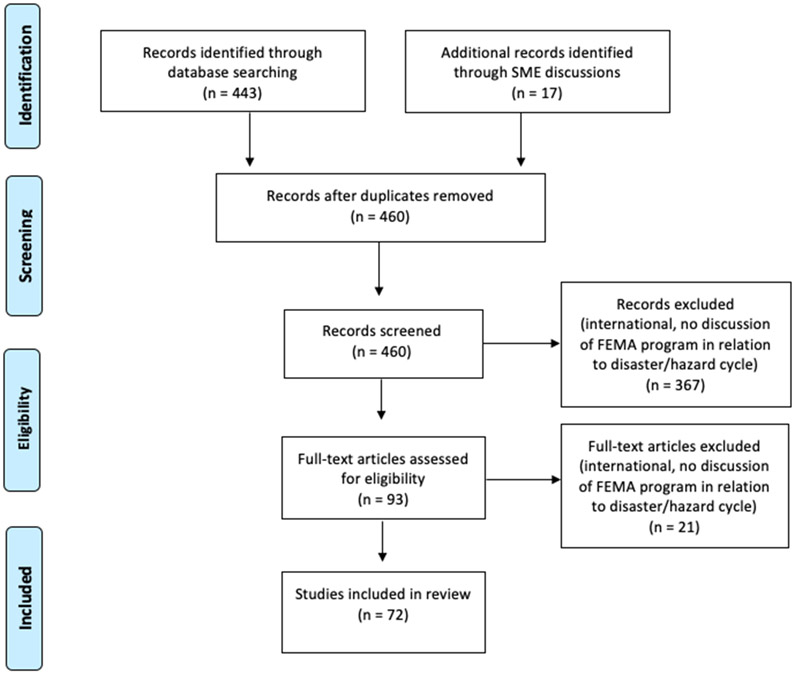
DESIGN/METHODOLOGY/APPROACH: The authors undertook a systematic review of the US disaster management agency, Federal Emergency Management Agency (FEMA), examining its programs through a lens of equity to understand how they shape disaster risk.
Despite a growing commitment to equity within FEMA, procedural, distributive, and contextual inequities result in interventions that perpetuate and amplify disaster risk for vulnerable and marginalized populations. Some of these inequities could be remediated by shifting toward a more bottom-up approach to disaster management, such as community-based disaster risk reduction approaches.
Disaster management agencies and other organizations can use the results of this study to better understand how to devise interventions in ways that limit risk creation for vulnerable populations, including through community-based approaches.
ORIGINALITY/VALUE: This study is the first to examine disaster risk creation from an organizational perspective, and the first to focus explicitly on how disaster management agencies can shape risk creation. This helps understand the linkages between disaster risk creation, equity and organizations.
灾害管理机构的任务是降低其所服务人群面临的风险。然而,其运作方式的不公平可能导致其活动反而制造灾害风险,尤其是对那些已经脆弱和边缘化的人群。本文探讨了灾害管理机构如何为脆弱和边缘化群体制造灾害风险,旨在揭示现有政策影响社区的方式,并提供有关政策和未来研究的建议。
设计/方法/途径:作者对美国灾害管理机构联邦紧急事务管理局(FEMA)进行了系统综述,从公平的角度审视其各项计划,以了解它们如何塑造灾害风险。
尽管联邦紧急事务管理局对公平的承诺日益增强,但程序、分配和背景方面的不公平导致干预措施使脆弱和边缘化人群面临的灾害风险持续存在并加剧。其中一些不公平可以通过转向更自下而上的灾害管理方法来补救,例如基于社区的灾害风险减少方法。
灾害管理机构和其他组织可以利用本研究结果,更好地理解如何设计干预措施,以限制对脆弱人群造成风险,包括通过基于社区的方法。
原创性/价值:本研究首次从组织角度审视灾害风险的产生,也是首次明确关注灾害管理机构如何塑造风险的产生。这有助于理解灾害风险产生、公平与组织之间的联系。