Melo Bruno F, Albert James S, Dagosta Fernando C P, Tagliacollo Victor A
Department of Ichthyology American Museum of Natural History New York New York USA.
Department of Biology University of Louisiana at Lafayette Lafayette Louisiana USA.
Ecol Evol. 2021 Nov 9;11(22):15815-15832. doi: 10.1002/ece3.8251. eCollection 2021 Nov.
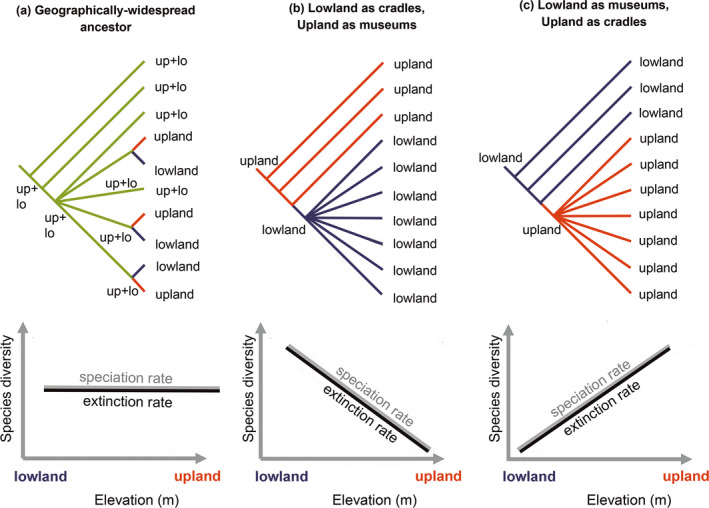
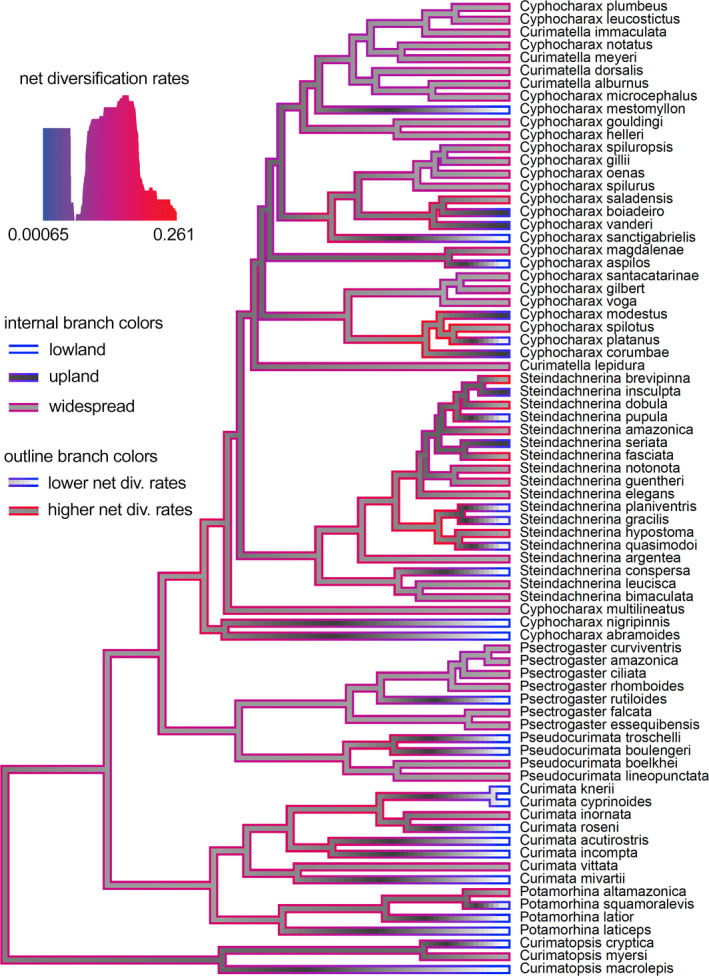
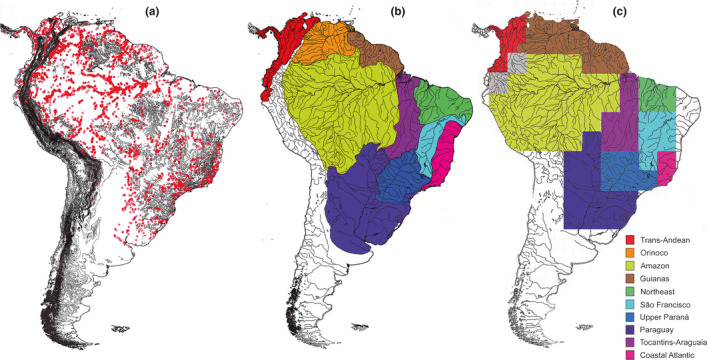
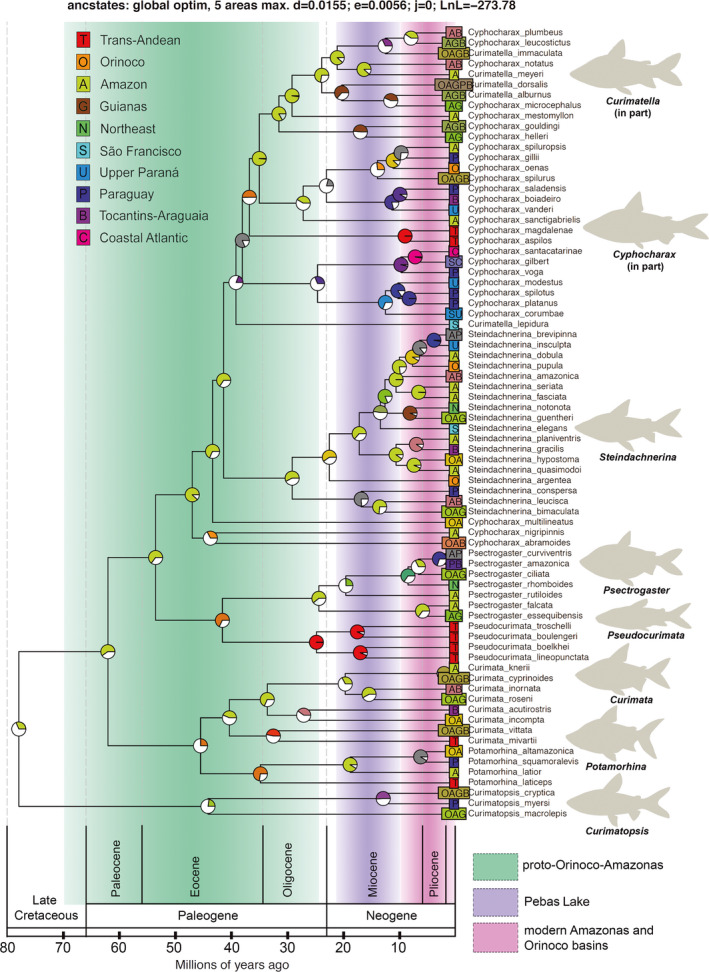
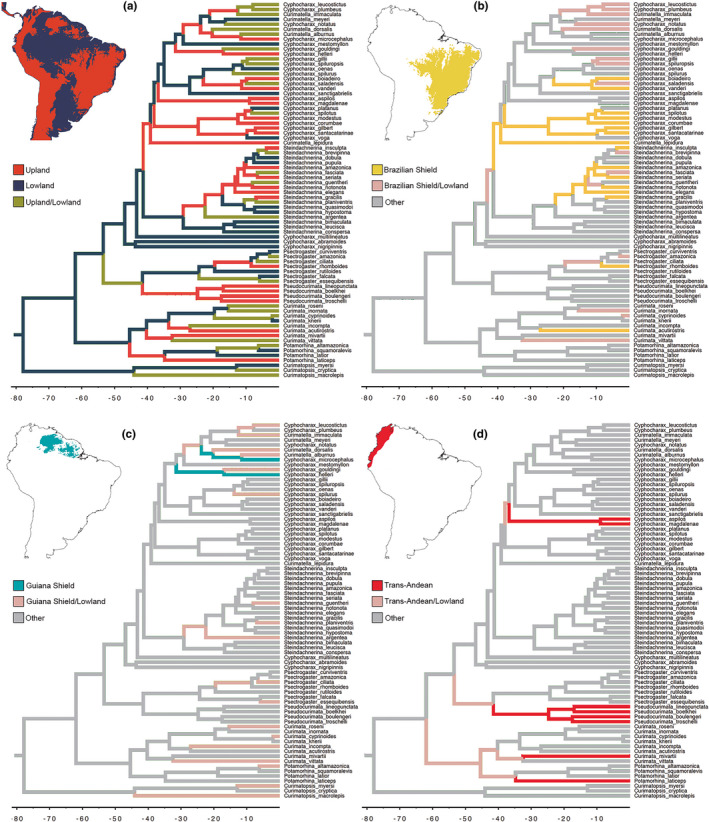
The Neotropics harbors a megadiverse ichthyofauna comprising over 6300 species with approximately 80% in just three taxonomic orders within the clade Characiphysi. This highly diverse group has evolved in tropical South America over tens to hundreds of millions of years influenced mostly by re-arrangements of river drainages in lowland and upland systems. In this study, we investigate patterns of spatial diversification in Neotropical freshwater fishes in the family Curimatidae, a species-rich clade of the order Characiformes. Specifically, we examined ancestral areas, dispersal events, and shifts in species richness using spatially explicit biogeographic and macroevolutionary models to determine whether lowlands-uplands serve as museums or cradles of diversification for curimatids. We used fossil information to estimate divergence times in BEAST, multiple time-stratified models of geographic range evolution in BioGeoBEARS, and alternative models of geographic state-dependent speciation and extinction in GeoHiSSE. Our results suggest that the most recent common ancestor of curimatids originated in the Late Cretaceous likely in lowland paleodrainages of northwestern South America. Dispersals from lowland to upland river basins of the Brazilian and Guiana shields occurred repeatedly across independently evolving lineages in the Cenozoic. Colonization of upland drainages was often coupled with increased rates of net diversification in species-rich genera such as and . Our findings demonstrate that colonization of novel aquatic environments at higher elevations is associated with an increased rate of diversification, although this pattern is clade-dependent and driven mostly by allopatric speciation. Curimatids reinforce an emerging perspective that Amazonian lowlands act as a museum by accumulating species along time, whereas the transitions to uplands stimulate higher net diversification rates and lineage diversification.
新热带地区拥有极为丰富的鱼类区系,包含超过6300个物种,其中约80%仅分布在脂鲤形目下的三个分类目中。这一高度多样化的类群在热带南美洲历经数千万年至数亿年的演化,主要受到低地和高地系统中河流排水系统重新排列的影响。在本研究中,我们调查了脂鲤科新热带淡水鱼的空间多样化模式,脂鲤科是脂鲤形目中一个物种丰富的类群。具体而言,我们使用空间明确的生物地理和宏观进化模型,研究祖先分布区、扩散事件以及物种丰富度的变化,以确定低地和高地是作为脂鲤科物种多样化的博物馆还是摇篮。我们利用化石信息在BEAST中估计分歧时间,在BioGeoBEARS中使用多个时间分层的地理范围进化模型,以及在GeoHiSSE中使用地理状态依赖的物种形成和灭绝替代模型。我们的结果表明,脂鲤科最近的共同祖先起源于晚白垩世,可能位于南美洲西北部的低地古排水系统中。在新生代,从低地向巴西和圭亚那地盾的高地流域的扩散在独立演化的谱系中反复发生。高地流域的定殖往往伴随着物种丰富的属(如[具体属名缺失]和[具体属名缺失])净多样化率的增加。我们的研究结果表明,向更高海拔的新水生环境的定殖与多样化率的增加有关,尽管这种模式依赖于类群,并且主要由异域物种形成驱动。脂鲤科强化了一种新出现的观点,即亚马逊低地通过长期积累物种而充当博物馆,而向高地的过渡则刺激了更高的净多样化率和谱系多样化。