Yang Yong, Juríček Michal
Department of Chemistry, University of Zurich, Winterthurerstrasse 190, 8057, Zurich, Switzerland.
Chempluschem. 2021 Nov 13;87(1):e202100468. doi: 10.1002/cplu.202100468.
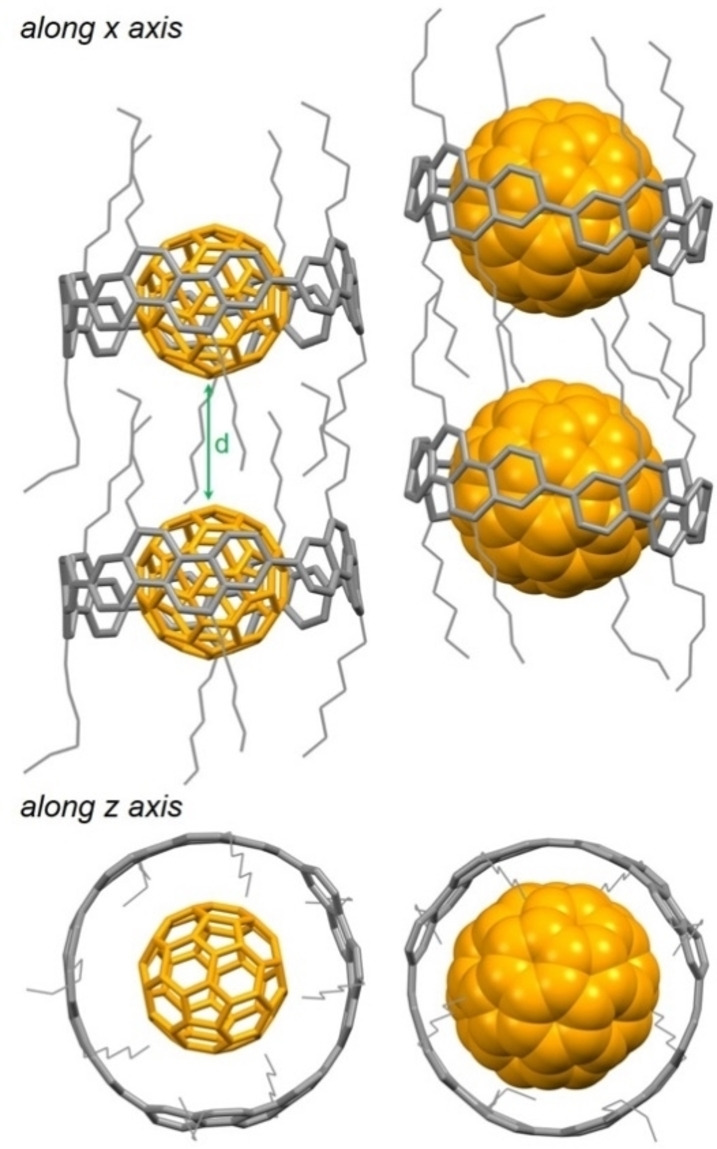
Carbon-nanohoop structures featuring one or more round-shaped cavities represent ideal supramolecular hosts for spherical fullerenes, with potential to form host-guest complexes that perform as organic semiconductors in the solid state. Due to the tight complexation between the shape-complementary hosts and guests, carbon nanohoops have the potential to shield fullerenes from water and oxygen, known to perturb the electron-transport process. Many nanohoop receptors have been found to form host-guest complexes with fullerenes. However, there is only a little or no control over the long-range order of encapsulated fullerenes in the solid state. Consequently, the potential of these complexes to perform as organic semiconductors is rarely evaluated. Herein, we present a survey of all known nanohoop-fullerene complexes, for which the solid-state structures were obtained. We discuss and propose instances where the inclusion fullerene guests form discrete supramolecular wires, which might open up possibilities for their use in electronic devices.
具有一个或多个圆形空腔的碳纳米环结构是球形富勒烯理想的超分子主体,有潜力形成在固态下作为有机半导体的主客体复合物。由于形状互补的主体和客体之间紧密的络合作用,碳纳米环有可能保护富勒烯免受水和氧气的影响,已知水和氧气会干扰电子传输过程。已发现许多纳米环受体与富勒烯形成主客体复合物。然而,对于固态中被包裹富勒烯的长程有序性几乎没有或完全没有控制。因此,很少评估这些复合物作为有机半导体的潜力。在此,我们对所有已知的获得了固态结构的纳米环 - 富勒烯复合物进行了综述。我们讨论并提出了一些实例,其中包含富勒烯客体形成离散的超分子线,这可能为它们在电子器件中的应用开辟可能性。