Calgary Pediatric Stroke Program, Alberta Children's Hospital, Calgary, Canada.
Hotchkiss Brain Institute, University of Calgary, Calgary, Canada.
Brain Behav. 2022 Jan;12(1):e2433. doi: 10.1002/brb3.2433. Epub 2021 Nov 25.
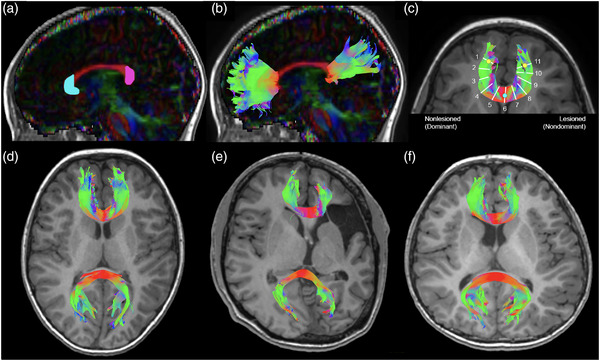
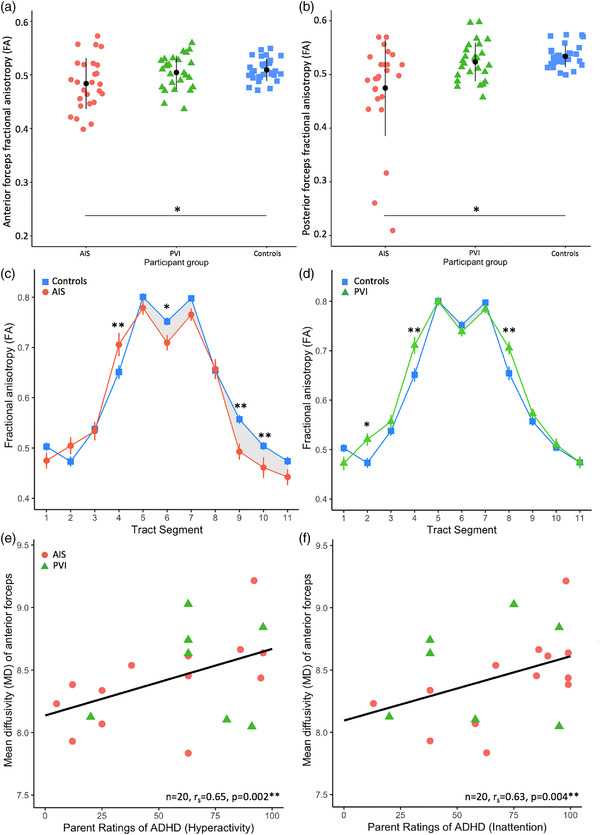
Perinatal stroke affects ∼1 in 1000 births and concomitant cognitive impairments are common but poorly understood. Rates of Attention Deficit/Hyperactivity Disorder (ADHD) are increased 5-10× and executive dysfunction can be disabling. We used diffusion imaging to investigate whether stroke-related differences in frontal white matter (WM) relate to cognitive impairments. Anterior forceps were isolated using tractography and sampled along the tract. Resulting metrics quantified frontal WM microstructure. Associations between WM metrics and parent ratings of ADHD symptoms (ADHD-5 rating scale) and executive functioning (Behavior Rating Inventory of Executive Function (BRIEF)) were explored. Eighty-three children were recruited (arterial ischemic stroke [AIS] n = 26; periventricular venous infarction [PVI] n = 26; controls n = 31). WM metrics were altered for stroke groups compared to controls. Along-tract analyses showed differences in WM metrics in areas approximating the lesion as well as more remote differences at midline and in the nonlesioned hemisphere. WM metrics correlated with parental ratings of ADHD and executive function such that higher diffusivity values were associated with poorer function. These findings suggest that underlying microstructure of frontal white matter quantified via tractography may provide a relevant biomarker associated with cognition and behavior in children with perinatal stroke.
围产期卒中影响每 1000 例出生中的 1 例,并发认知障碍较为常见,但了解甚少。注意力缺陷多动障碍(ADHD)的发病率增加了 5-10 倍,并且执行功能障碍可能致残。我们使用弥散张量成像(DTI)研究了与卒中相关的额叶白质(WM)差异是否与认知障碍有关。使用轨迹追踪法分离出前连合,并沿着轨迹进行采样。所得指标量化了额叶 WM 微观结构。探讨了 WM 指标与 ADHD 症状(ADHD-5 评定量表)和执行功能(行为评定量表)的父母评分之间的相关性。共招募了 83 名儿童(动脉缺血性卒中 [AIS] n=26;脑室周围静脉梗死 [PVI] n=26;对照组 n=31)。与对照组相比,卒中组的 WM 指标发生了改变。沿轨迹分析显示,WM 指标在病变区域及其更远的中线和非病变半球区域存在差异。WM 指标与父母对 ADHD 和执行功能的评分相关,即弥散值越高,功能越差。这些发现表明,通过轨迹追踪法量化的额叶白质的基础微观结构可能提供了与围产期卒中儿童认知和行为相关的相关生物标志物。