Department of Orthopaedic and Trauma Surgery, Ospedale Buon Consiglio Fatebenefratelli, Via Petrarca 35, 80123, Napoli (NA), Italy.
Orthopedics and Sport Medicine Unit, Campolongo Hospital, Salerno, Italy.
J Orthop Traumatol. 2021 Nov 26;22(1):49. doi: 10.1186/s10195-021-00613-8.
Several modifications to the original Grammont reverse shoulder arthroplasty (RSA) design have been proposed to prevent distinctive issues, such as both glenoid and humeral lateralization. The aim of this systematic review was to determine rates of problems, complications, reoperations, and revisions after onlay lateralized humeral stem RSA, hypothesizing that these are design related.
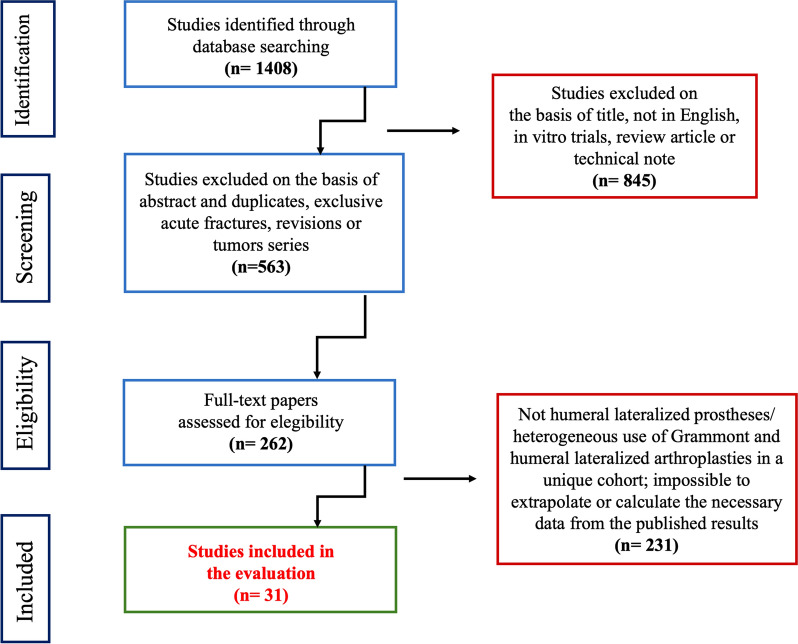
This systematic review was performed in accordance with the PRISMA statement guidelines. A literature search was conducted (1 January 2000 to 14 April 2020) using PubMed, Cochrane Reviews, Scopus, and Google Scholar, employing several combinations of keywords: "reverse shoulder arthroplasty," "reverse shoulder prosthesis," "inverse shoulder arthroplasty," "inverse shoulder prosthesis," "problems," "complications," "results," "outcomes," "reoperation," and "revision."
Thirty-one studies with 4893 RSA met inclusion criteria. The 892 postoperative problems and 296 postoperative complications represented overall problem and complication rates of 22.7% and 7.5%, respectively. Forty-one reoperations and 63 revisions resulted, with overall reoperation and revision rates of 1.7% and 2.6%, respectively.
Problem, complication, and reintervention rates proved acceptable when implanting a high humeral lateralization stem RSA. The most frequent problem was scapular notching (12.6%), and the most common postoperative complication was scapular stress fracture (1.8%). An overall humeral complication rate of 1.9% was identified, whereas no humeral fractures or stem loosening were reported with short stems. Infections (1.3%) were the most common reason for component revision, followed by instability (0.8%).
Systematic review IV.
为了预防独特的问题,如肩盂和肱骨的外侧化,对原始 Grammont 反式肩关节置换术(RSA)设计进行了几种修改。本系统评价的目的是确定覆盖式外侧化肱骨柄 RSA 后出现问题、并发症、再次手术和翻修的发生率,假设这些与设计有关。
本系统评价按照 PRISMA 声明指南进行。使用 PubMed、Cochrane 综述、Scopus 和 Google Scholar 进行文献检索(2000 年 1 月 1 日至 2020 年 4 月 14 日),采用了几个关键词的组合:“反向肩关节置换术”、“反向肩关节假体”、“反向肩关节置换术”、“反向肩关节假体”、“问题”、“并发症”、“结果”、“结果”、“再次手术”和“修订”。
符合纳入标准的 31 项研究共纳入 4893 例 RSA。892 例术后问题和 296 例术后并发症分别代表了 22.7%和 7.5%的总体问题和并发症发生率。41 例再次手术和 63 例翻修,再次手术和翻修的总发生率分别为 1.7%和 2.6%。
当植入高肱骨外侧化柄 RSA 时,证明问题、并发症和再次干预的发生率是可以接受的。最常见的问题是肩胛切迹(12.6%),最常见的术后并发症是肩胛应力骨折(1.8%)。总体肱骨并发症发生率为 1.9%,而短柄未见肱骨骨折或柄松动。感染(1.3%)是最常见的翻修原因,其次是不稳定(0.8%)。
系统评价 IV 级。