Tosello Barthélémy, Méziane Sahra, Resseguier Noémie, Marret Stéphane, Cambonie Gilles, Zahed Meriem, Brévaut-Malaty Véronique, Beltran Anzola Any, Gire Catherine
Department of Neonatology, North Hospital, University Hospital of Marseille, Chemin des Bourrely, CEDEX 20, 13915 Marseille, France.
Aix Marseille Université, CNRS, EFS, ADES, 13915 Marseille, France.
Children (Basel). 2021 Oct 20;8(11):943. doi: 10.3390/children8110943.
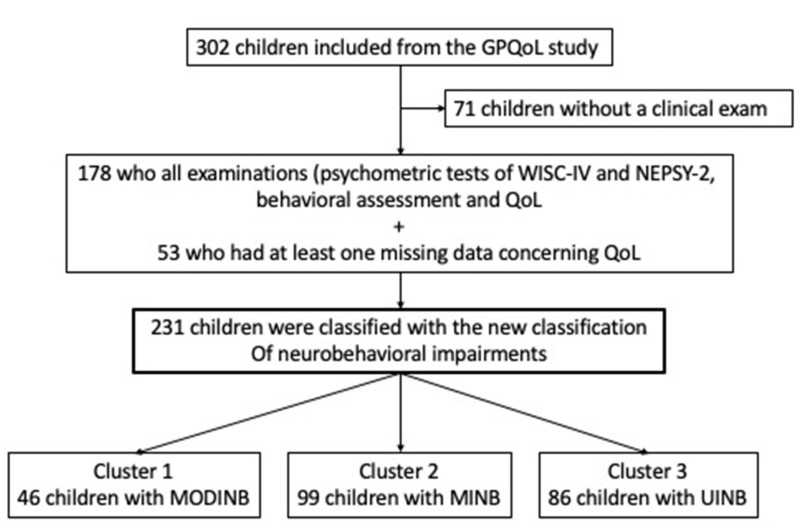
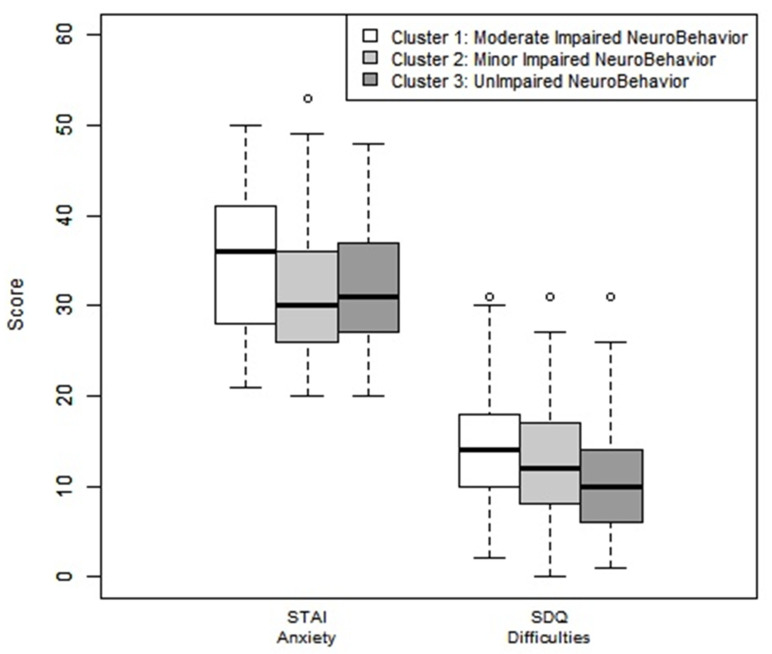
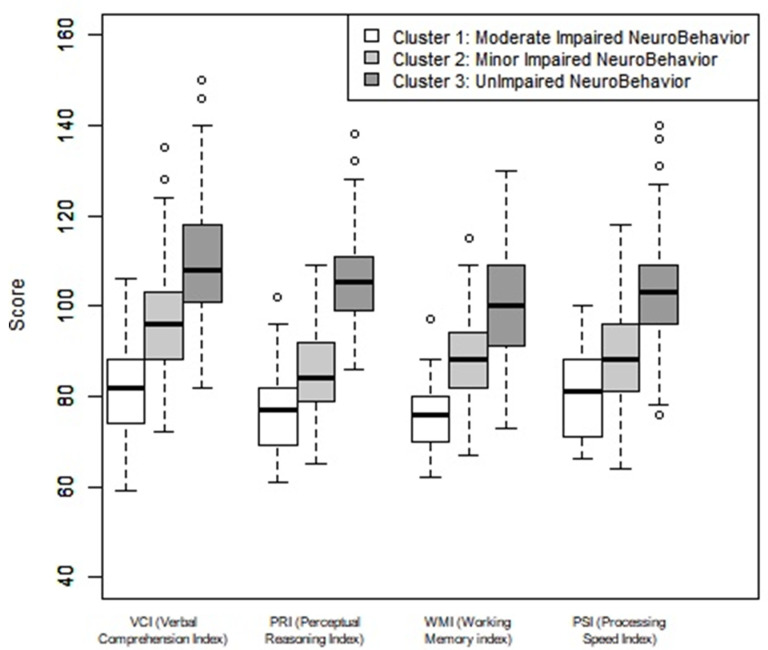
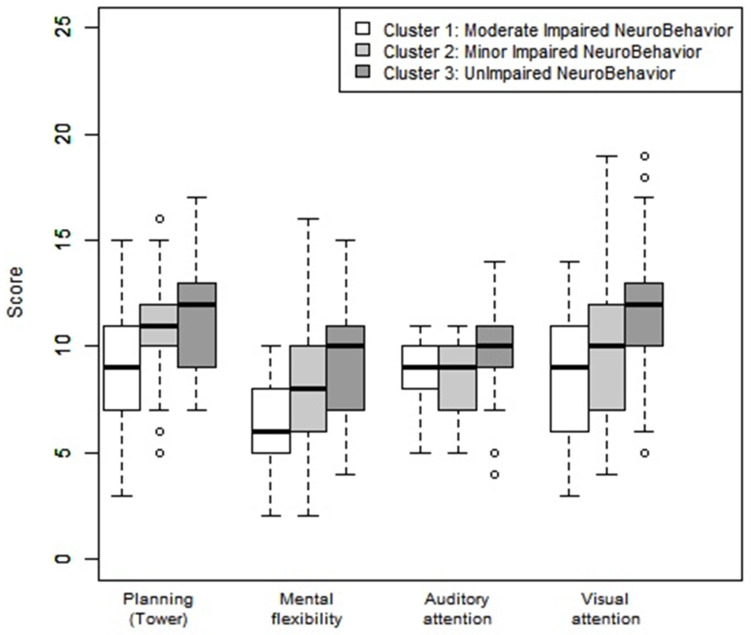
School-aged extremely preterm (EPT) children have multiple specific neurocognitive/behavioral disorders that are often associated with other disorders; this manifests a true neurobehavioral "phenotype" of prematurity. To determine a profile of cognitive/behavioral impairments in a population of school-aged EPT children (7-10 years-old) without major disabilities, a cross-sectional study was conducted in five medical centers. An algorithm distributed the study population according to four WISC-IV subtests, five NEPSY-2 subtests, and two variables of figure of Rey. The behavior (SDQ), anxiety (Spielberg STAI-C), and generic QoL (Kidscreen 10 and VSP-A) were also evaluated. The study included 231 school-aged EPT children. Three neurobehavioral "phenotypes" were defined according to their severity: 1 = moderately, 2 = minor, and 3 = unimpaired. In all the profiles, the working memory, perceptual reasoning, as well as mental flexibility, were close to or below average, and their emotional behavior was always troubled. Self-esteem and school-work were the most impacted QoL areas. The unimpaired neurobehavior exhibited emotional behavioral impairment and executive dysfunction. The profile analysis defined distinct outcome groups and provided an informative means of identifying factors related to developmental outcomes. The QoL deterioration is determined by the severity of the three neurobehavioral "phenotypes", which is defined as well as by dysexecutive and/or behavioral disorders.
学龄期极早产儿(EPT)存在多种特定的神经认知/行为障碍,且常与其他障碍相关;这体现了早产真正的神经行为“表型”。为确定一群无重大残疾的学龄期EPT儿童(7至10岁)的认知/行为损伤概况,在五个医疗中心开展了一项横断面研究。一种算法根据四个韦氏儿童智力量表第四版(WISC-IV)子测验、五个第二版神经心理成套测验(NEPSY-2)子测验以及雷伊图形的两个变量对研究人群进行分类。还评估了行为(优势与困难问卷,SDQ)、焦虑(斯皮尔伯格状态-特质焦虑量表儿童版,STAI-C)和一般生活质量(儿童生活质量量表10项版,Kidscreen 10和视觉空间感知能力评估,VSP-A)。该研究纳入了231名学龄期EPT儿童。根据严重程度定义了三种神经行为“表型”:1 = 中度,2 = 轻度,3 = 未受损。在所有概况中,工作记忆、知觉推理以及心理灵活性均接近或低于平均水平,且他们的情绪行为总是存在问题。自尊和学业是生活质量受影响最大的领域。未受损的神经行为表现出情绪行为损伤和执行功能障碍。概况分析定义了不同的结果组,并提供了一种识别与发育结果相关因素的有益方法。生活质量的恶化由三种神经行为“表型”的严重程度决定,其定义方式以及执行功能障碍和/或行为障碍也是如此。