Kwon Yongseok, Ryu Jihye, Ju Seyoung
National Institute of Agricultural Sciences, 166 Nongsaengmyeong-ro, Wanju-gun 55365, Korea.
Major in Food Science, College of Biomedical and Health Science, Konkuk University, Chungju 27478, Korea.
Foods. 2021 Nov 18;10(11):2860. doi: 10.3390/foods10112860.
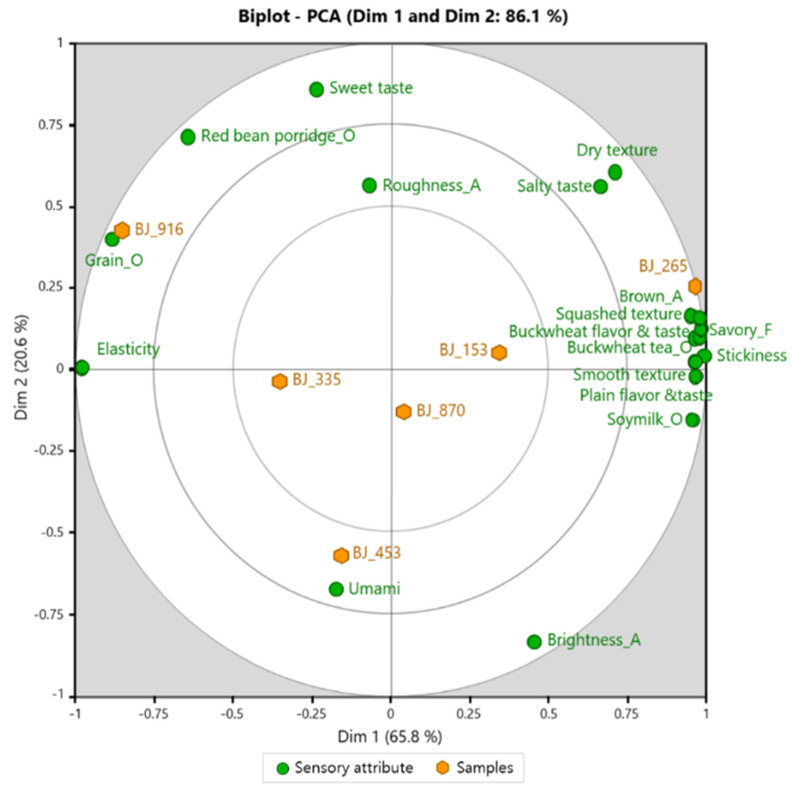
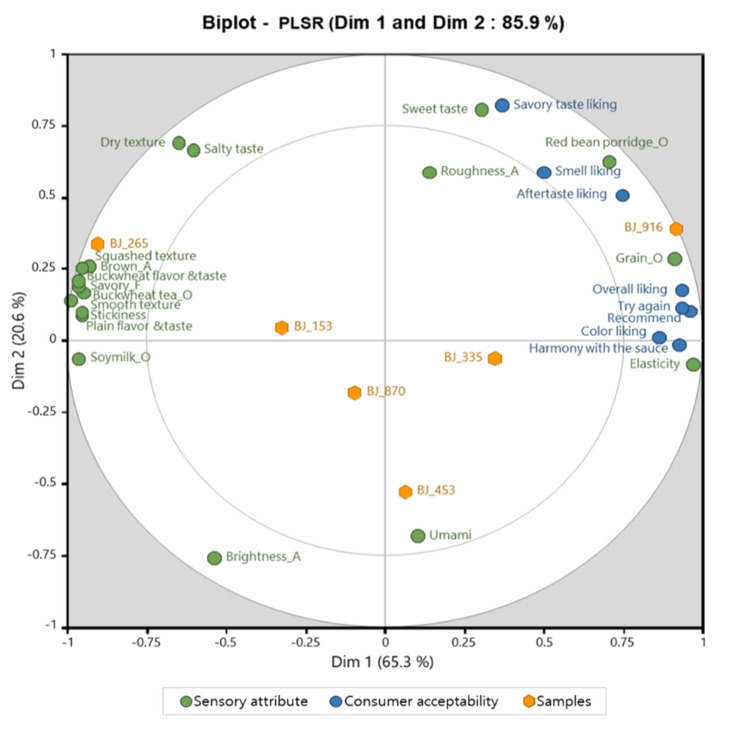
Buckwheat contains more essential proteins, dietary fiber, vitamins, minerals, and diverse phytochemicals than wheat and rice. The aims of this study are to develop the descriptive sensory attributes and evaluate the consumer acceptability of six buckwheat jellies (memilmuk) with added mung bean starch and to analyze the relationship between their descriptive sensory attributes and consumer acceptability. Statistical analyses were performed by one-way analysis of variance (ANOVA), principal component analysis (PCA), and partial least squares regression (PLSR). A total of 18 sensory attributes of buckwheat jelly, including appearance (brown, brightness, and roughness), odor/aroma (soymilk smell, grain smell, red bean porridge smell, and buckwheat tea smell), flavor or taste (savory flavor, plain taste, buckwheat taste, sweet taste, salty taste, and umami), and texture (squashed, dry, smooth, elasticity and stickiness) were developed. Consumer acceptability tests of six buckwheat jellies were conducted by 93 consumers evaluating for color, smell, savory taste, aftertaste, harmony with the sauce, overall liking, and would recommend or try again. Buckwheat jelly with 25% of mung bean starch (BJ_916) was the most favorable jelly sample among the six samples. All attributes except color, smell, and the savory taste of samples showed a significant difference ( < 0.001). BJ_916 showed a close relationship with a grain smell, elasticity, red bean porridge smell, and sweet taste of descriptive attributes and also all attributes of consumer acceptability. The determination of sensory attributes and consumer acceptability of buckwheat jelly will help to improve sensory characteristics to fulfill consumer needs and desires. Furthermore, this current study will help facilitate the expansion of the buckwheat consumption market.
与小麦和大米相比,荞麦含有更多的必需蛋白质、膳食纤维、维生素、矿物质和多种植物化学物质。本研究的目的是确定六种添加了绿豆淀粉的荞麦果冻(memilmuk)的描述性感官属性,评估消费者对其的接受度,并分析描述性感官属性与消费者接受度之间的关系。采用单因素方差分析(ANOVA)、主成分分析(PCA)和偏最小二乘回归(PLSR)进行统计分析。共确定了18种荞麦果冻的感官属性,包括外观(棕色、亮度和粗糙度)、气味/香气(豆浆味、谷物味、红豆粥味和荞麦茶味)、风味或味道(鲜味、原味、荞麦味、甜味、咸味和鲜味)以及质地(压扁感、干燥感、光滑感、弹性和粘性)。93名消费者对六种荞麦果冻进行了消费者接受度测试,评估内容包括颜色、气味、鲜味、余味、与酱汁的协调性、总体喜好程度以及是否会推荐或再次尝试。在六个样品中,添加25%绿豆淀粉的荞麦果冻(BJ_916)是最受喜爱的果冻样品。除样品的颜色、气味和鲜味外,所有属性均显示出显著差异(<0.001)。BJ_916与描述性属性中的谷物味、弹性、红豆粥味和甜味以及消费者接受度的所有属性都有密切关系。确定荞麦果冻的感官属性和消费者接受度将有助于改善感官特性,以满足消费者的需求和期望。此外,本研究将有助于促进荞麦消费市场的扩大。