Tanase Daniela Maria, Gosav Evelina Maria, Petrov Daniela, Jucan Alina Ecaterina, Lacatusu Cristina Mihaela, Floria Mariana, Tarniceriu Claudia Cristina, Costea Claudia Florida, Ciocoiu Manuela, Rezus Ciprian
Department of Internal Medicine, "Grigore T. Popa" University of Medicine and Pharmacy, 700115 Iasi, Romania.
Internal Medicine Clinic, "Sf. Spiridon" County Clinical Emergency Hospital Iasi, 700111 Iasi, Romania.
Diagnostics (Basel). 2021 Nov 5;11(11):2053. doi: 10.3390/diagnostics11112053.
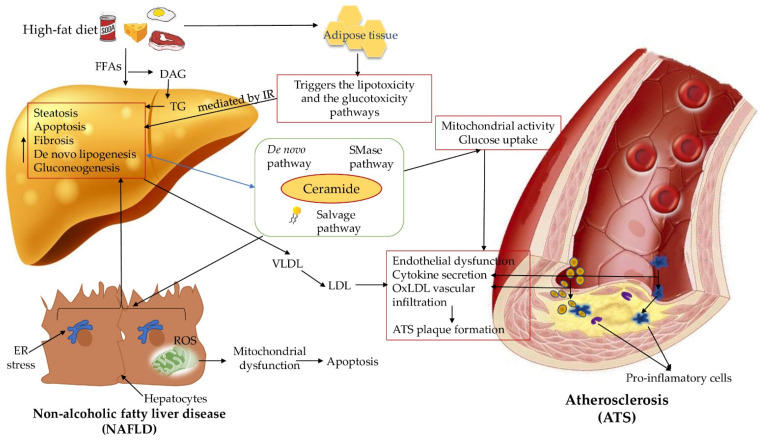
Non-alcoholic fatty liver disease (NAFLD) and atherosclerosis (ATS) are worldwide known diseases with increased incidence and prevalence. These two are driven and are interconnected by multiple oxidative and metabolic functions such as lipotoxicity. A gamut of evidence suggests that sphingolipids (SL), such as ceramides, account for much of the tissue damage. Although in humans they are proving to be accurate biomarkers of adverse cardiovascular disease outcomes and NAFLD progression, in rodents, pharmacological inhibition or depletion of enzymes driving de novo ceramide synthesis prevents the development of metabolic driven diseases such as diabetes, ATS, and hepatic steatosis. In this narrative review, we discuss the pathways which generate the ceramide synthesis, the potential use of circulating ceramides as novel biomarkers in the development and progression of ATS and related diseases, and their potential use as therapeutic targets in NAFDL-ATS development which can further provide new clues in this field.
非酒精性脂肪性肝病(NAFLD)和动脉粥样硬化(ATS)是全球范围内发病率和患病率不断上升的疾病。这两种疾病由多种氧化和代谢功能(如脂毒性)驱动且相互关联。大量证据表明,鞘脂(SL),如神经酰胺,是造成大部分组织损伤的原因。尽管在人类中它们已被证明是不良心血管疾病结局和NAFLD进展的准确生物标志物,但在啮齿动物中,对驱动神经酰胺从头合成的酶进行药理学抑制或清除可预防代谢驱动疾病(如糖尿病、ATS和肝脂肪变性)的发展。在这篇叙述性综述中,我们讨论了产生神经酰胺合成的途径、循环神经酰胺作为ATS及相关疾病发展和进展中的新型生物标志物的潜在用途,以及它们作为NAFLD-ATS发展中治疗靶点的潜在用途,这可为该领域进一步提供新线索。