Yu Xinfang, Li Wei, Young Ken H, Li Yong
Section of Epidemiology and Population Science, Department of Medicine, Baylor College of Medicine, One Baylor Plaza, Houston, TX 77030, USA.
Hematopathology Division, Department of Pathology, Duke University Medical Center, Durham, NC 27710, USA.
Biomedicines. 2021 Nov 16;9(11):1702. doi: 10.3390/biomedicines9111702.
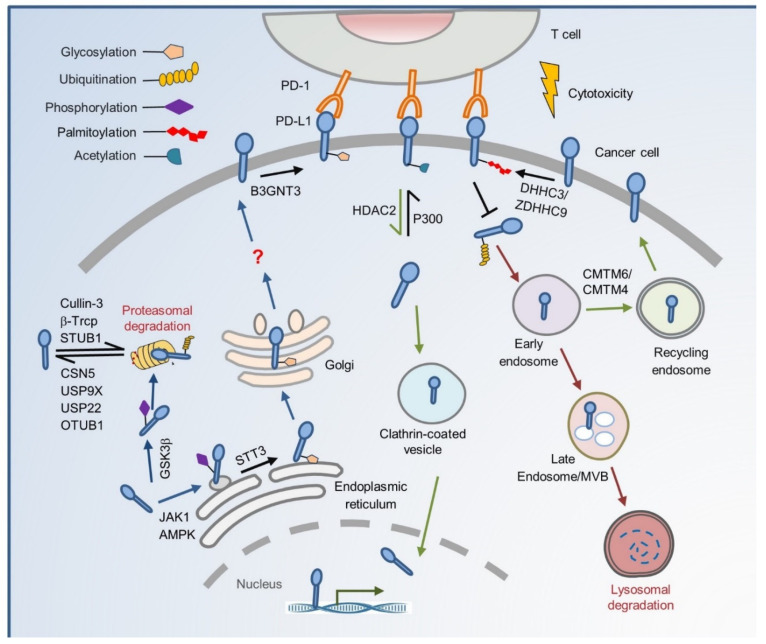
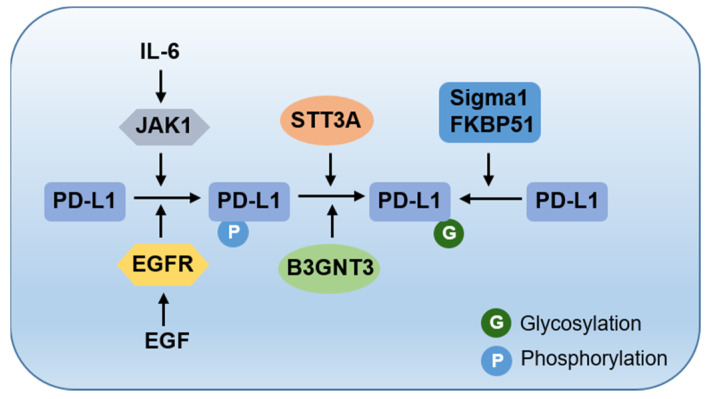
Programmed death-ligand 1 (PD-L1) is one of the most classic immune checkpoint molecules. Cancer cells express PD-L1 to inhibit the activity of effector T cells' cytotoxicity through programmed death 1 (PD-1) engagement in exposure to inflammatory cytokines. PD-L1 expression levels on cancer cells might affect the clinical response to anti-PD-1/PD-L1 therapies. Hence, understanding molecular mechanisms for regulating PD-L1 expression is essential for improving the clinical response rate and efficacy of PD-1/PD-L1 blockade. Posttranslational modifications (PTMs), including phosphorylation, glycosylation, ubiquitination, and acetylation, regulate PD-L1 stability, cellular translocation, and interaction with its receptor. A coordinated positive and negative regulation via PTMs is required to ensure the balance and function of the PD-L1 protein. In this review, we primarily focus on the roles of PTMs in PD-L1 expression, trafficking, and antitumor immune response. We also discuss the implication of PTMs in anti-PD-1/PD-L1 therapies.
程序性死亡配体1(PD-L1)是最经典的免疫检查点分子之一。癌细胞表达PD-L1,通过程序性死亡1(PD-1)与炎性细胞因子结合来抑制效应T细胞的细胞毒性活性。癌细胞上的PD-L1表达水平可能会影响对抗PD-1/PD-L1疗法的临床反应。因此,了解调节PD-L1表达的分子机制对于提高PD-1/PD-L1阻断疗法的临床反应率和疗效至关重要。翻译后修饰(PTM),包括磷酸化、糖基化、泛素化和乙酰化,可调节PD-L1的稳定性、细胞转运及其与受体的相互作用。需要通过PTM进行协调的正负调节,以确保PD-L1蛋白的平衡和功能。在本综述中,我们主要关注PTM在PD-L1表达、运输和抗肿瘤免疫反应中的作用。我们还讨论了PTM在抗PD-1/PD-L1疗法中的意义。