Key Laboratory of Landscaping Agriculture, Ministry of Agriculture and Rural Affairs, College of Horticulture, Nanjing Agricultural University, Nanjing 210095, China.
Key Laboratory of Biology of Ornamental Plants in East China, National Forestry and Grassland Administration, College of Horticulture, Nanjing Agricultural University, Nanjing 210095, China.
Int J Mol Sci. 2021 Nov 9;22(22):12124. doi: 10.3390/ijms222212124.
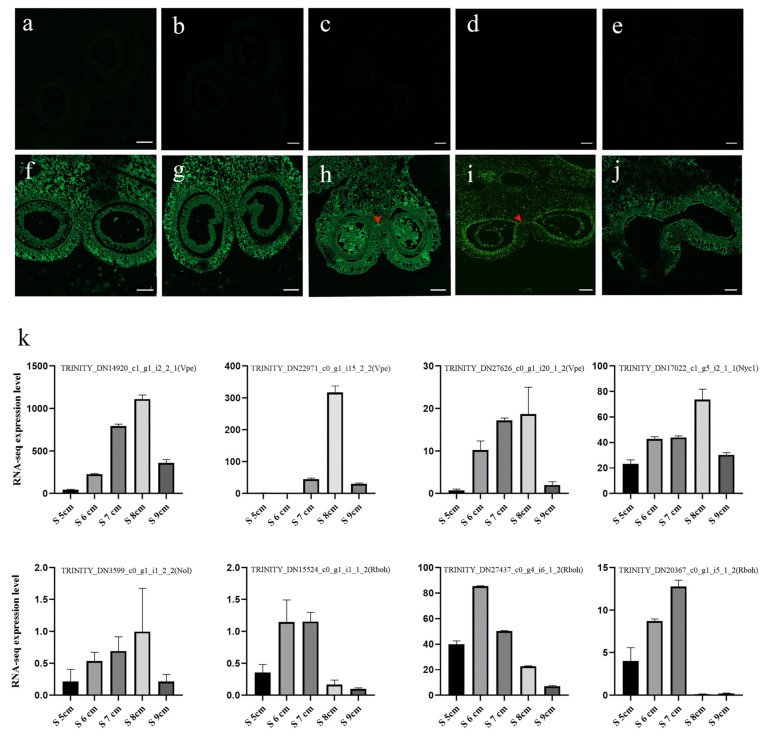
Lily ( spp.) is a widely cultivated horticultural crop that has high ornamental and commercial value but also the serious problem of pollen pollution. However, mechanisms of anther dehiscence in lily remain largely unknown. In this study, the morphological characteristics of the stomium zone (SZ) from different developmental stages of 'Siberia' lily anthers were investigated. In addition, transcriptomic and metabolomic data were analyzed to identify the differentially expressed genes (DEGs) and secondary metabolites involved in stomium degeneration. According to morphological observations, SZ lysis occurred when flower buds were 6-8 cm in length and was completed in 9 cm. Transcriptomic analysis identified the genes involved in SZ degeneration, including those associated with hormone signal transduction, cell structure, reactive oxygen species (ROS), and transcription factors. A weighted co-expression network showed strong correlations between transcription factors. In addition, TUNEL (TdT-mediated dUTP nick-end labeling) assays showed that programmed cell death was important during anther SZ degeneration. Jasmonates might also have key roles in anther dehiscence by affecting the expression of the genes involved in pectin lysis, water transport, and cysteine protease. Collectively, the results of this study improve our understanding of anther dehiscence in lily and provide a data platform from which the molecular mechanisms of SZ degeneration can be revealed.
百合( spp.)是一种广泛种植的园艺作物,具有很高的观赏和商业价值,但也存在花粉污染的严重问题。然而,百合花药开裂的机制在很大程度上尚不清楚。本研究对不同发育阶段‘西伯利亚’百合花药的裂口区(SZ)的形态特征进行了研究。此外,还分析了转录组和代谢组数据,以鉴定参与裂口退化的差异表达基因(DEGs)和次生代谢物。根据形态学观察,当花蕾长 6-8 厘米时,SZ 开始裂解,并在 9 厘米时完成。转录组分析鉴定了参与 SZ 退化的基因,包括与激素信号转导、细胞结构、活性氧(ROS)和转录因子相关的基因。加权共表达网络显示转录因子之间存在很强的相关性。此外,TUNEL(末端转移酶介导的 dUTP 缺口末端标记)检测表明,程序性细胞死亡在花药 SZ 退化过程中很重要。茉莉酸甲酯可能通过影响参与果胶裂解、水分运输和半胱氨酸蛋白酶的基因的表达,在花药开裂中也起着关键作用。总之,本研究结果提高了我们对百合花药开裂的认识,并提供了一个揭示 SZ 退化分子机制的数据平台。