Asan Medical Center, Asan Institute for Life Sciences, University of Ulsan College of Medicine, Seoul 05505, Korea.
Int J Mol Sci. 2021 Nov 15;22(22):12334. doi: 10.3390/ijms222212334.
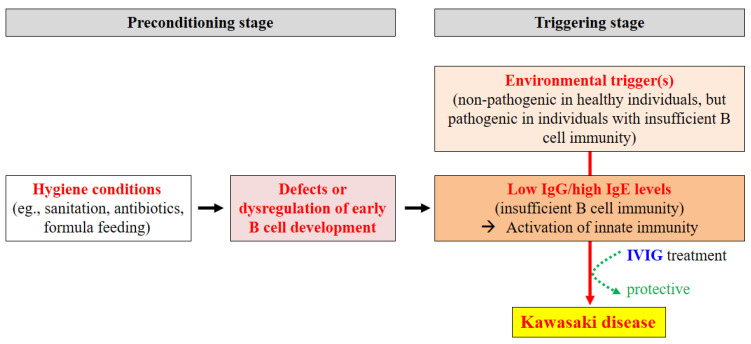
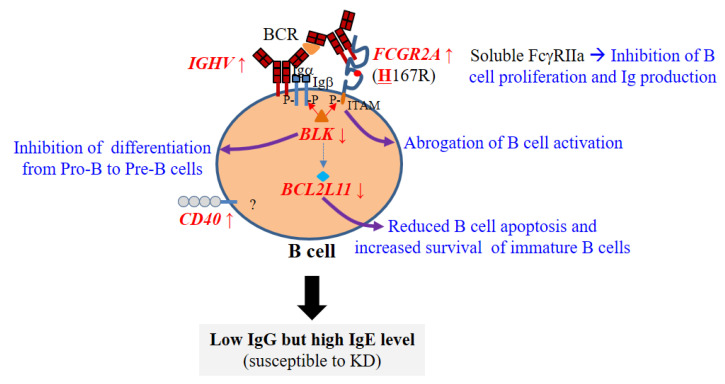
Kawasaki disease (KD) is an acute systemic vasculitis that occurs predominantly in children under 5 years of age. Despite much study, the etiology of KD remains unknown. However, epidemiological and immunological data support the hygiene hypothesis as a possible etiology. It is thought that more sterile or clean modern living environments due to increased use of sanitizing agents, antibiotics, and formula feeding result in a lack of immunological challenges, leading to defective or dysregulated B cell development, accompanied by low IgG and high IgE levels. A lack of B cell immunity may increase sensitivity to unknown environmental triggers that are nonpathogenic in healthy individuals. Genetic studies of KD show that all of the KD susceptibility genes identified by genome-wide association studies are involved in B cell development and function, particularly in early B cell development (from the pro-B to pre-B cell stage). The fact that intravenous immunoglobulin is an effective therapy for KD supports this hypothesis. In this review, I discuss clinical, epidemiological, immunological, and genetic studies showing that the etiopathogenesis of KD in infants and toddlers can be explained by the hygiene hypothesis, and particularly by defects or dysregulation during early B cell development.
川崎病(KD)是一种主要发生在 5 岁以下儿童的急性全身性血管炎。尽管进行了大量研究,但 KD 的病因仍不清楚。然而,流行病学和免疫学数据支持卫生假说可能是一种病因。人们认为,由于消毒剂、抗生素和配方奶的使用增加,现代生活环境更加无菌或清洁,导致免疫挑战不足,从而导致 B 细胞发育缺陷或失调,同时伴有 IgG 水平降低和 IgE 水平升高。B 细胞免疫缺乏可能会增加对非致病性环境触发因素的敏感性,而这些触发因素在健康个体中是不存在的。KD 的遗传研究表明,全基因组关联研究确定的所有 KD 易感基因都参与了 B 细胞的发育和功能,特别是在早期 B 细胞发育(从前 B 细胞到 pre-B 细胞阶段)。静脉注射免疫球蛋白是 KD 的有效治疗方法,这一事实支持了这一假说。在这篇综述中,我讨论了临床、流行病学、免疫学和遗传学研究,这些研究表明,婴幼儿 KD 的病因发病机制可以用卫生假说,特别是早期 B 细胞发育过程中的缺陷或失调来解释。