Ferreira Rui Gilberto, Mendonça Carolina Rodrigues, de Moraes Carolina Leão, de Abreu Tacon Fernanda Sardinha, Ramos Lelia Luanne Gonçalves, E Melo Natalia Cruz, Sbragia Lourenço, do Amaral Waldemar Naves, Ruano Rodrigo
Postgraduate Program in Health Sciences, Universidade Federal de Goiás, Goiânia 74650-050, GO, Brazil.
Department of Obstetrics and Gynaecology, Hospital das Clínicas, Universidade Federal de Goiás, Goiânia 74605-020, GO, Brazil.
J Clin Med. 2021 Nov 9;10(22):5215. doi: 10.3390/jcm10225215.
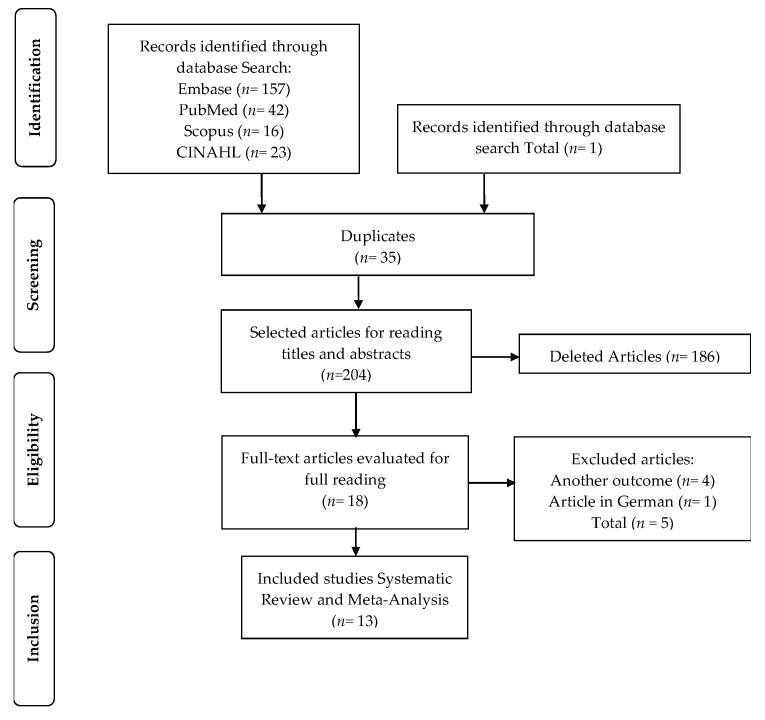
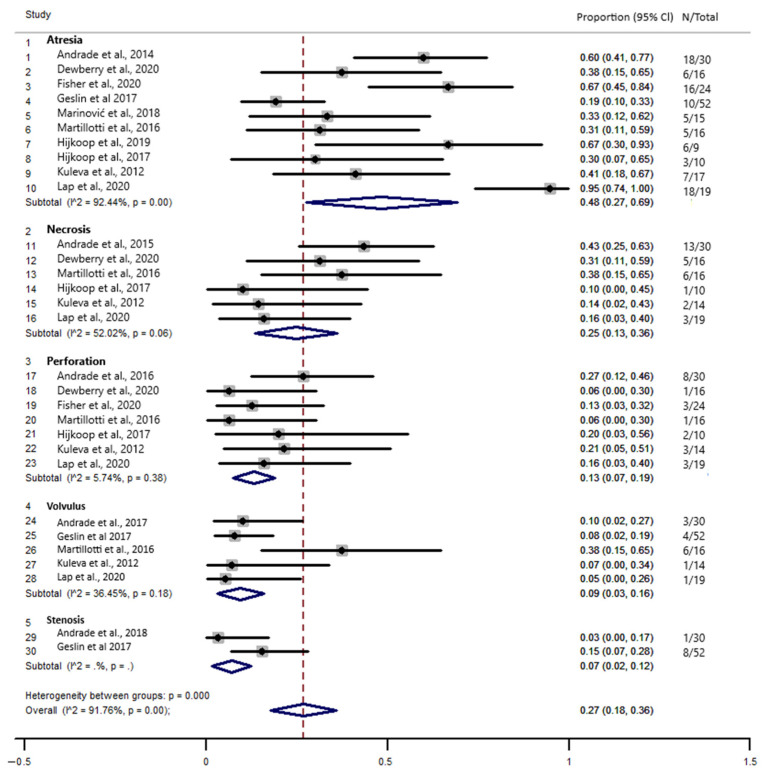
Although gastroschisis is often diagnosed by prenatal ultrasound, there is still a gap in the literature about which prenatal ultrasound markers can predict complex gastroschisis. This systematic review and meta-analysis aimed to investigate the ultrasound markers that characterize complex gastroschisis. A systematic review of the literature was conducted according to the guidelines of PRISMA. The protocol was registered (PROSPERO ID CRD42020211685). Meta-analysis was displayed graphically on Forest plots, which estimate prevalence rates and risk ratios, with 95% confidence intervals, using STATA version 15.0. The combined prevalence of intestinal complications in fetuses with complex gastroschisis was 27.0%, with a higher prevalence of atresia (about 48%), followed by necrosis (about 25%). The prevalence of deaths in newborns with complex gastroschisis was 15.0%. The predictive ultrasound markers for complex gastroschisis were intraabdominal bowel dilatation (IABD) (RR 3.01, 95% CI 2.22 to 4.07; I = 15.7%), extra-abdominal bowel dilatation (EABD) (RR 1.55, 95% CI 1.01 to 2.39; I = 77.1%), and polyhydramnios (RR 3.81, 95% CI 2.09 to 6.95; I = 0.0%). This review identified that IABD, EABD, and polyhydramnios were considered predictive ultrasound markers for complex gastroschisis. However, evidence regarding gestational age at the time of diagnosis is needed.
虽然腹裂畸形通常通过产前超声诊断,但关于哪些产前超声标志物可预测复杂型腹裂畸形,文献中仍存在空白。本系统评价和荟萃分析旨在研究表征复杂型腹裂畸形的超声标志物。根据PRISMA指南对文献进行了系统评价。该方案已注册(PROSPERO编号CRD42020211685)。使用STATA 15.0版本在森林图上以图形方式展示荟萃分析,森林图用于估计患病率和风险比,并给出95%置信区间。复杂型腹裂畸形胎儿肠道并发症的合并患病率为27.0%,闭锁的患病率较高(约48%),其次是坏死(约25%)。复杂型腹裂畸形新生儿的死亡率为15.0%。复杂型腹裂畸形的预测性超声标志物为腹腔内肠扩张(IABD)(RR 3.01,95%CI 2.22至4.07;I = 15.7%)、腹腔外肠扩张(EABD)(RR 1.55,95%CI 1.01至2.39;I = 77.1%)和羊水过多(RR 3.81,95%CI 2.09至6.95;I = 0.0%)。本评价确定IABD、EABD和羊水过多被认为是复杂型腹裂畸形的预测性超声标志物。然而,还需要有关诊断时孕周的证据。