Thakur Nishant, Yim Kwangil, Abdul-Ghafar Jamshid, Seo Kyung Jin, Chong Yosep
Department of Hospital Pathology, College of Medicine, The Catholic University of Korea, Seoul 07345, Korea.
Cancers (Basel). 2021 Nov 9;13(22):5594. doi: 10.3390/cancers13225594.
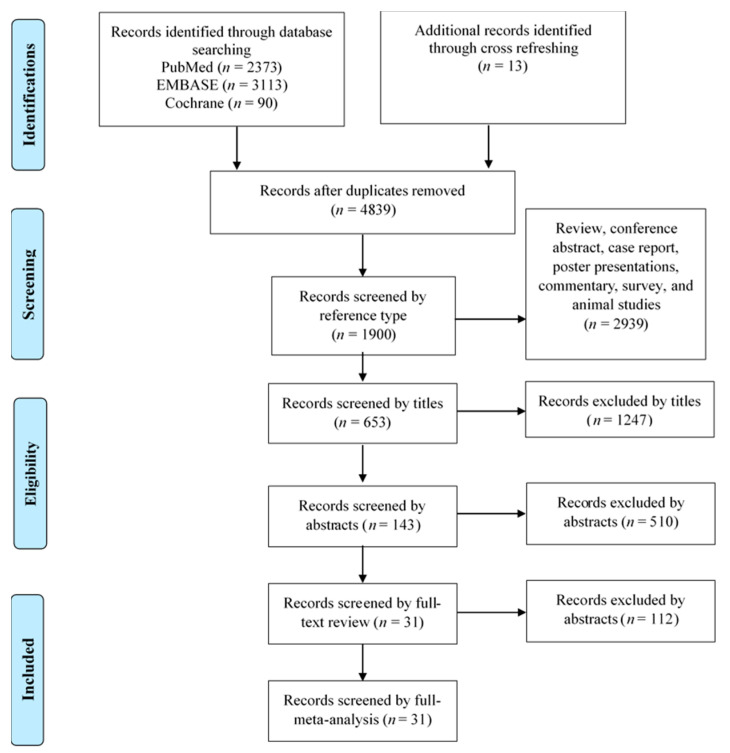
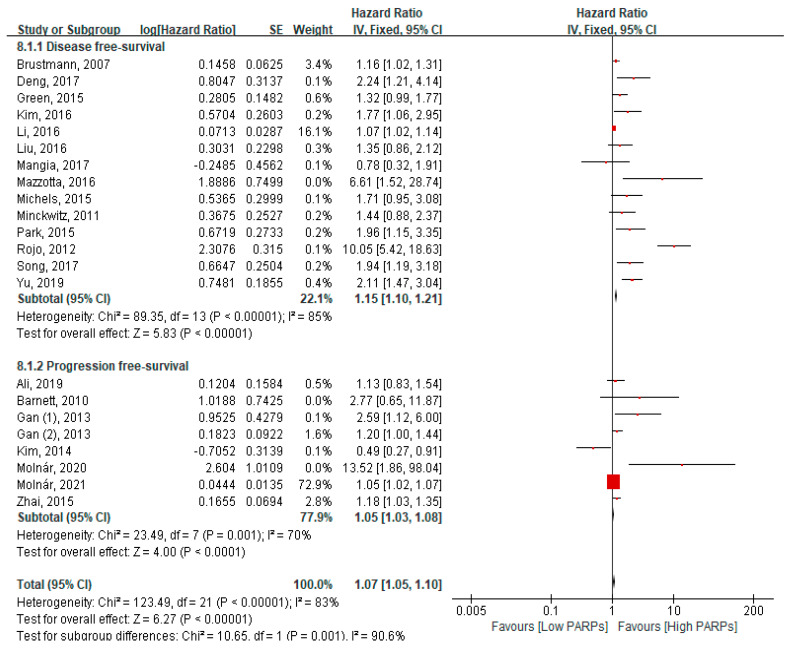
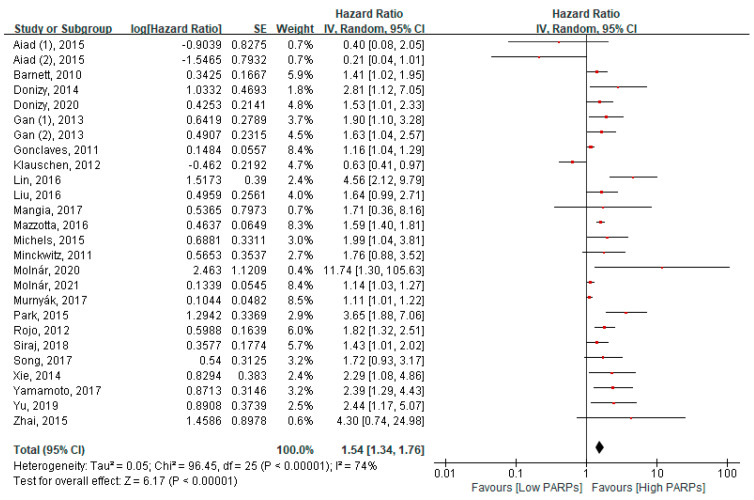
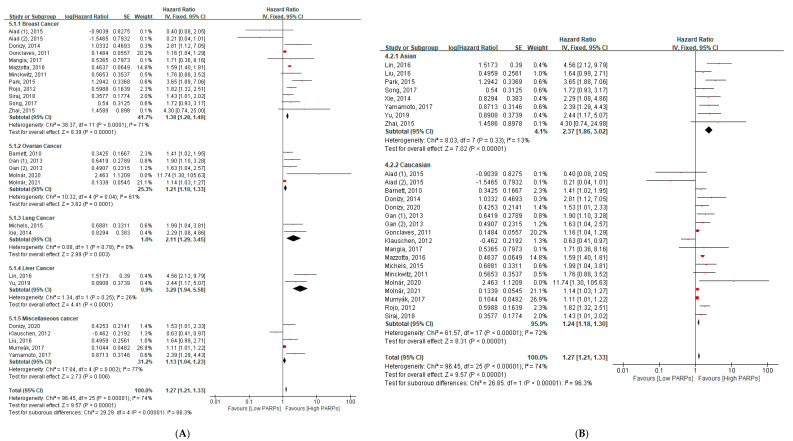
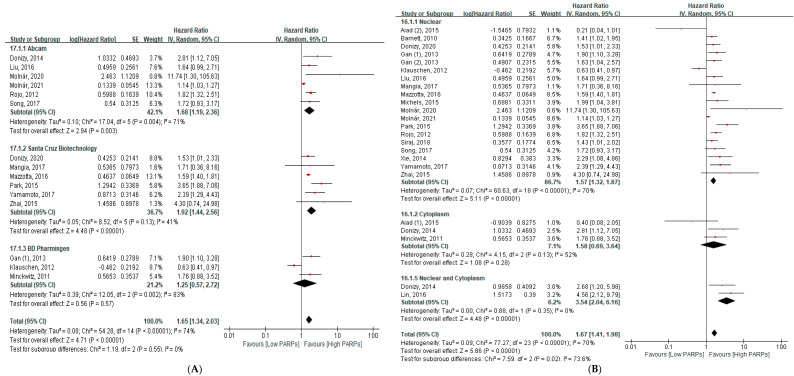
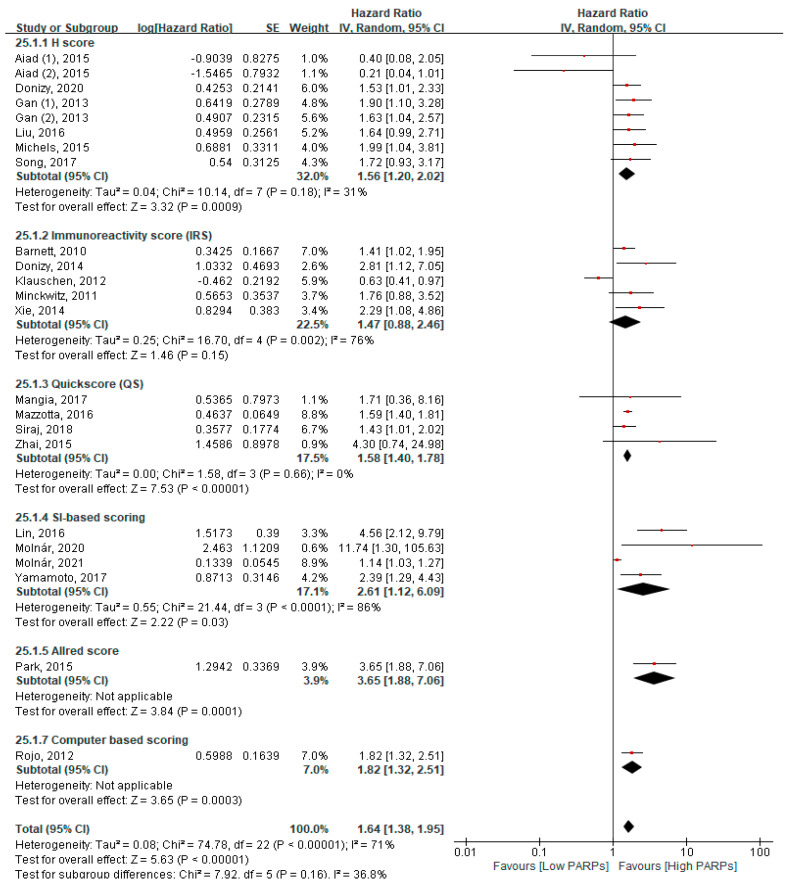
Poly (ADP-ribose) polymerase (PARP) is a DNA damage repair protein, and its inhibitors have shown promising results in clinical trials. The prognostic significance of PARP is inconsistent in studies of various cancers. In the present study, we conducted a systematic review and meta-analysis to reveal the prognostic and clinicopathological significance of PARP expression in multiple solid cancers. We searched the MEDLINE, EMBASE, and Cochrane databases for relevant research articles published from 2005 to 2021. The pooled hazard ratio (HR) with confidence interval (CI) was calculated to investigate the relationship between PARP expression and survival in multiple solid cancers. In total, 10,667 patients from 31 studies were included. A significant association was found between higher PARP expression and overall survival (OS) (HR = 1.54, 95% CI = 1.34-1.76, < 0.001), disease-free survival (DFS) (HR = 1.15, 95% CI = 1.10-1.21, < 0.001), and progression-free survival (PFS) (HR = 1.05, 95% CI = 1.03-1.08, < 0.001). Subgroup analyses showed that PARP overexpression was significantly related to poor OS in patients with breast cancers (HR = 1.38, 95% CI = 1.28-1.49, < 0.001), ovary cancers (HR = 1.21, 95% CI = 1.10-1.33, = 0.001), lung cancers (HR = 2.11, 95% CI = 1.29-3.45, = 0.003), and liver cancers (HR = 3.29, 95% CI = 1.94-5.58, < 0.001). Regarding ethnicity, Asian people have almost twice their worst survival rate compared to Caucasians. The pooled odds ratio analysis showed a significant relationship between higher PARP expression and larger tumour size, poor tumour differentiation, lymph node metastasis, distant metastasis, higher TNM stage and lymphovascular invasion, and positive immunoreactivity for Ki-67, BRCA1, and BRCA2. In addition, nuclear expression assessed by the QS system using Abcam and Santa Cruz Biotechnology seems to be the most commonly used and reproducible IHC method for assessing PARP expression. This meta-analysis revealed that higher PARP expression was associated with a worse OS, DFS, and PFS in patients with solid cancers. Moreover, inhibition of this pathway through its specific inhibitors may extend the survival of patients with higher PARP expression.
聚(ADP - 核糖)聚合酶(PARP)是一种DNA损伤修复蛋白,其抑制剂在临床试验中已显示出有前景的结果。PARP的预后意义在各种癌症的研究中并不一致。在本研究中,我们进行了一项系统评价和荟萃分析,以揭示PARP表达在多种实体癌中的预后及临床病理意义。我们在MEDLINE、EMBASE和Cochrane数据库中检索了2005年至2021年发表的相关研究文章。计算合并风险比(HR)及置信区间(CI),以研究PARP表达与多种实体癌患者生存之间的关系。总共纳入了来自31项研究的10667例患者。发现PARP高表达与总生存期(OS)(HR = 1.54,95%CI = 1.34 - 1.76,P < 0.001)、无病生存期(DFS)(HR = 1.15,95%CI = 1.10 - 1.21,P < 0.001)和无进展生存期(PFS)(HR = 1.05,95%CI = 1.03 - 1.08,P < 0.001)之间存在显著关联。亚组分析表明,PARP过表达与乳腺癌(HR = 1.38,95%CI = 1.28 - 1.49,P < 0.001)、卵巢癌(HR = 1.21,95%CI = 1.10 - 1.33,P = 0.001)、肺癌(HR = 2.11,95%CI = 1.29 - 3.45,P = 0.003)和肝癌(HR = 3.29,95%CI = 1.94 - 5.58,P < 0.001)患者的不良OS显著相关。在种族方面,亚洲人的最差生存率几乎是白种人的两倍。合并比值比分析显示,PARP高表达与肿瘤体积较大、肿瘤分化差、淋巴结转移、远处转移、较高的TNM分期和淋巴管浸润以及Ki - 67、BRCA1和BRCA2的免疫反应阳性之间存在显著关系。此外,使用Abcam和Santa Cruz Biotechnology的QS系统评估的核表达似乎是评估PARP表达最常用且可重复的免疫组化方法。这项荟萃分析表明,PARP高表达与实体癌患者较差的OS、DFS和PFS相关。此外,通过其特异性抑制剂抑制该途径可能会延长PARP高表达患者的生存期。