Jayakrishnan Thejus, Aulakh Sonikpreet, Baksh Mizba, Nguyen Kianna, Ailawadhi Meghna, Samreen Ayesha, Parrondo Ricardo, Sher Taimur, Roy Vivek, Manochakian Rami, Paulus Aneel, Chanan-Khan Asher, Ailawadhi Sikander
Department of Hematology and Medical Oncology, Taussig Cancer Institute, Cleveland, OH 44106, USA.
Departments of Internal Medicine and Neurosciences, West Virginia University, Morgantown, WV 26506, USA.
Cancers (Basel). 2021 Nov 18;13(22):5770. doi: 10.3390/cancers13225770.
Concern exists that the clinical trial populations differ from respective cancer populations in terms of their age distribution affecting the generalizability of the results, especially in underrepresented minorities. We hypothesized that the clinical trials that do not report race are likely to suffer from a higher degree of age disparity.
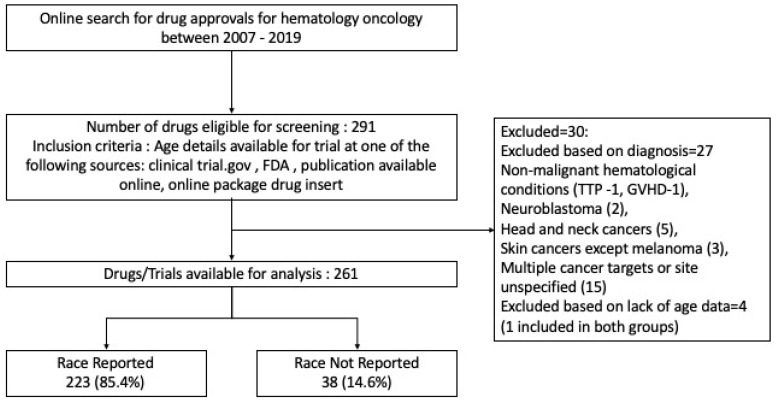
Food and Drug Administration (FDA) drug approvals from July 2007 to June 2019 were reviewed to identify oncology approvals, and trials with age details were selected. The outcomes studied were the weighted mean difference in age between the clinical trial population and real-world population for various cancers, the prevalence of race reporting and association of age and race reporting with each other.
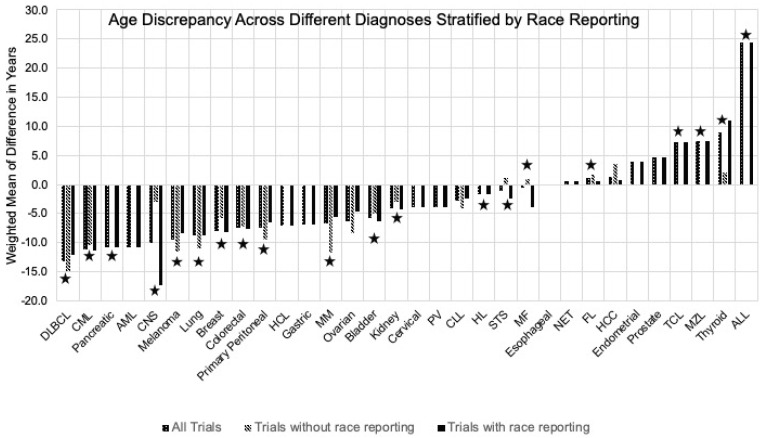
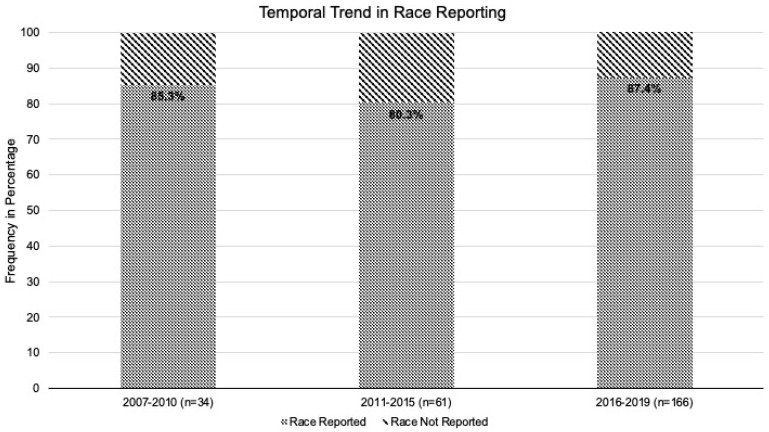
Of the 261 trials, race was reported in 223 (85.4%) of the trials, while 38 trials (14.6%) had no mention of race. Race reporting improved minimally over time: 29 (85.3%) in 2007-2010 vs. 49 (80.3%) in 2011-2014 vs. 145 (85.4%) during the period 2015-2019 (-value = 0.41). Age discrepancy between the clinical trial population and the real-world population was higher for studies that did not report race (mean difference -8.8 years (95% CI -12.6 to -5.0 years)) vs. studies that did report it (mean difference -5.1 years, (95% CI -6.4 to -3.7 years), -value = 0.04).
The study demonstrates that a significant number of clinical trials leading to cancer drug approvals suffer from racial and age disparity when compared to real-world populations, and that the two factors may be interrelated. We recommend continued efforts to recruit diverse populations.
人们担心临床试验人群在年龄分布方面与各自的癌症人群不同,这会影响结果的普遍性,尤其是在代表性不足的少数群体中。我们假设未报告种族的临床试验可能存在更高程度的年龄差异。
回顾了2007年7月至2019年6月美国食品药品监督管理局(FDA)的药物批准情况,以确定肿瘤学批准情况,并选择了有年龄详细信息的试验。研究的结果包括各种癌症的临床试验人群与现实世界人群之间年龄的加权平均差异、种族报告的患病率以及年龄与种族报告之间的关联。
在261项试验中,223项(85.4%)试验报告了种族,而38项试验(14.6%)未提及种族。随着时间的推移,种族报告的改善微乎其微:2007 - 2010年为29项(85.3%),2011 - 2014年为49项(80.3%),2015 - 2019年为145项(85.4%)(P值 = 0.41)。未报告种族的研究中,临床试验人群与现实世界人群之间的年龄差异更大(平均差异 - 8.8岁(95%置信区间 - 12.6至 - 5.0岁)),而报告了种族的研究(平均差异 - 5.1岁,(95%置信区间 - 6.4至 - 3.7岁),P值 = 0.04)。
该研究表明,与现实世界人群相比,大量导致癌症药物批准的临床试验存在种族和年龄差异,并且这两个因素可能相互关联。我们建议继续努力招募多样化的人群。