German Cancer Research Center (DKFZ), Division Signaling and Functional Genomics, BioQuant and Medical Faculty Mannheim, Heidelberg University, D-69120 Heidelberg, Germany.
Cells. 2021 Nov 13;10(11):3156. doi: 10.3390/cells10113156.
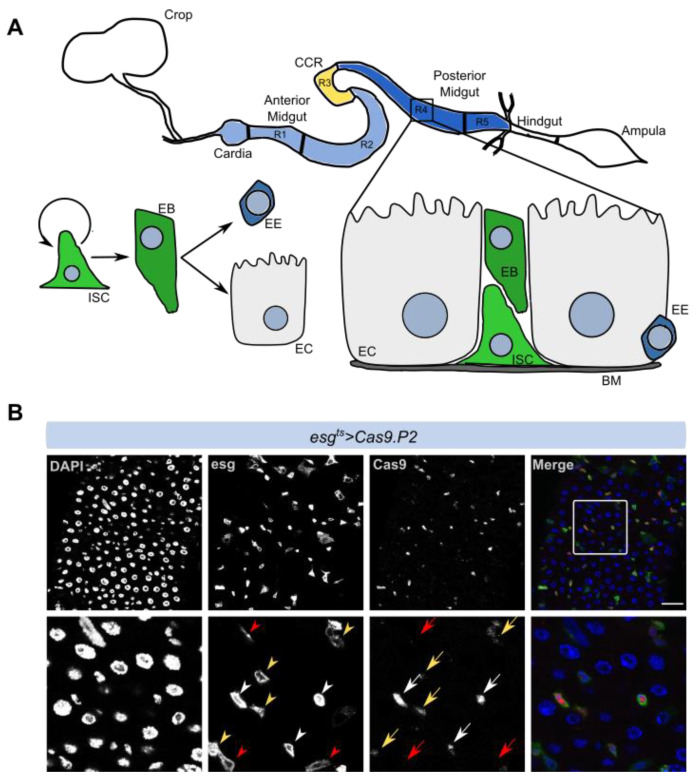
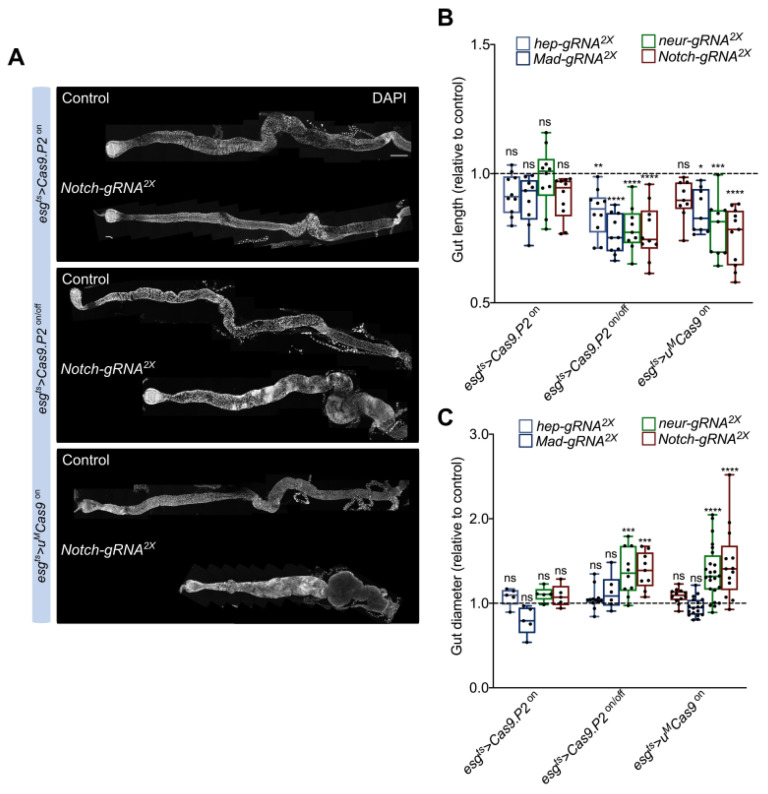
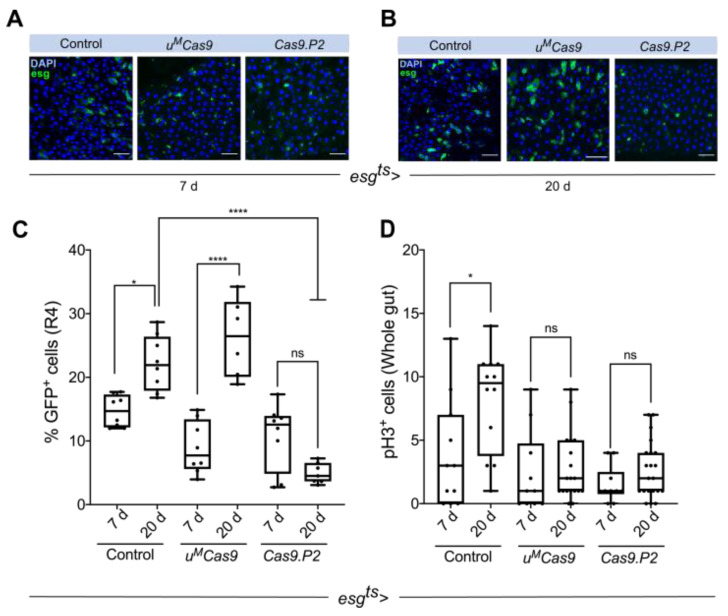
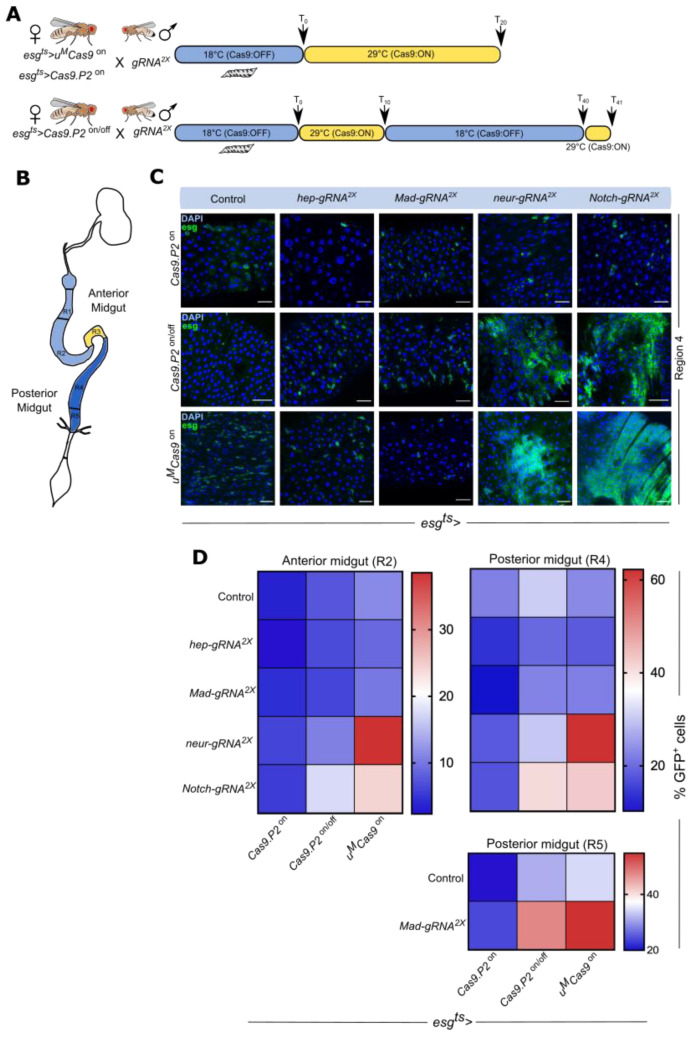
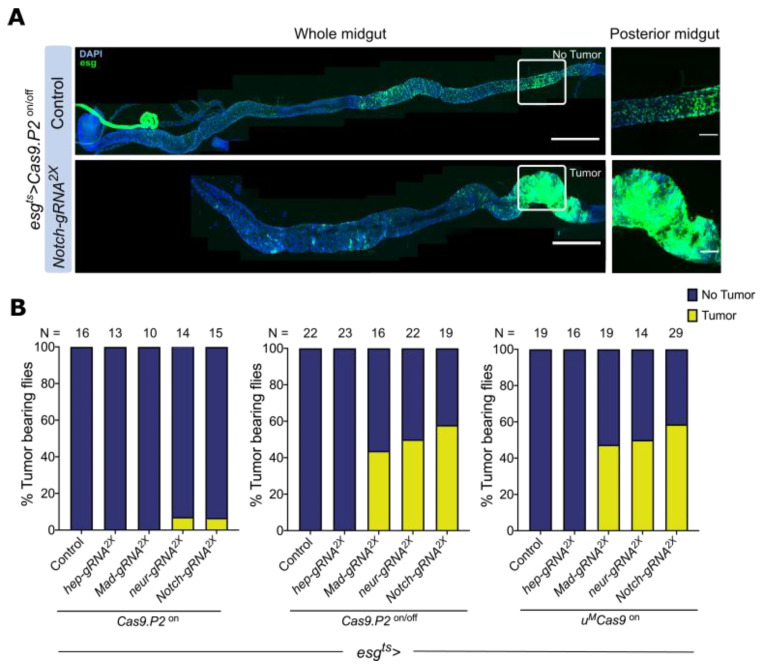
CRISPR-Cas has revolutionized genetics and extensive efforts have been made to enhance its editing efficiency by developing increasingly more elaborate tools. Here, we evaluate the CRISPR-Cas9 system in to assess its ability to induce stem cell-derived tumors in the intestine. We generated conditional tissue-specific CRISPR knockouts using different Cas9 expression vectors with guide RNAs targeting the BMP, Notch, and JNK pathways in intestinal progenitors such as stem cells (ISCs) and enteroblasts (EBs). Perturbing Notch and BMP signaling increased the proliferation of ISCs/EBs and resulted in the formation of intestinal tumors, albeit with different efficiencies. By assessing both the anterior and posterior regions of the midgut, we observed regional differences in ISC/EB proliferation and tumor formation upon mutagenesis. Surprisingly, high continuous expression of Cas9 in ISCs/EBs blocked age-dependent increase in ISCs/EBs proliferation and when combined with gRNAs targeting tumor suppressors, it prevented tumorigenesis. However, no such effects were seen when temporal parameters of Cas9 were adjusted to regulate its expression levels or with a genetically modified version, which expresses Cas9 at lower levels, suggesting that fine-tuning Cas9 expression is essential to avoid deleterious effects. Our findings suggest that modifications to Cas9 expression results in differences in editing efficiency and careful considerations are required when choosing reagents for CRISPR-Cas9 mutagenesis studies. In summary, can serve as a powerful model for context-dependent CRISPR-Cas based perturbations and to test genome-editing systems in vivo.
CRISPR-Cas 技术彻底改变了遗传学,人们付出了巨大的努力来开发越来越复杂的工具,以提高其编辑效率。在这里,我们评估了 CRISPR-Cas9 系统在中的功能,以评估其在诱导肠道干细胞衍生肿瘤方面的能力。我们使用不同的 Cas9 表达载体生成了条件组织特异性 CRISPR 敲除,这些载体带有靶向肠道祖细胞(如干细胞(ISCs)和肠母细胞(EBs))中的 BMP、Notch 和 JNK 通路的向导 RNA。干扰 Notch 和 BMP 信号会增加 ISCs/EBs 的增殖,并导致肠道肿瘤的形成,尽管效率不同。通过评估中肠的前区和后区,我们观察到在诱变后 ISC/EB 增殖和肿瘤形成存在区域差异。令人惊讶的是,ISCs/EBs 中 Cas9 的高持续表达阻止了 ISCs/EBs 增殖的年龄依赖性增加,并且当与靶向肿瘤抑制基因的 gRNA 结合使用时,它阻止了肿瘤发生。然而,当调整 Cas9 的时间参数来调节其表达水平或使用表达水平较低的基因修饰版本时,没有观察到这种效果,这表明精细调节 Cas9 表达对于避免有害影响至关重要。我们的研究结果表明,Cas9 表达的修饰导致编辑效率的差异,在选择用于 CRISPR-Cas9 诱变研究的试剂时需要仔细考虑。总之, 可以作为基于 CRISPR-Cas 的上下文依赖性扰动的有力模型,并在体内测试基因组编辑系统。