Sundaram Suneha, Olson Sean, Sharma Paranjay, Rajendra Shanmugarajah
Department of Medicine, Robert Wood Johnson University Hospital, Rahway, NJ 07065, USA.
Kansas City University, Kansas City, MO 64106, USA.
Pathogens. 2021 Nov 19;10(11):1508. doi: 10.3390/pathogens10111508.
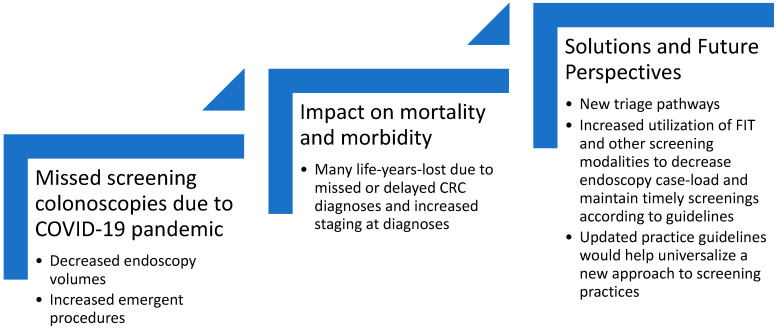
The COVID-19 pandemic has impacted all aspects of medical care, including cancer screening and preventative measures. Colorectal cancer screening declined significantly at the onset of the pandemic as the result of an intentional effort to conserve resources, prioritize emergencies and reduce risk of transmission. There has already been an increase in diagnosis at more advanced stages and symptomatic emergencies due to suspended screenings. As endoscopy units find their way back to pre-pandemic practices, a backlog of cases remains. The missed CRC diagnoses amongst the missed screenings carry a risk of increased morbidity and mortality which will only increase as time-to-diagnosis grows. This review discusses the impact of COVID-19 on colonoscopy screening rates, trends in stages/symptoms/circumstances at diagnosis, and economic and social impact of delayed diagnosis. Triaging and use of FITs are proposed solutions to the challenge of catching up with the large number of pandemic-driven missed CRC screenings.
新冠疫情对医疗保健的各个方面都产生了影响,包括癌症筛查和预防措施。由于有意节省资源、优先处理紧急情况以及降低传播风险,在疫情初期,结直肠癌筛查显著减少。由于筛查暂停,晚期诊断和症状性紧急情况的诊断数量已经增加。随着内镜检查单位恢复到疫情前的做法,病例积压仍然存在。在错过的筛查中未被诊断出的结直肠癌存在发病率和死亡率增加的风险,而且随着诊断时间的延长,这种风险只会增加。本综述讨论了新冠疫情对结肠镜检查筛查率的影响、诊断时的分期/症状/情况趋势以及延迟诊断的经济和社会影响。提出了粪便免疫化学检测(FITs)的分诊和使用方法,以应对大量因疫情导致的错过的结直肠癌筛查这一挑战。