UCAM Research Center for High Performance Sport, Catholic University of Murcia, 30107 Murcia, Spain.
Strength and Conditioning Society, 00118 Rome, Italy.
Sensors (Basel). 2021 Nov 10;21(22):7482. doi: 10.3390/s21227482.
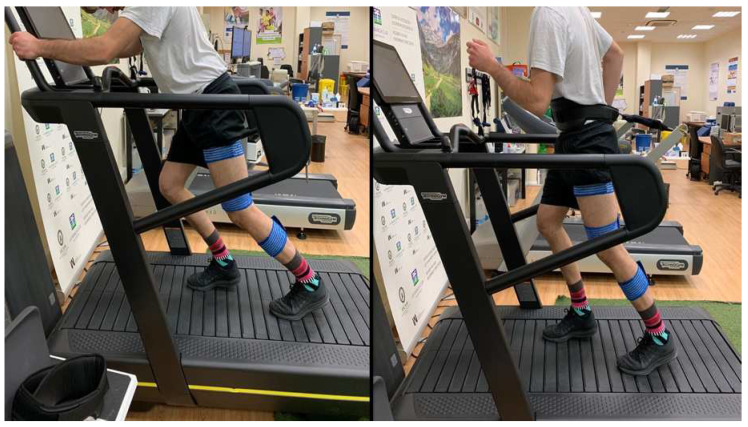
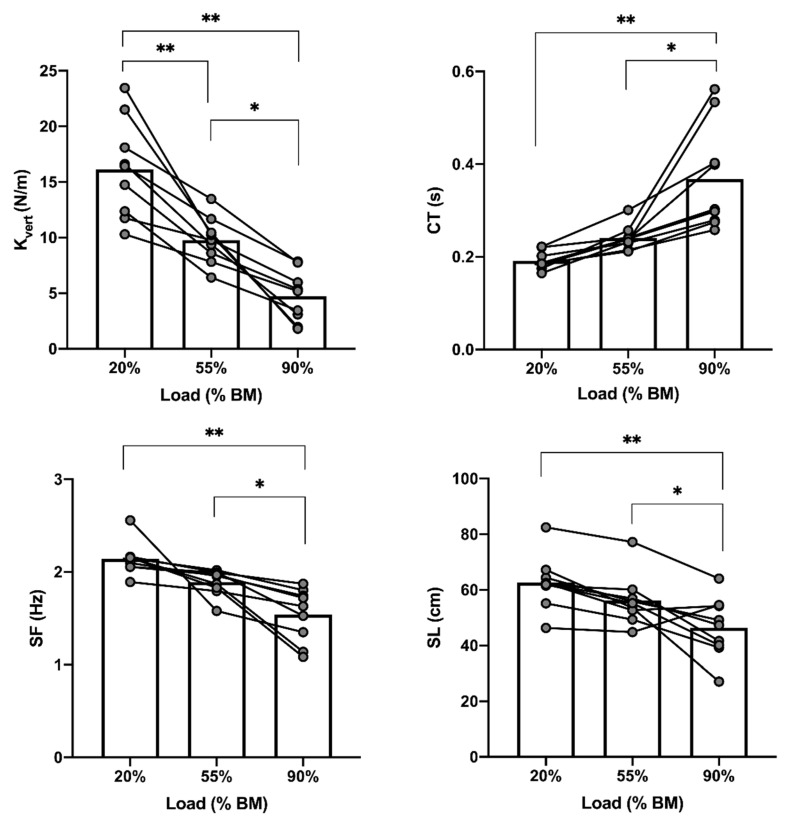
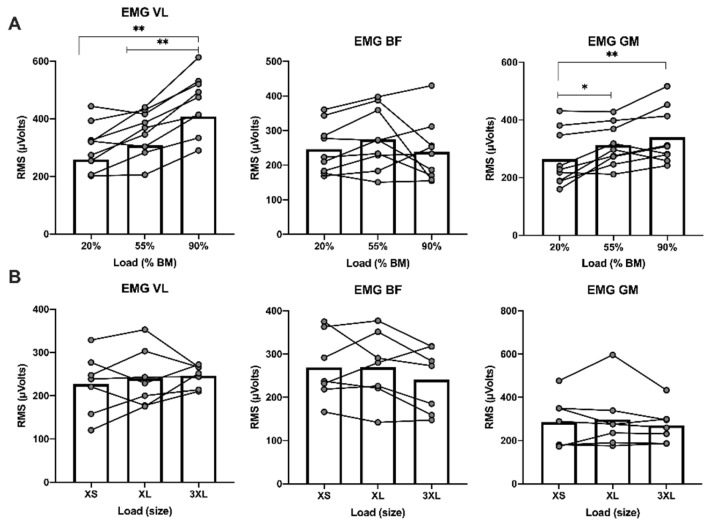
This study's aim was to analyze muscle activation and kinematics of sled-pushing and resisted-parachute sprinting with three load conditions on an instrumentalized SKILLRUN treadmill. Nine male amateur rugby union players (21.3 ± 4.3 years, 75.8 ± 10.2 kg, 176.6 ± 8.8 cm) performed a sled-push session consisting of three 15-m repetitions at 20%, 55% and 90% body mas and another resisted-parachute session using three different parachute sizes (XS, XL and 3XL). Sprinting kinematics and muscle activity of three lower-limb muscles (biceps femoris (BF), vastus lateralis (VL) and gastrocnemius medialis (GM)) were measured. A repeated-measures analysis of variance (RM-ANOVA) showed that higher loads during the sled-push increased (VL) ( ≤ 0.001) and (GM) ( ≤ 0.001) but not (BF) ( = 0.278) activity. Furthermore, it caused significant changes in sprinting kinematics, stiffness and joint angles. Resisted-parachute sprinting did not change kinematics or muscle activation, despite producing a significant overload (i.e., speed loss). In conclusion, increased sled-push loading caused disruptions in sprinting technique and altered lower-limb muscle activation patterns as opposed to the resisted-parachute. These findings might help practitioners determine the more adequate resisted sprint exercise and load according to the training objective (e.g., power production or speed performance).
本研究旨在分析在 Instrumentalized SKILLRUN 跑步机上进行 sled-pushing 和 resisted-parachute 冲刺时,三种负荷条件下的肌肉激活和运动学。九名男性业余橄榄球联盟运动员(21.3 ± 4.3 岁,75.8 ± 10.2 公斤,176.6 ± 8.8 厘米)进行了 sled-push 测试,包括三个 15 米重复,负荷分别为 20%、55%和 90%的体重;以及另一个使用三个不同降落伞尺寸(XS、XL 和 3XL)的 resisted-parachute 测试。测量了三个下肢肌肉(股二头肌(BF)、股外侧肌(VL)和腓肠肌内侧(GM))的冲刺运动学和肌肉活动。重复测量方差分析(RM-ANOVA)显示,sled-push 时较高的负荷增加了(VL)(≤0.001)和(GM)(≤0.001)的肌肉活动,但不增加(BF)(=0.278)的肌肉活动。此外,它还导致了冲刺运动学、刚度和关节角度的显著变化。尽管 resisted-parachute 产生了显著的过载(即速度损失),但它并没有改变冲刺的运动学或肌肉激活。总之,sled-push 负荷的增加导致了冲刺技术的中断,并改变了下肢肌肉的激活模式,与 resisted-parachute 不同。这些发现可能有助于教练根据训练目标(例如,力量产生或速度表现)确定更合适的抵抗冲刺练习和负荷。