Cai Mengru, Zeng Yawen, Liu Manting, You Longtai, Huang Huating, Hao Yang, Yin Xingbin, Qu Changhai, Ni Jian, Dong Xiaoxv
School of Chinese Material Medica, Beijing University of Chinese Medicine, Beijing 102488, China.
Department of Radiology, Division of Translational Nanobiomaterials and Imaging, Leiden University Medical Center, NL-2333 ZA Leiden, The Netherlands.
Pharmaceutics. 2021 Nov 17;13(11):1945. doi: 10.3390/pharmaceutics13111945.
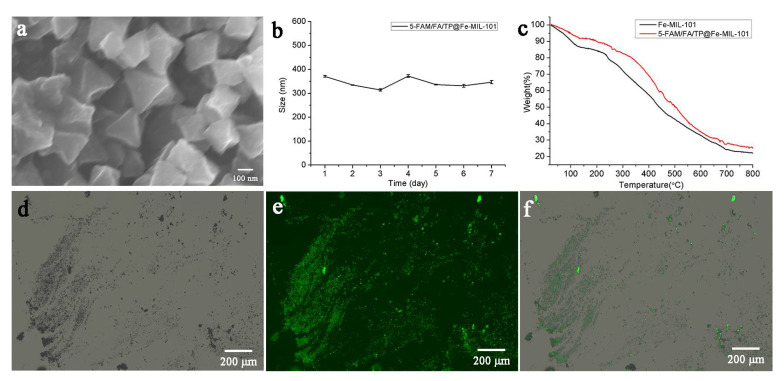
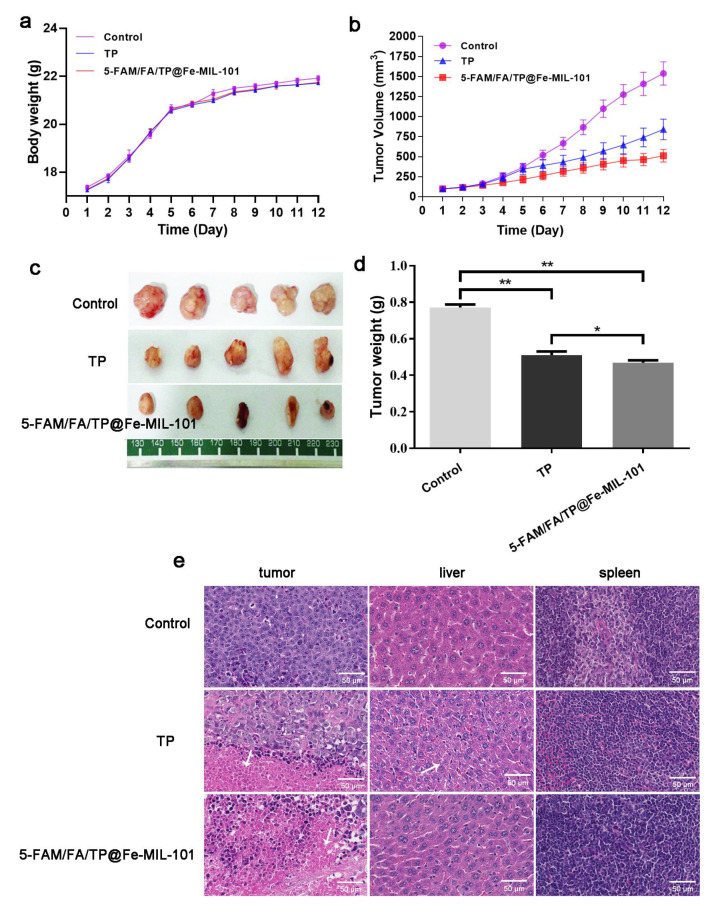
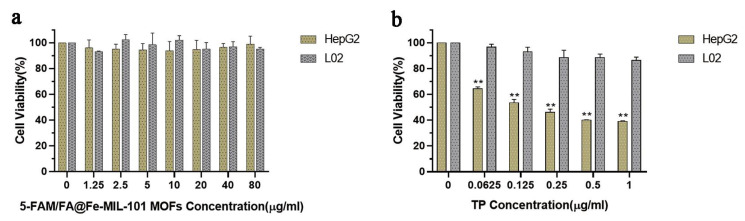
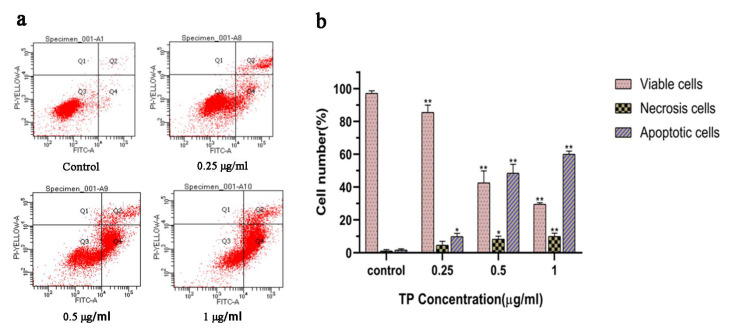
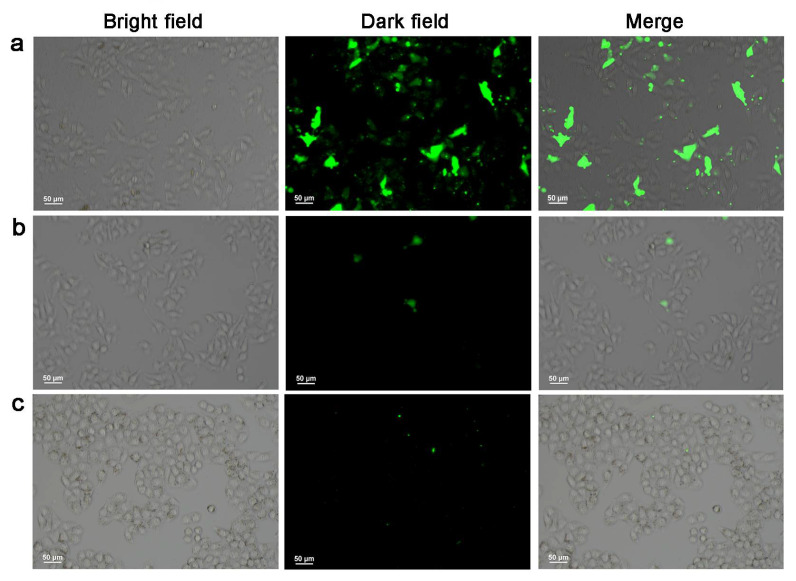
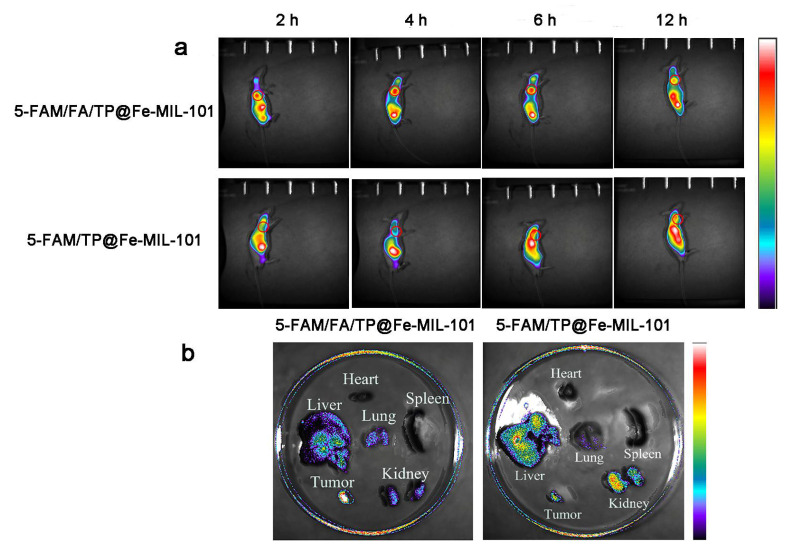
The antitumor activity of triptolide (TP) has received widespread attention, although its toxicity severely limits its clinical application. Therefore, the design of a targeted drug delivery system (TDDS) has important application prospects in tumor treatment. Metal-organic frameworks (MOFs), with high drug-carrying capacity and good biocompatibility, have aroused widespread interest for drug delivery systems. Herein, folic acid (FA) and 5-carboxylic acid fluorescein (5-FAM) were used to modify Fe-MIL-101 to construct a functionalized nano-platform (5-FAM/FA/TP@Fe-MIL-101) for the targeted delivery of the anti-tumor drug triptolide and realize in vivo fluorescence imaging. Compared with Fe-MIL-101, functionalized nanoparticles not only showed better targeted therapy efficiency, but also reduced the systemic toxicity of triptolide. In addition, the modification of 5-FAM facilitated fluorescence imaging of the tumor site and realized the construction of an integrated nano-platform for fluorescence imaging and treatment. Both in vitro and in vivo studies of functionalized nanoparticles have demonstrated excellent fluorescence imaging and synergistic targeting anticancer activity with negligible systemic toxicity. The development of functional nano-platform provides new ideas for the design of MOF-based multifunctional nano-drug delivery system, which can be used for precise treatment of tumor.
雷公藤甲素(TP)的抗肿瘤活性受到广泛关注,尽管其毒性严重限制了其临床应用。因此,设计靶向给药系统(TDDS)在肿瘤治疗中具有重要的应用前景。金属有机框架(MOF)具有高载药能力和良好的生物相容性,已引起药物递送系统的广泛关注。在此,使用叶酸(FA)和5-羧基荧光素(5-FAM)修饰Fe-MIL-101,构建用于抗肿瘤药物雷公藤甲素靶向递送的功能化纳米平台(5-FAM/FA/TP@Fe-MIL-101)并实现体内荧光成像。与Fe-MIL-101相比,功能化纳米颗粒不仅显示出更好的靶向治疗效率,还降低了雷公藤甲素的全身毒性。此外,5-FAM的修饰促进了肿瘤部位的荧光成像,并实现了用于荧光成像和治疗的集成纳米平台的构建。功能化纳米颗粒的体外和体内研究均证明了其出色的荧光成像和协同靶向抗癌活性,且全身毒性可忽略不计。功能化纳米平台的开发为基于MOF的多功能纳米药物递送系统的设计提供了新思路,可用于肿瘤的精准治疗。