O'Brien Travis J, Fenton Kevin, Sidahmed Alfateh, Barbour April, Harralson Arthur F
Department of Pharmacology and Physiology, George Washington University, Washington, DC 20052, USA.
Department of Biostatistics, George Washington University, Washington, DC 20052, USA.
J Pers Med. 2021 Nov 18;11(11):1226. doi: 10.3390/jpm11111226.
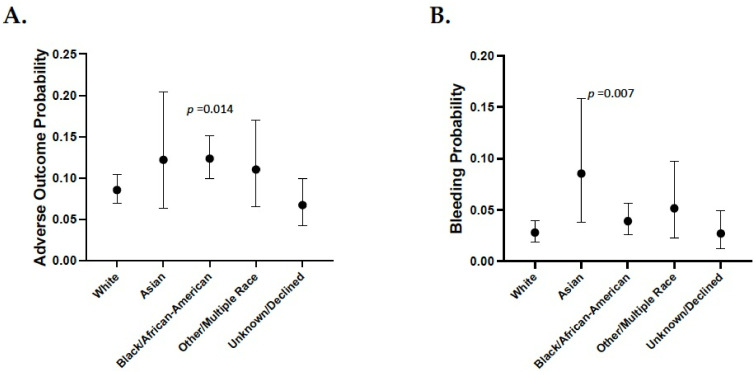
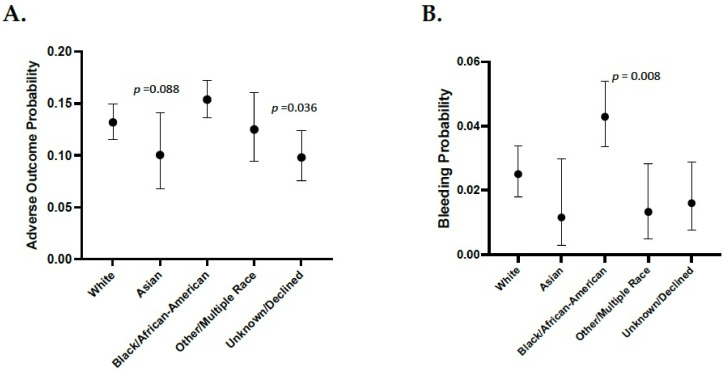
The Clinical Pharmacogenetics Implementation Consortium (CPIC) establishes evidence-based guidelines for utilizing pharmacogenetic information for certain priority drugs. Warfarin, clopidogrel and simvastatin are cardiovascular drugs that carry strong prescribing guidance by CPIC. The respective pharmacogenes for each of these drugs exhibit considerable variability amongst different ethnic/ancestral/racial populations. Race and ethnicity are commonly employed as surrogate biomarkers in clinical practice and can be found in many prescribing guidelines. This is controversial due to the large variability that exists amongst different racial/ethnic groups, lack of detailed ethnic information and the broad geographic categorization of racial groups. Using a retrospective analysis of electronic health records (EHR), we sought to determine the degree to which self-reported race/ethnicity contributed to the probability of adverse drug reactions for these drugs. All models used individuals self-reporting as White as the comparison group. The majority of apparent associations between different racial groups and drug toxicity observed in the "race only" model failed to remain significant when we corrected for covariates. We did observe self-identified Asian race as a significant predictor ( = 0.016) for warfarin hemorrhagic events in all models. In addition, patients identifying as either Black/African-American ( = 0.001) or Other/Multiple race ( = 0.019) had a lower probability of reporting an adverse reaction than White individuals while on simvastatin even after correcting for other covariates. In both instances where race/ethnicity was predictive of drug toxicity (i.e., warfarin, simvastatin), the findings are consistent with the known global variability in the pharmacogenes described in the CPIC guidelines for these medications. These results confirm that the reliability of using self-identified race/ethnic information extracted from EHRs as a predictor of adverse drug reactions is likely limited to situations where the genes influencing drug toxicity display large, distinct ethnogeographic variability.
临床药物基因组学实施联盟(CPIC)制定了基于证据的指南,用于将药物基因组学信息应用于某些重点药物。华法林、氯吡格雷和辛伐他汀是心血管药物,CPIC为其提供了强有力的处方指导。这些药物各自的药物基因在不同种族/祖先/人种群体中表现出相当大的变异性。种族和民族在临床实践中通常被用作替代生物标志物,并且在许多处方指南中都能找到。由于不同种族/民族群体之间存在很大变异性、缺乏详细的种族信息以及种族群体的广泛地理分类,这一点存在争议。通过对电子健康记录(EHR)进行回顾性分析,我们试图确定自我报告的种族/民族在多大程度上导致了这些药物发生药物不良反应的可能性。所有模型均以自我报告为白人的个体作为对照组。在“仅种族”模型中观察到的不同种族群体与药物毒性之间的大多数明显关联,在我们校正协变量后不再显著。在所有模型中,我们确实观察到自我认定为亚洲种族是华法林出血事件的显著预测因素(P = 0.016)。此外,即使在校正其他协变量后,自我认定为黑人/非裔美国人(P = 0.001)或其他/多种族(P = 0.019)的患者在服用辛伐他汀时报告不良反应的可能性低于白人个体。在种族/民族可预测药物毒性的两种情况下(即华法林、辛伐他汀),研究结果与CPIC针对这些药物的指南中描述的药物基因已知的全球变异性一致。这些结果证实,从电子健康记录中提取的自我认定的种族/民族信息作为药物不良反应预测指标的可靠性可能仅限于影响药物毒性的基因表现出大的、明显的种族地理变异性的情况。