Windisch Saskia, Walter Anja, Moradtalab Narges, Walker Frank, Höglinger Birgit, El-Hasan Abbas, Ludewig Uwe, Neumann Günter, Grosch Rita
Department of Nutritional Crop Physiology, Institute of Crop Sciences, University of Hohenheim, 70599 Stuttgart, Germany.
Central Chemical-Analytical Laboratory, Institute of Phytomedicine, University of Hohenheim, 70599 Stuttgart, Germany.
Plants (Basel). 2021 Oct 29;10(11):2336. doi: 10.3390/plants10112336.
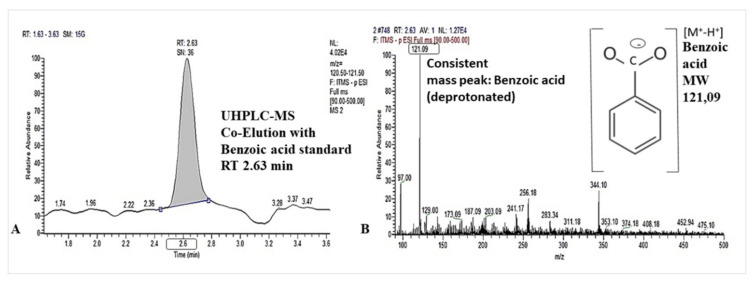
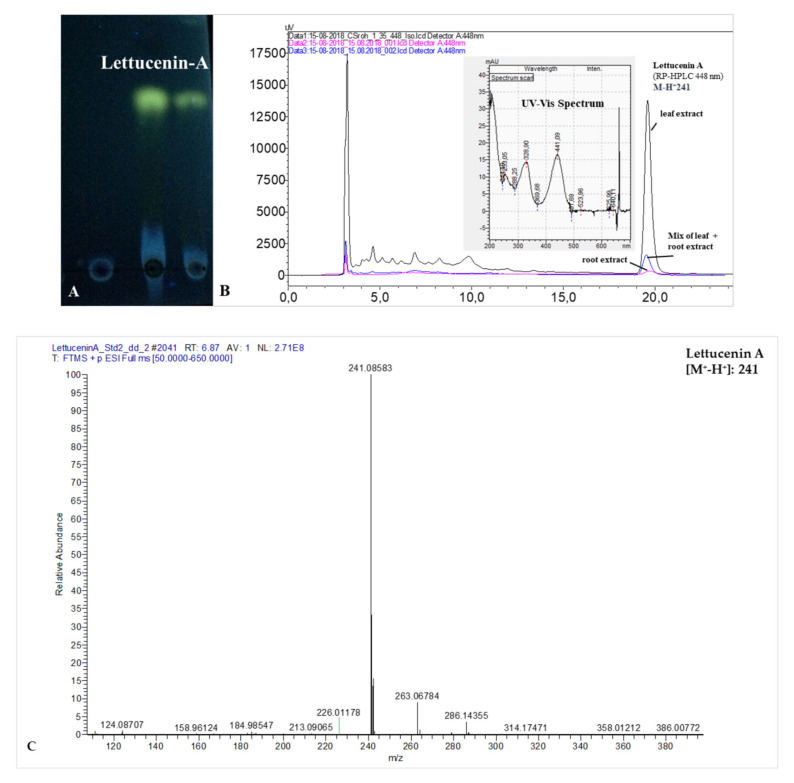
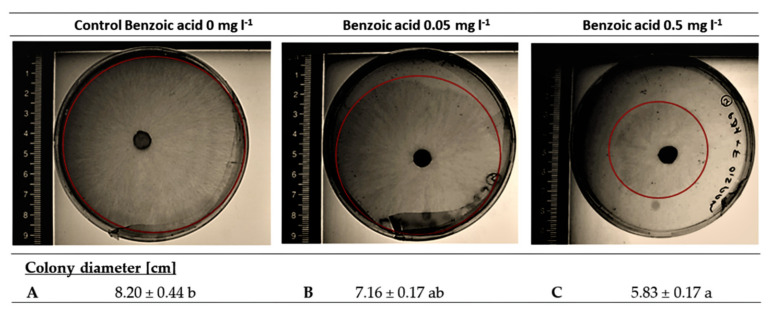
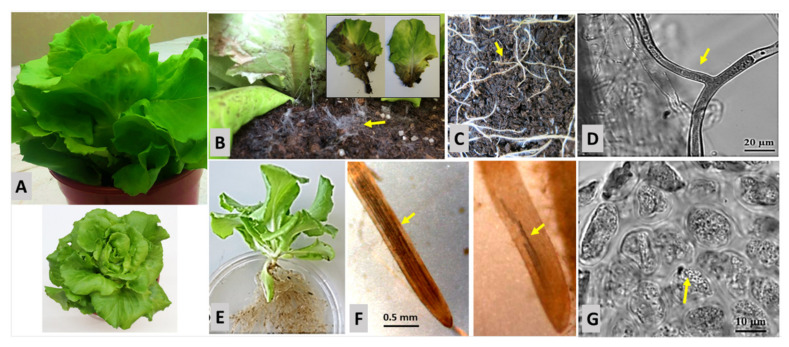
Soil-borne pathogens can severely limit plant productivity. Induced defense responses are plant strategies to counteract pathogen-related damage and yield loss. In this study, we hypothesized that benzoic acid and lettucenin A are involved as defense compounds against and in lettuce. To address this hypothesis, we conducted growth chamber experiments using hydroponics, peat culture substrate and soil culture in pots and minirhizotrons. Benzoic acid was identified as root exudate released from lettuce plants upon pathogen infection, with pre-accumulation of benzoic acid esters in the root tissue. The amounts were sufficient to inhibit hyphal growth of in vitro (30%), to mitigate growth retardation (51%) and damage of fine roots (130%) in lettuce plants caused by , but were not able to overcome plant growth suppression induced by infection. Additionally, lettucenin A was identified as major phytoalexin, with local accumulation in affected plant tissues upon infection with pathogens or chemical elicitation (CuSO) and detected in trace amounts in root exudates. The results suggest a two-stage defense mechanism with pathogen-induced benzoic acid exudation initially located in the rhizosphere followed by accumulation of lettucenin A locally restricted to affected root and leaf tissues.
土传病原菌会严重限制植物生产力。诱导防御反应是植物对抗病原体相关损害和产量损失的策略。在本研究中,我们假设苯甲酸和莴苣素A作为防御化合物参与生菜抵御[病原菌名称未给出]的过程。为验证这一假设,我们使用水培、泥炭栽培基质以及盆栽和微根窗中的土壤栽培进行了生长室实验。苯甲酸被鉴定为病原菌感染后生菜植株释放的根系分泌物,且根组织中存在苯甲酸酯的预积累。其含量足以在体外抑制[病原菌名称未给出]的菌丝生长(30%),减轻生菜植株因[病原菌名称未给出]引起的生长迟缓(51%)和细根损伤(130%),但无法克服由[病原菌名称未给出]感染诱导的植物生长抑制。此外,莴苣素A被鉴定为主要植保素,在病原体感染或化学诱导剂(CuSO)处理后,在受影响的植物组织中局部积累,且在根系分泌物中检测到微量存在。结果表明存在一种两阶段防御机制,病原菌诱导的苯甲酸分泌最初位于根际,随后莴苣素A积累并局部局限于受影响的根和叶组织。