Ning Weimin, Jiang Lei, Yang Mei, Lei Tianhao, Liu Chan, Zhao Fei, Shu Pan, Liu Yong
Agricultural Science College, Xichang University, Xichang 615000, China.
Longping Branch, Biology College, Hunan University, Changsha 410125, China.
Metabolites. 2025 Aug 13;15(8):548. doi: 10.3390/metabo15080548.
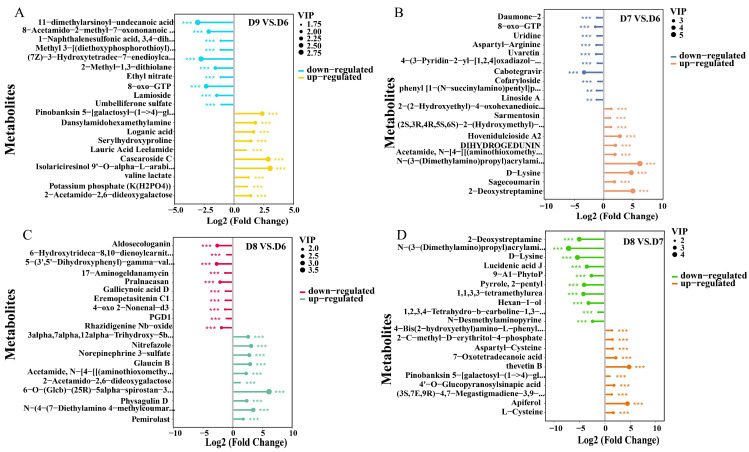
The bacterial wilt of tomatoes, caused by , is a soil-borne plant disease that causes substantial agricultural economic losses. Various nanoparticles have been utilized as antibacterial agents to mitigate pathogenic destructiveness and improve crop yields. However, there is a lack of in-depth research on how nanoparticles affect tomato metabolite levels to regulate the bacterial wilt of tomatoes. : In this study, healthy and bacterial wilt-infected tomatoes were treated with Cu-Ag nanoparticles, and a metabolomics analysis was carried out. The results showed that Cu-Ag nanoparticles had a significant prevention and control effect on the bacterial wilt of tomatoes. Metabolomic analysis revealed that the nanoparticles could significantly up-regulate the expression levels of terpenol lipids, organic acids, and organic oxygen compounds in diseased tomatoes, and enhance key metabolic pathways such as amino acid metabolism, carbohydrate metabolism, secondary metabolite metabolism, and lipid metabolism. These identified metabolites and pathways could regulate plant growth and defense against pathogens. Correlation analysis between the tomato microbiome and metabolites showed that most endophytic microorganisms and rhizospheric bacteria were positively correlated with fatty acyls groups and organic oxygen compounds. This study reveals that Cu-Ag nanoparticles can actively regulate the bacterial wilt of tomatoes by up-regulating the levels of lipid metabolism and organic oxygen compounds, providing an important theoretical basis for the application of nanoparticles in agriculture.
由[病原体名称缺失]引起的番茄青枯病是一种土传植物病害,会造成巨大的农业经济损失。各种纳米颗粒已被用作抗菌剂,以减轻病原体的破坏作用并提高作物产量。然而,关于纳米颗粒如何影响番茄代谢物水平以调控番茄青枯病,目前缺乏深入研究。本研究中,对健康和感染青枯病的番茄用铜银纳米颗粒进行处理,并开展了代谢组学分析。结果表明,铜银纳米颗粒对番茄青枯病具有显著的防治效果。代谢组学分析显示,纳米颗粒可显著上调患病番茄中萜醇脂质、有机酸和有机氧化合物的表达水平,并增强氨基酸代谢、碳水化合物代谢、次生代谢物代谢和脂质代谢等关键代谢途径。这些鉴定出的代谢物和途径可调节植物生长并抵御病原体。番茄微生物组与代谢物之间的相关性分析表明,大多数内生微生物和根际细菌与脂肪酰基和有机氧化合物呈正相关。本研究表明,铜银纳米颗粒可通过上调脂质代谢和有机氧化合物水平来积极调控番茄青枯病,为纳米颗粒在农业中的应用提供了重要的理论依据。