Gobbo Federica, Fornasiero Diletta, De Marco Maria Alessandra, Zecchin Bianca, Mulatti Paolo, Delogu Mauro, Terregino Calogero
Comparative Biomedical Sciences Division, Istituto Zooprofilattico Sperimentale delle Venezie, 35020 Legnaro, PD, Italy.
Veterinary Epidemiology Unit, Laboratory of Epidemiological Surveillance and Veterinary Legislation, Istituto Zooprofilattico Sperimentale delle Venezie, 35020 Legnaro, PD, Italy.
Microorganisms. 2021 Oct 20;9(11):2188. doi: 10.3390/microorganisms9112188.
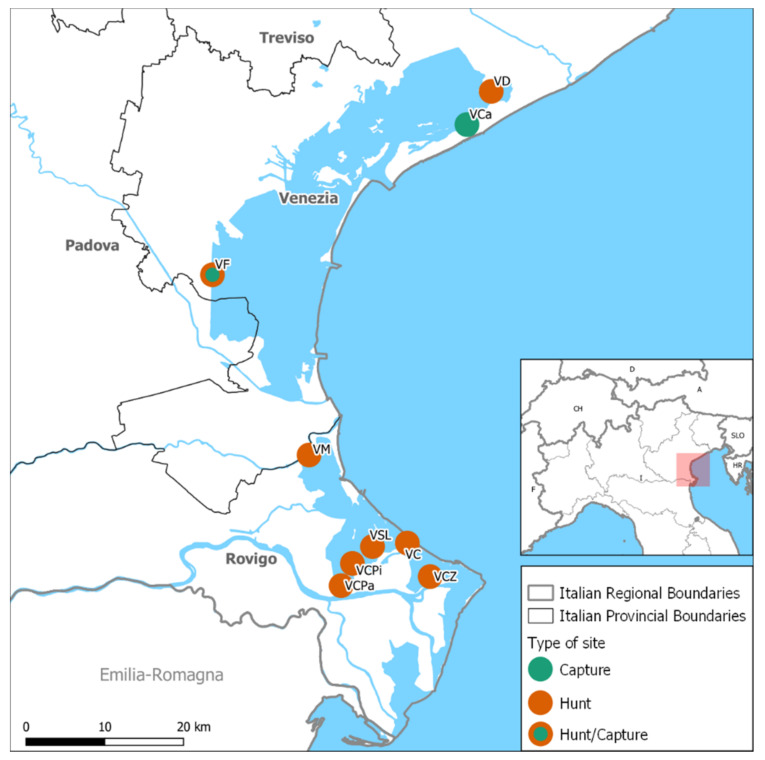
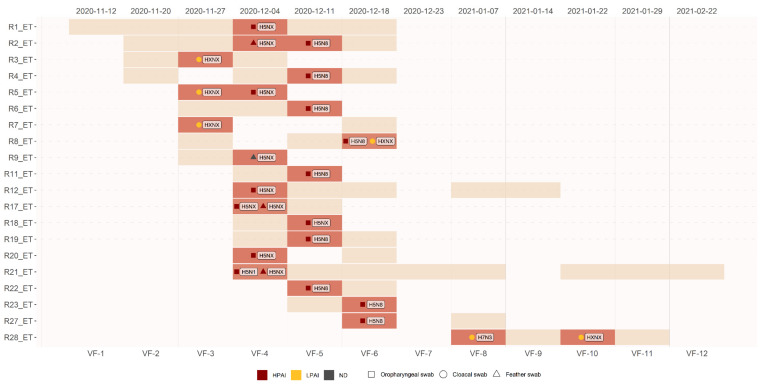
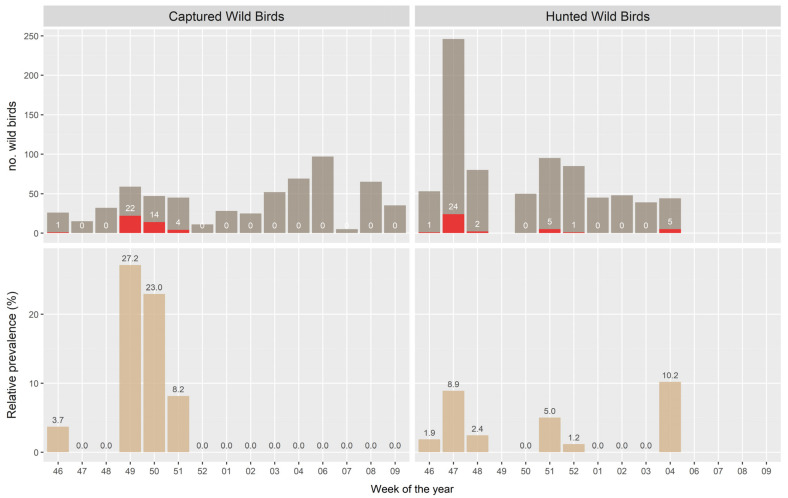
The increasing involvement of wild waterfowl in H5 Highly Pathogenic Avian Influenza Virus (HPAIV) circulation continues to pose a threat to animal and public health worldwide. In winter 2020-2021, two field surveillance activities were carried out on a weekly basis, through virological and serological analyses, in 823 hunted and 521 trapped migratory aquatic birds in northeast Italy. Sixty Eurasian teals were recaptured several times, which allowed us to follow the progression of the HPAI H5 infection in naturally infected wild waterfowl. Oropharyngeal, cloacal, and feather swabs (OS, CS and FS) were collected from each duck and tested by real time rRT-PCR Type A influenza. The identified viruses were characterized and pathotyped by sequencing. Several viruses belonging to three different HPAI H5 subtypes were detected: H5N8, H5N5, and H5N1. High prevalence of infection with HPAI H5 clade 2.3.4.4b during November-December 2020 (up to 27.1%) was observed in captured Eurasian teals, while infection rates in hunted dabbling ducks, mainly Eurasian wigeons, showed the highest prevalence of infection in November 2020 (8.9%) and January 2021 (10.2%). All HPAI positive birds were also clinically healthy when recaptured weeks apart. The OS and FS showed the highest detection efficiency of HPAIV. Our results highlight that HPAI passive surveillance should be complemented by a targeted active surveillance to more efficiently detect novel HPAI viruses.
野生水禽在H5高致病性禽流感病毒(HPAIV)传播中的参与度不断增加,这继续对全球动物和公共卫生构成威胁。在2020年至2021年冬季,通过病毒学和血清学分析,对意大利东北部823只猎获的和521只捕获的迁徙水鸟每周开展两次野外监测活动。60只欧亚绿头鸭被多次重新捕获,这使我们能够追踪自然感染野生水禽中HPAI H5感染的进展情况。从每只鸭子采集口咽、泄殖腔和羽毛拭子(OS、CS和FS),并通过实时rRT-PCR A型流感进行检测。通过测序对鉴定出的病毒进行特征分析和致病型鉴定。检测到几种属于三种不同HPAI H5亚型的病毒:H5N8、H5N5和H5N1。在2020年11月至12月期间,捕获的欧亚绿头鸭中观察到HPAI H5进化分支2.3.4.4b的高感染率(高达27.1%),而猎获的涉禽鸭(主要是欧亚斑嘴鸭)的感染率在2020年11月(8.9%)和2021年1月(10.2%)显示出最高的感染率。所有HPAI阳性鸟类在相隔数周被重新捕获时临床也均健康。OS和FS显示出HPAIV的最高检测效率。我们的结果强调,HPAI被动监测应辅以有针对性的主动监测,以更有效地检测新型HPAI病毒。