Wu Yang, Li Huimin, Li Yang
School of Chemical Engineering and Technology, Tianjin University, Tianjin 300072, China.
Microorganisms. 2021 Nov 21;9(11):2396. doi: 10.3390/microorganisms9112396.
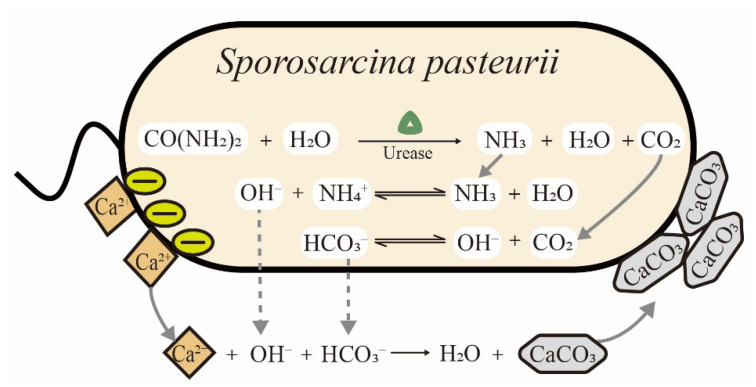
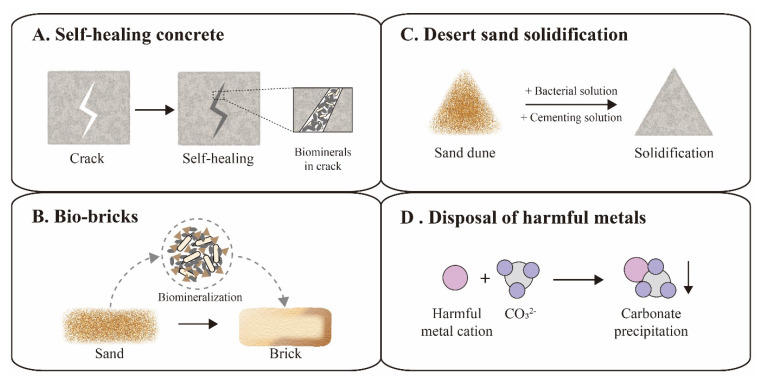
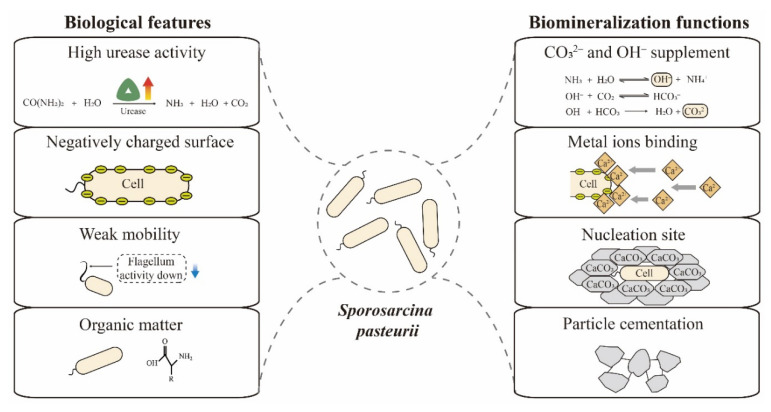
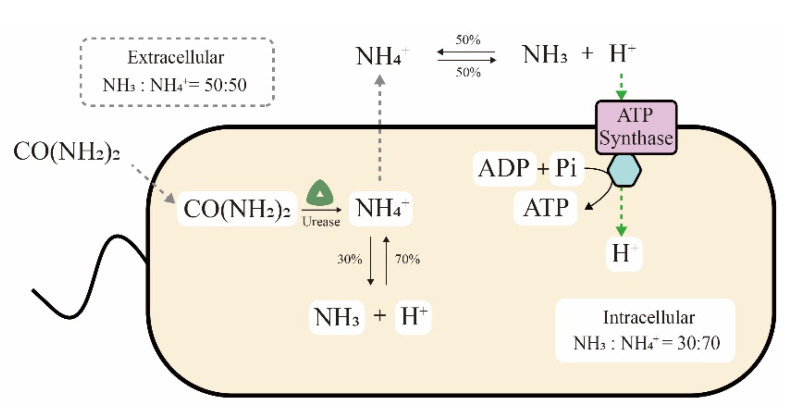
Biomineralization has emerged as a novel and eco-friendly technology for artificial mineral formation utilizing the metabolism of organisms. Due to its highly efficient urea degradation ability, is arguably the most widely investigated organism in ureolytic biomineralization studies, with wide potential application in construction and environmental protection. In emerging, large-scale commercial engineering applications, attention was also paid to practical challenges and issues. In this review, we summarize the features of cells contributing to the biomineralization reaction, aiming to reveal the mechanism of artificial mineral formation catalyzed by bacterial cells. Progress in the application of this technology in construction and environmental protection is discussed separately. Furthermore, the urgent challenges and issues in large-scale application are also discussed, along with potential solutions. We aim to offer new ideas to researchers working on the mechanisms, applications and challenges of biomineralization.
生物矿化已成为一种利用生物体新陈代谢形成人工矿物的新型环保技术。由于其高效的尿素降解能力,在尿素分解生物矿化研究中,它可以说是研究最为广泛的生物体,在建筑和环境保护领域具有广阔的应用潜力。在新兴的大规模商业工程应用中,人们也关注到了实际挑战和问题。在本综述中,我们总结了有助于生物矿化反应的细胞特征,旨在揭示细菌细胞催化人工矿物形成的机制。分别讨论了该技术在建筑和环境保护中的应用进展。此外,还讨论了大规模应用中面临的紧迫挑战和问题以及潜在的解决方案。我们旨在为从事生物矿化机制、应用和挑战研究的人员提供新思路。