Department of Epidemiology, University of Alabama at Birmingham, Birmingham, AL 35294, USA.
Department of Medicine, Division of Endocrinology, Diabetes, and Nutrition, University of Maryland School of Medicine, Baltimore, MD 21201, USA.
Nutrients. 2021 Nov 10;13(11):4000. doi: 10.3390/nu13114000.
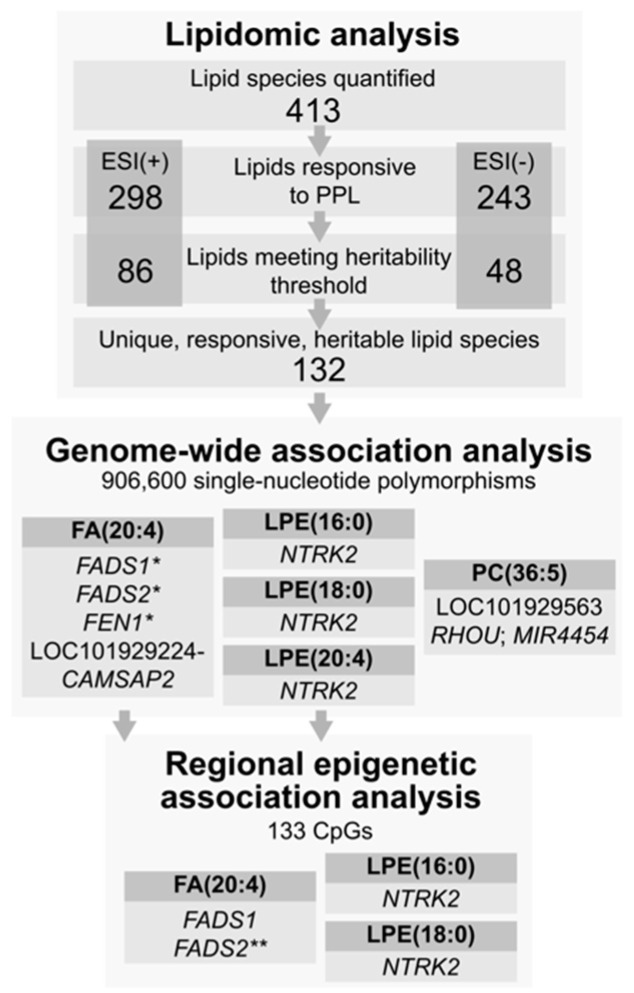
Postprandial lipemia (PPL) is an important risk factor for cardiovascular disease. Inter-individual variation in the dietary response to a meal is known to be influenced by genetic factors, yet genes that dictate variation in postprandial lipids are not completely characterized. Genetic studies of the plasma lipidome can help to better understand postprandial metabolism by isolating lipid molecular species which are more closely related to the genome. We measured the plasma lipidome at fasting and 6 h after a standardized high-fat meal in 668 participants from the Genetics of Lipid-Lowering Drugs and Diet Network study (GOLDN) using ultra-performance liquid chromatography coupled to (quadrupole) time-of-flight mass spectrometry. A total of 413 unique lipids were identified. Heritable and responsive lipid species were examined for association with single-nucleotide polymorphisms (SNPs) genotyped on the Affymetrix 6.0 array. The most statistically significant SNP findings were replicated in the Amish Heredity and Phenotype Intervention (HAPI) Heart Study. We further followed up findings from GOLDN with a regional analysis of cytosine-phosphate-guanine (CpGs) sites measured on the Illumina HumanMethylation450 array. A total of 132 lipids were both responsive to the meal challenge and heritable in the GOLDN study. After correction for multiple testing of 132 lipids (α = 5 × 10/132 = 4 × 10), no SNP was statistically significantly associated with any lipid response. Four SNPs in the region of a known lipid locus (fatty acid desaturase 1 and 2/ and ) on chromosome 11 had < 8.0 × 10 for arachidonic acid FA(20:4). Those SNPs replicated in HAPI Heart with < 3.3 × 10. CpGs around the region were associated with arachidonic acid and the relationship of one SNP was partially mediated by a CpG ( = 0.005). Both SNPs and CpGs from the fatty acid desaturase region on chromosome 11 contribute jointly and independently to the diet response to a high-fat meal.
餐后血脂血症(PPL)是心血管疾病的一个重要危险因素。已知个体对膳食的反应存在差异受遗传因素的影响,但决定餐后脂质变化的基因尚未完全确定。对血浆脂质组学的遗传研究有助于通过分离与基因组更密切相关的脂质分子种类来更好地了解餐后代谢。我们使用超高效液相色谱法与(四极杆)飞行时间质谱法,在来自降脂药物和饮食网络研究(GOLDN)的 668 名参与者中,在空腹和标准化高脂肪餐后 6 小时测量了血浆脂质组。共鉴定出 413 种独特的脂质。对可遗传和有反应的脂质种类进行了单核苷酸多态性(SNP)与 Affymetrix 6.0 阵列上基因分型的关联分析。最具统计学意义的 SNP 发现结果在阿米什遗传和表型干预(HAPI)心脏研究中得到了复制。我们进一步对 GOLDN 的发现进行了跟进,对在 Illumina HumanMethylation450 阵列上测量的胞嘧啶-磷酸-鸟嘌呤(CpG)位点进行了区域分析。在 GOLDN 研究中,共有 132 种脂质既对膳食挑战有反应,又具有遗传性。在对 132 种脂质进行多次测试校正后(α=5×10/132=4×10),没有 SNP 与任何脂质反应呈统计学显著相关。在染色体 11 上已知脂质基因座(脂肪酸去饱和酶 1 和 2/和)区域的 4 个 SNP 与花生四烯酸 FA(20:4)的<8.0×10。这些 SNP 在 HAPI 心脏研究中具有<3.3×10 的关联性。区域周围的 CpG 与花生四烯酸有关,一个 SNP 的关系部分由一个 CpG 介导(=0.005)。染色体 11 上脂肪酸去饱和酶区域的 SNP 和 CpG 共同和独立地影响高脂肪餐后的饮食反应。