Department of Pathophysiology, Poznan University of Medical Sciences, 61-701 Poznan, Poland.
Department of Gastroenterology, Dietetics and Internal Diseases, Poznan University of Medical Sciences, 60-355 Poznan, Poland.
Nutrients. 2021 Nov 15;13(11):4089. doi: 10.3390/nu13114089.
Chronotype is the pattern of the circadian rhythm that allows an individual to optimize times of sleep and activity. It has been observed that chronotypes may associate with some conditions and diseases, including obesity. It is not known, however, whether chronotypes determine the effectiveness of weight loss regimens. Therefore, in the present study, we compared the outcomes of a 3-week moderate calorie restriction undertaken by individuals with obesity under the same controlled hospital conditions.
A total of 131 participants with obesity (median BMI 40.0) were studied. The subjects underwent the same dietary intervention over 3 weeks, with a 30% reduction in daily caloric intake. The individual chronotypes were assessed by the morning and evening questionnaire (MEQ) according to Horne and Östberg. Anthropometric and biochemical parameters were assessed by routine methods.
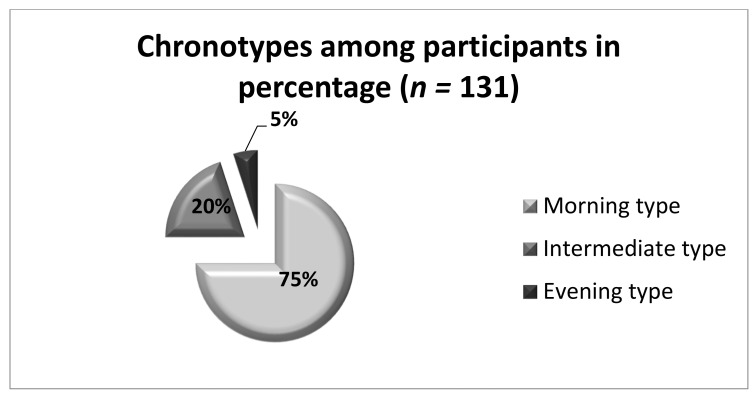
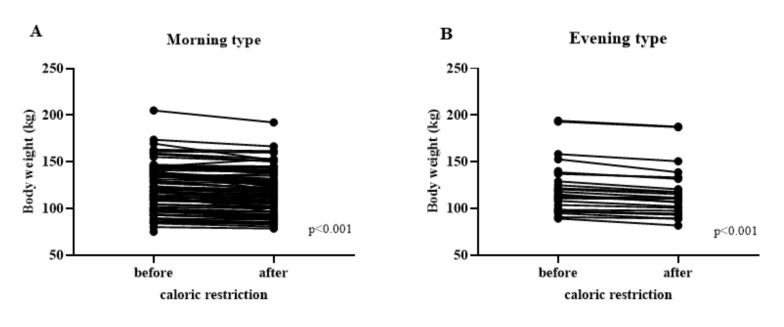
Of all patients examined, 75% had the morning (lark) chronotype and 25% had the evening (owl) chronotype. These patient sub-groups did not differ in terms of demographic, anthropometric and biochemical characteristics at baseline. After 3 weeks of calorie restriction, both groups experienced a similar loss of weight and BMI (Body Mass Index) (3.4 ± 0.38% for larks vs. 4.1 ± 0.47% for owls, = 0.45), with owls exhibiting a marginally greater loss of body fat (3.1 ± 0.79%) compared with larks (2.6 ± 0.64%), = 0.02. On the other hand, the larks had a more discernable, but not statistically significant from owls, decrease in glycated haemoglobin and CRP (C Reactive Protein).
The chronotype of individuals with obesity does not have a significant effect on the magnitude of the body weight loss, but there is a tendency observed towards the reduction in body fat content in owls through changing their meal and sleep timing to earlier hours, in response to moderate calorie restriction applied under the same controlled conditions.
时型是昼夜节律的模式,使个体能够优化睡眠和活动时间。已经观察到时型可能与某些情况和疾病相关,包括肥胖。然而,目前还不清楚时型是否决定了减肥方案的有效性。因此,在本研究中,我们比较了在相同的受控医院条件下,肥胖个体接受为期 3 周的适度热量限制的结果。
共研究了 131 名肥胖患者(中位数 BMI 为 40.0)。所有患者均接受了为期 3 周的相同饮食干预,每日热量摄入减少 30%。个体时型通过 Horne 和 Östberg 的早晚问卷(MEQ)进行评估。通过常规方法评估人体测量和生化参数。
在所检查的所有患者中,75%为晨型(百灵鸟),25%为晚型(猫头鹰)。这两组患者在基线时的人口统计学、人体测量学和生化特征方面没有差异。经过 3 周的热量限制,两组患者的体重和 BMI(体重指数)均有相似的减轻(百灵鸟为 3.4±0.38%,猫头鹰为 4.1±0.47%, = 0.45),猫头鹰的体脂减少幅度略高于百灵鸟(3.1±0.79%比 2.6±0.64%, = 0.02)。另一方面,百灵鸟的糖化血红蛋白和 CRP(C 反应蛋白)有更明显但与猫头鹰无统计学差异的下降。
肥胖个体的时型对体重减轻的幅度没有显著影响,但观察到猫头鹰通过改变进餐和睡眠时间以适应适度热量限制,使体脂含量减少的趋势。这种改变是在相同的受控条件下进行的。