Department of Radiology, Hallym University Dongtan Sacred Heart Hospital, Hwaseong-si, Gyeonggi-do, South Korea.
Department of Radiology, Hallym University Dongtan Sacred Heart Hospital, Hwaseong-si, Gyeonggi-do, South Korea.
Semin Oncol. 2021 Aug-Dec;48(4-6):283-291. doi: 10.1053/j.seminoncol.2021.10.002. Epub 2021 Oct 26.
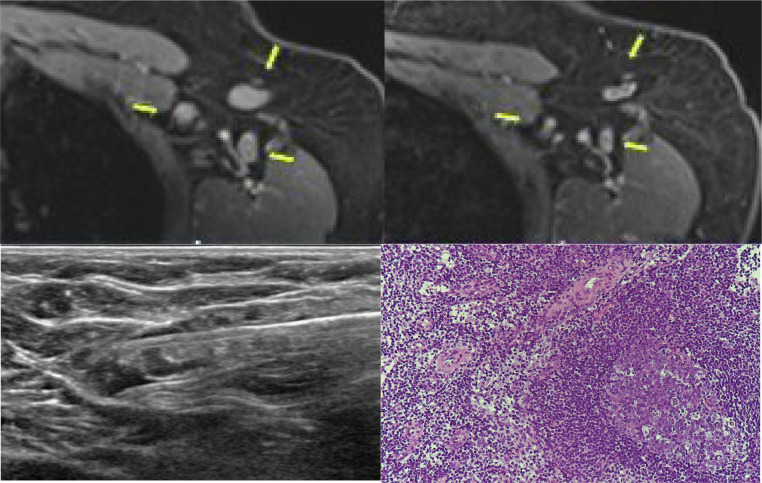
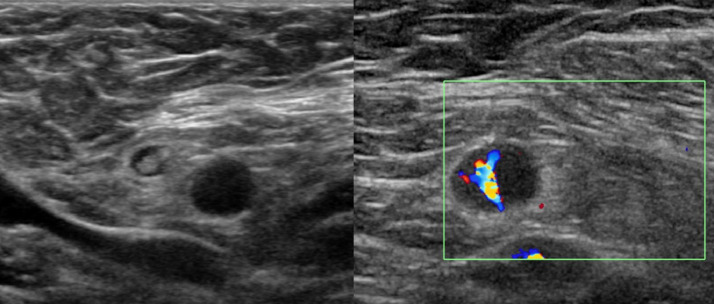
Lymphadenopathy (LAP) after COVID-19 vaccination in patients with a diagnosis of cancer has been challenging. We analyzed imaging and clinical features from early cases of axillary LAP in six COVID-19 vaccine recipients with a history of breast cancer.
Among the patients with a history of breast cancer and recent COVID-19 vaccine administration, six patients who showed isolated axillary LAP were gathered. Radiologic features were reviewed from breast ultrasound, chest computed tomography, and breast magnetic resonance imaging. Clinical and pathological information were obtained for analysis.
The interval between ultrasound detection of LAP and last COVID-19 vaccine administration ranged from 14 to 28 days (mean 21.67 days). Round shape of the lymph node and irregular cortex were noted in 2 and 0 cases, respectively. Mean maximum cortical thickness, length to width ratio and interval aggravation in maximum cortical thickening were 4.2 mm, 1.34, and 2.81-fold with cut-off value of 3 mm, 1.5, 2.0-fold, respectively.
We observed axillary LAP ipsilateral to a recent vaccine administration persisting longer than what the Centers for Disease Control and Prevention announced. In our patients, COVID-19 vaccine-related LAP tended to show increased cortical thickness without cortical irregularity. Oncologist as well as radiologist should be familiar with the fact that COVID-19 vaccines, regardless of vaccine type or dosage, can frequently cause ipsilateral axillary LAP, showing some suspicious features more often than others, and can persist longer than anticipated so that both over- and underdiagnosis can be avoided. We report our observations in six patients and provide an exhaustive review of the published literature.
癌症患者接种 COVID-19 疫苗后出现淋巴结病(LAP)具有挑战性。我们分析了 6 名乳腺癌病史的 COVID-19 疫苗接种者早期腋窝 LAP 的影像学和临床特征。
在有乳腺癌病史和近期 COVID-19 疫苗接种的患者中,收集了 6 名出现孤立性腋窝 LAP 的患者。回顾了乳腺超声、胸部 CT 和乳腺磁共振成像的影像学特征。获取了临床和病理信息进行分析。
LAP 超声检测到与最后一次 COVID-19 疫苗接种之间的间隔时间为 14 至 28 天(平均 21.67 天)。在 2 例和 0 例中分别观察到淋巴结呈圆形和皮质不规则。平均最大皮质厚度、长度与宽度比和最大皮质增厚间隔加重分别为 4.2mm、1.34 和 2.81 倍,截断值为 3mm、1.5 和 2.0 倍。
我们观察到最近疫苗接种同侧腋窝 LAP 持续时间长于疾病预防控制中心宣布的时间。在我们的患者中,COVID-19 疫苗相关的 LAP 倾向于表现为皮质厚度增加而无皮质不规则。肿瘤学家和放射科医生都应该熟悉这样一个事实,即 COVID-19 疫苗,无论疫苗类型或剂量如何,都会经常引起同侧腋窝 LAP,表现出一些比其他更可疑的特征,并且持续时间可能比预期的要长,从而避免过度和诊断不足。我们报告了 6 名患者的观察结果,并对已发表的文献进行了详尽的回顾。