Addiction Development and Psychopathology (ADAPT)-lab, Developmental Psychology, Department of Psychology, University of Amsterdam, Amsterdam, The Netherlands
Department of Research, Development and Prevention, Student Health Service, University of Amsterdam, Amsterdam, The Netherlands.
BMJ Open. 2021 Nov 26;11(11):e049554. doi: 10.1136/bmjopen-2021-049554.
Emerging adulthood is a phase in life that is associated with an increased risk to develop a variety of mental health disorders including anxiety and depression. However, less than 25% of university students receive professional help for their mental health reports. Internet-based cognitive behavioural therapy (iCBT) may entail useful interventions in a format that is attractive for university students. The aim of this study protocol is to test the effectiveness of a therapist-guided versus a computer-guided transdiagnostic iCBT programme with a main focus on anxiety and depression.
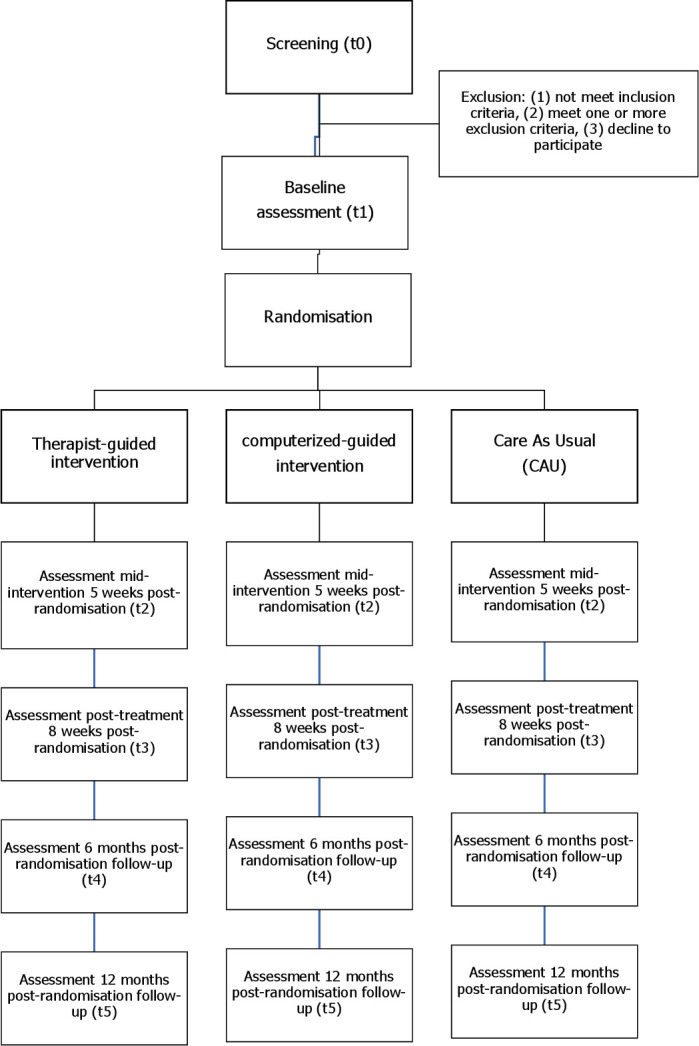
University students with anxiety and/or depressive symptoms will be randomised to a (1) 7-week iCBT programme (excluding booster session) with therapist feedback, (2) the identical iCBT programme with computer feedback only or (3) care as usual. Participants in the care as usual condition are informed and referred to conventional care services and encouraged to seek the help they need. Primary outcome variables are self-reported levels of anxiety as measured with the General Anxiety Disorder-7 and self-reported levels of depression as measured with the Patient Health Questionnaire-9. Secondary outcomes include treatment adherence, client satisfaction, medical service use, substance use, quality of life and academic achievement. Assessments will take place at baseline (t1), midtreatment (t2), post-treatment (t3), at 6 months (t4) and 12 months (t5) postbaseline. Social anxiety and perfectionism are included as potentially important predictors of treatment outcome. Power calculations are based on a 3 (group) × 3 (measurement: pretreatment, midtreatment and post-treatment) interaction, resulting in an aimed sample of 276 participants. Data will be analysed based on intention-to-treat and per protocol samples using mixed linear models.
The current study was approved by the Medical Ethics Review Committee (METC) of the Academic Medical Centre, Amsterdam, The Netherlands (number: NL64929.018.18). Results of this trial will be published in peer-reviewed journals.
NL7328.
成年初显期是人生的一个阶段,在此期间,各种心理健康障碍(包括焦虑和抑郁)的发病风险增加。然而,不到 25%的大学生会寻求专业帮助来解决心理健康问题。基于互联网的认知行为疗法(iCBT)可能会以一种对大学生有吸引力的形式提供有用的干预措施。本研究方案旨在测试以焦虑和/或抑郁为主要焦点的治疗师指导与计算机指导的跨诊断 iCBT 方案的有效性。
有焦虑和/或抑郁症状的大学生将被随机分配到(1)7 周的 iCBT 方案(不包括强化疗程),有治疗师反馈,(2)相同的 iCBT 方案,只有计算机反馈,或(3)常规护理。常规护理组的参与者会获得信息并被转介到常规护理服务,并被鼓励寻求他们所需的帮助。主要结局变量是使用一般焦虑障碍 7 项量表(GAD-7)自我报告的焦虑程度和使用患者健康问卷 9 项量表(PHQ-9)自我报告的抑郁程度。次要结局包括治疗依从性、客户满意度、医疗服务使用、物质使用、生活质量和学业成绩。评估将在基线(t1)、治疗中期(t2)、治疗后(t3)、6 个月(t4)和 12 个月(t5)进行。社交焦虑和完美主义被纳入潜在的重要治疗结果预测因素。基于 3(组)×3(测量:治疗前、治疗中、治疗后)的交互作用,进行了功效计算,目标样本量为 276 名参与者。数据将根据意向治疗和方案样本使用混合线性模型进行分析。
本研究已得到阿姆斯特丹学术医学中心医学伦理审查委员会(METC)的批准(编号:NL64929.018.18)。该试验的结果将发表在同行评议的期刊上。
NL7328。