Pensier Joris, De Jong Audrey, Chanques Gerald, Futier Emmanuel, Azoulay Elie, Molinari Nicolas, Jaber Samir
Department of Anesthesia and Intensive Care Unit, Regional University Hospital of Montpellier, St-Eloi Hospital, University of Montpellier, PhyMedExp, INSERM U1046, CNRS UMR, 9214 CEDEX 5, Montpellier, France.
Department of Peri-Operative Medicine, CHU Clermont-Ferrand, 63000, Clermont-Ferrand, France.
Ann Intensive Care. 2021 Nov 27;11(1):165. doi: 10.1186/s13613-021-00954-x.
Critical care randomized controlled trials (RCTs) are often published in high-impact journals, whether general journals [the New England Journal of Medicine (NEJM), The Lancet, the Journal of the American Medical Association (JAMA)] or critical care journals [Intensive Care Medicine (ICM), the American Journal of Respiratory and Critical Care Medicine (AJRCCM), Critical Care Medicine (CCM)]. As rejection occurs in up to 97% of cases, it might be appropriate to assess pre-submission probability of being published. The objective of this study was to develop and internally validate a simplified score predicting whether an ongoing trial stands a chance of being published in high-impact general journals.
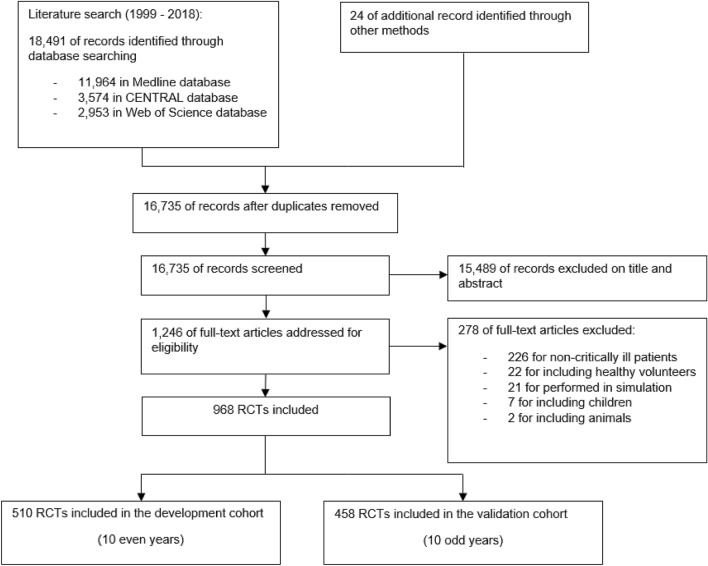
A cohort of critical care RCTs published between 1999 and 2018 in the three highest impact medical journals (NEJM, The Lancet, JAMA) or the three highest impact critical care journals (ICM, AJRCCM, CCM) was split into two samples (derivation cohort, validation cohort) to develop and internally validate the simplified score. Primary outcome was journal of publication assessed as high-impact general journal (NEJM, The Lancet, JAMA) or critical care journal (ICM, AJRCCM, CCM).
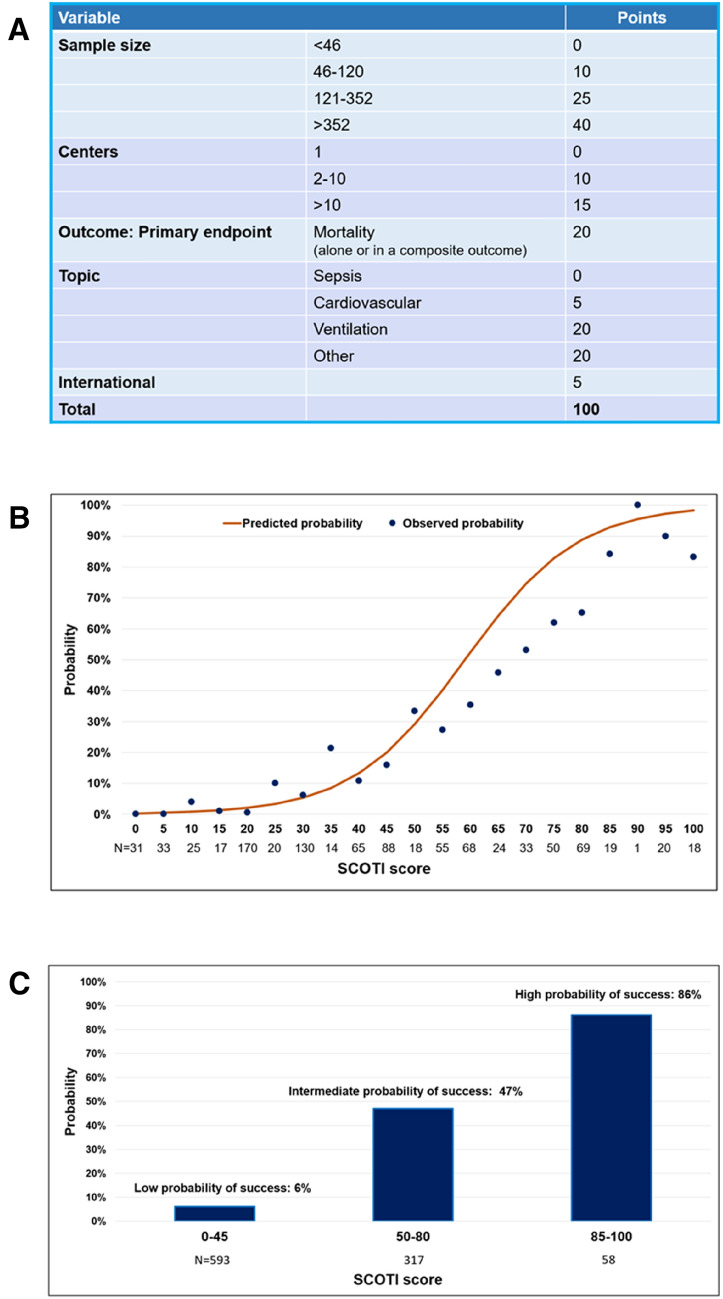
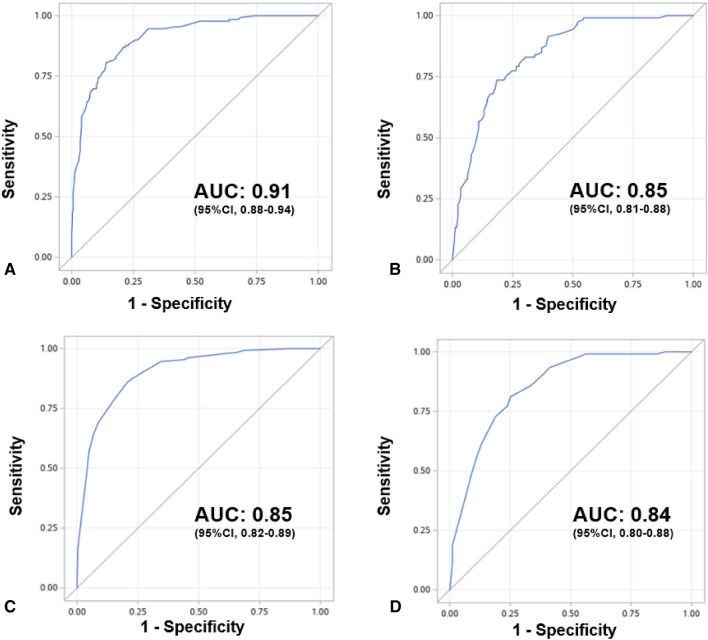
A total of 968 critical care RCTs were included in the predictive cohort and split into a derivation cohort (n = 510) and a validation cohort (n = 458). In the derivation cohort, the sample size (P value < 0.001), the number of centers involved (P value = 0.01), mortality as primary outcome (P value = 0.002) or a composite item including mortality as primary outcome (P value = 0.004), and topic [ventilation (P value < 0.001) or miscellaneous (P value < 0.001)] were independent factors predictive of publication in high-impact general journals, compared to high-impact critical care journals. The SCOTI score (Sample size, Centers, Outcome, Topic, and International score) was developed with an area under the ROC curve of 0.84 (95% Confidence Interval, 0.80-0.88) in validation by split sample.
The SCOTI score, developed and validated by split sample, accurately predicts the chances of a critical care RCT being published in high-impact general journals, compared to high-impact critical care journals.
重症监护随机对照试验(RCTs)通常发表在高影响力期刊上,无论是综合期刊[《新英格兰医学杂志》(NEJM)、《柳叶刀》、《美国医学会杂志》(JAMA)]还是重症监护期刊[《重症医学》(ICM)、《美国呼吸与重症医学杂志》(AJRCCM)、《危重病医学》(CCM)]。由于高达97%的病例会被拒稿,因此评估投稿前被发表的概率可能是合适的。本研究的目的是开发并内部验证一个简化评分,以预测正在进行的试验是否有机会在高影响力综合期刊上发表。
将1999年至2018年在三本影响力最高的医学期刊(NEJM、《柳叶刀》、JAMA)或三本影响力最高的重症监护期刊(ICM、AJRCCM、CCM)上发表的重症监护RCT队列分为两个样本(推导队列、验证队列),以开发并内部验证简化评分。主要结局是发表期刊,分为高影响力综合期刊(NEJM、《柳叶刀》、JAMA)或重症监护期刊(ICM、AJRCCM、CCM)。
预测队列共纳入968项重症监护RCT,并分为推导队列(n = 510)和验证队列(n = 458)。在推导队列中,样本量(P值<0.001)、涉及的中心数量(P值 = 0.01)、以死亡率作为主要结局(P值 = 0.002)或以包括死亡率作为主要结局的复合项目(P值 = 0.004)以及主题[通气(P值<0.001)或其他(P值<0.001)]是与高影响力重症监护期刊相比,预测在高影响力综合期刊上发表的独立因素。通过拆分样本验证,开发了SCOTI评分(样本量、中心、结局、主题和国际评分),其ROC曲线下面积为0.84(95%置信区间,0.80 - 0.88)。
通过拆分样本开发并验证的SCOTI评分,与高影响力重症监护期刊相比,能够准确预测重症监护RCT在高影响力综合期刊上发表的机会。