Regional Center for Child and Youth Mental Health and Child Welfare, Department of Mental Health, Norwegian University of Science and Technology, Trondheim, Norway.
Department of Child and Adolescent Psychiatry, St. Olavs University Hospital, Trondheim, Norway.
BMC Psychol. 2021 Nov 27;9(1):185. doi: 10.1186/s40359-021-00689-1.
Prevention is essential to reduce the development of symptomology among children and adolescents into disorders, thereby improving public health and reducing costs. Therefore, easily administered screening and early assessment methods with good reliability and validity are necessary to effectively identify children's functioning and how these develop. The Brief Problem Monitor (BPM) is an instrument designed for this purpose. This study examined the psychometric properties of the Norwegian version of the BPM parent (BPM-P) and teacher (BPM-T) versions, including internal reliability and construct validity at assessing children with internalizing problems.
Baseline data were collected from a national randomized controlled intervention study. Children aged 8-12 years with self-reported symptoms of anxiety and/or depression with one standard deviation above a chosen population's mean were included in this study. Teachers (n = 750) and parents (n = 596) rated children using the BPM-T and BPM-P, respectively. Internal consistency was measured using Cronbach's alpha, and multi-informant agreement between the BPM-P and BPM-T was measured using Spearman's correlations. Construct validity was assessed via confirmatory factor analysis.
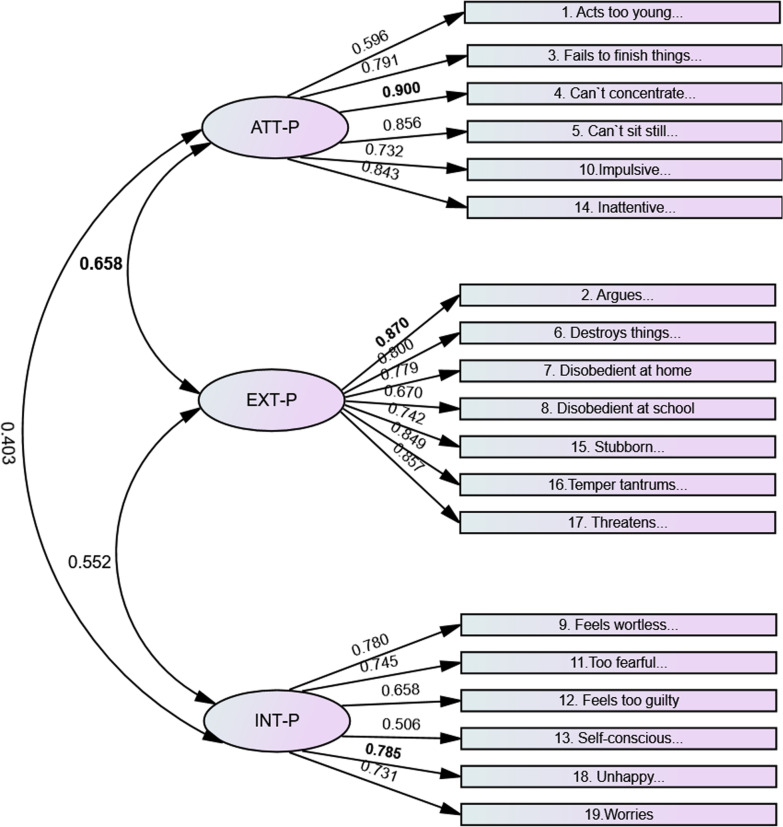
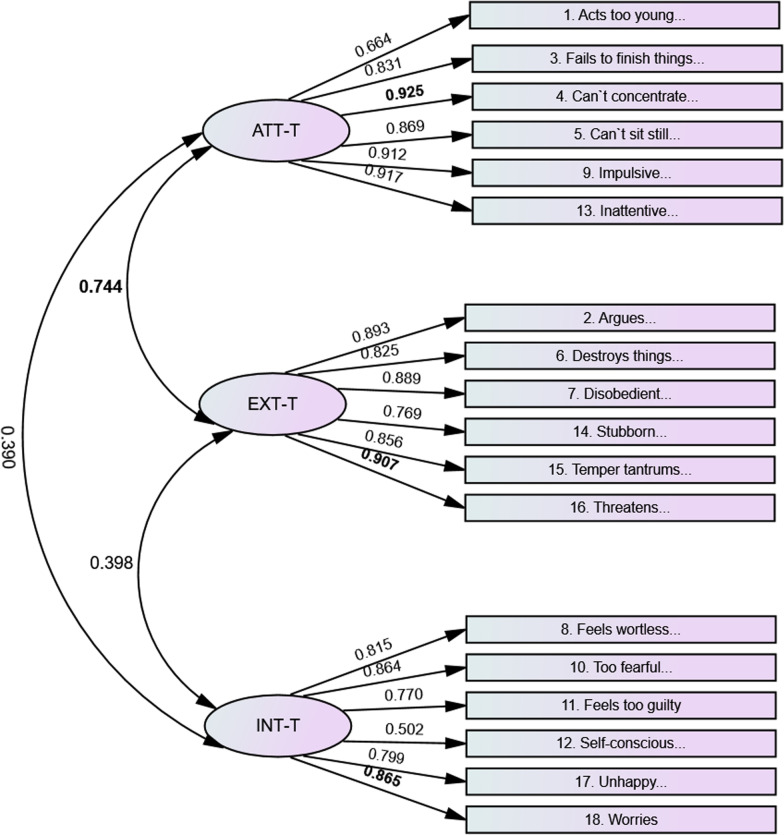
Internal consistency was good throughout all domains for both the BPM-P and BPM-T, with a Cronbach's alpha ranging from .763 to .878. Multi-informant agreement between the parents and the teacher was moderate on the externalizing, attention, and total scales and low on the internalizing scale. The model fit for the three-factor structure of the BPM was excellent for the BPM-P and good for the BPM-T.
Internal consistency was good, and the original three-factor solution of the BPM-P and BPM-T was confirmed based on our sample of school children at-risk for emotional problems. These promising results indicate that the BPM may be a valid short assessment tool for measuring attentional, behavioral, and internalizing problems in children. Trial registration in Clinical Trials: NCT02340637; June 12, 2014.
预防对于减少儿童和青少年出现症状发展为障碍至关重要,从而改善公共卫生并降低成本。因此,需要容易管理的、具有良好信度和效度的筛查和早期评估方法,以有效识别儿童的功能以及这些功能的发展情况。简要问题监测器(BPM)就是为此目的而设计的一种工具。本研究检验了挪威版家长用 BPM(BPM-P)和教师用 BPM(BPM-T)版本的心理测量学特性,包括评估有内化问题儿童时的内部一致性和构念效度。
本研究的基线数据来自一项全国性的随机对照干预研究。该研究纳入了自我报告有焦虑和/或抑郁症状且得分高于所选人群平均值一个标准差的 8-12 岁儿童。教师(n=750)和家长(n=596)分别使用 BPM-T 和 BPM-P 对儿童进行评估。内部一致性采用克朗巴赫 α 进行测量,BPM-P 和 BPM-T 之间的多信息者一致性采用斯皮尔曼相关进行测量。构念效度通过验证性因子分析进行评估。
BPM-P 和 BPM-T 的所有领域的内部一致性均良好,克朗巴赫 α 值范围为.763 至.878。父母和教师之间的多信息者一致性在外化、注意力和总分量表上为中等,在内化量表上为低等。BPM-P 的三因素结构模型拟合度优秀,BPM-T 的模型拟合度良好。
内部一致性良好,BPM-P 和 BPM-T 的原始三因素结构得到了我们这个有情绪问题风险的学龄儿童样本的验证。这些有前景的结果表明,BPM 可能是一种有效的简短评估工具,可用于测量儿童的注意力、行为和内化问题。临床试验注册:NCT02340637;2014 年 6 月 12 日。