Institute of Advanced Materials (IAM), Key Laboratory of Flexible Electronics (KLOFE) Nanjing Tech University, 30 South Puzhu Road, Nanjing, 211816, China.
Institute of Advanced Materials (IAM), Key Laboratory of Flexible Electronics (KLOFE) Nanjing Tech University, 30 South Puzhu Road, Nanjing, 211816, China.
Biosens Bioelectron. 2022 Feb 15;198:113823. doi: 10.1016/j.bios.2021.113823. Epub 2021 Nov 21.
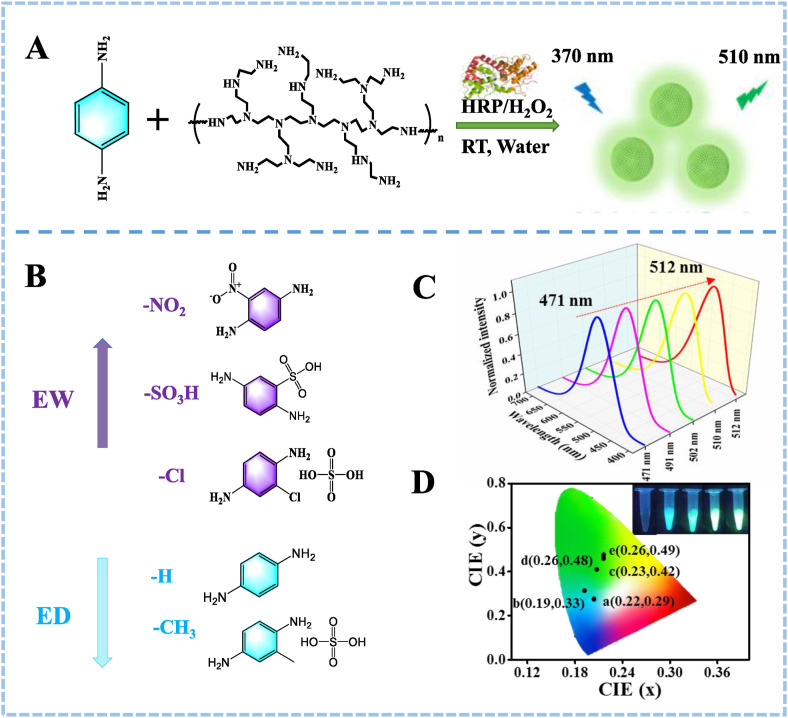
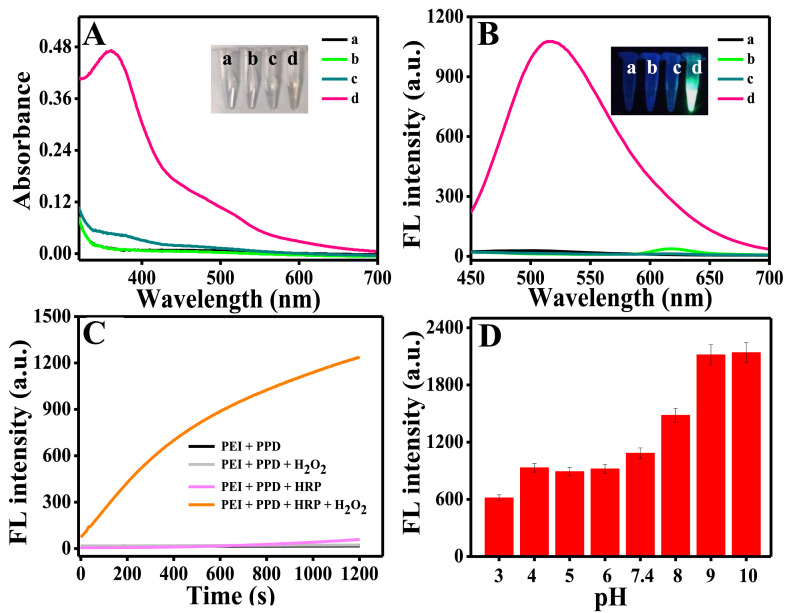
Direct in situ fluorescent enzyme-linked immunosorbent assay (ELISA) is rarely investigated and reported. Herein, a direct in situ high-performance HRP-labeled fluorescent immunoassay platform was constructed. The platform was developed based on a rapid in situ fluorogenic reaction between Polyethyleneimine (PEI) and p-Phenylenediamine (PPD) analogues to generate fluorescent copolymer nanoparticles (FCNPs). The formation mechanism of FCNPs was found to be the oxidation of •OH radicals, which was further proved by nitrogen protection and scavenger of •OH radicals. Meantime, the fluorescence wavelength of FCNPs could be adjusted from 471 to 512 nm by introducing various substitution groups into the PPD structure. Using cardiac troponin I (cTnI) and SARS-CoV-2 nucleocapsid protein (N-protein) as the model antigens, the proposed fluorescent ELISA exhibited a wide dynamic range of 5-180 ng/mL and a low limit of detection (LOD) of 0.19 ng/mL for cTnI, and dynamic range of 0-120 ng/mL and a LOD of 0.33 ng/mL for SARS-CoV-2 N protein, respectively. Noteworthy, the proposed method was successful applied to evaluate the cTnI and SARS-CoV-2 N protein levels in serum with satisfied results. Therefore, the proposed platform paved ways for developing novel fluorescence-based HRP-labeled ELISA technologies and broadening biomarker related clinical diagnostics.
直接原位荧光酶联免疫吸附测定(ELISA)很少被研究和报道。在此,构建了一种直接原位高效辣根过氧化物酶标记荧光免疫分析平台。该平台是基于聚乙二胺(PEI)和对苯二胺(PPD)类似物之间的快速原位荧光生成反应构建的,以生成荧光共聚物纳米颗粒(FCNPs)。发现 FCNPs 的形成机制是 •OH 自由基的氧化,这通过氮气保护和 •OH 自由基的清除剂进一步得到了证明。同时,通过在 PPD 结构中引入各种取代基,可以将 FCNPs 的荧光波长从 471nm 调节到 512nm。以心肌肌钙蛋白 I(cTnI)和 SARS-CoV-2 核衣壳蛋白(N-蛋白)为模型抗原,所提出的荧光 ELISA 表现出宽的动态范围,cTnI 的检测下限(LOD)为 0.19ng/mL,检测下限为 5-180ng/mL;SARS-CoV-2 N 蛋白的动态范围为 0-120ng/mL,LOD 为 0.33ng/mL。值得注意的是,该方法成功应用于评估血清中的 cTnI 和 SARS-CoV-2 N 蛋白水平,结果令人满意。因此,该平台为开发新型基于荧光的辣根过氧化物酶标记 ELISA 技术和拓宽生物标志物相关的临床诊断铺平了道路。