Department of Medicine, Stony Brook University, Stony Brook, NY, USA; Stony Brook Cancer Center, Stony Brook University, Stony Brook, NY, USA.
Department of Genetics, School of Medicine, Yale University, New Haven, CT, USA.
J Lipid Res. 2022 Jan;63(1):100154. doi: 10.1016/j.jlr.2021.100154. Epub 2021 Nov 24.
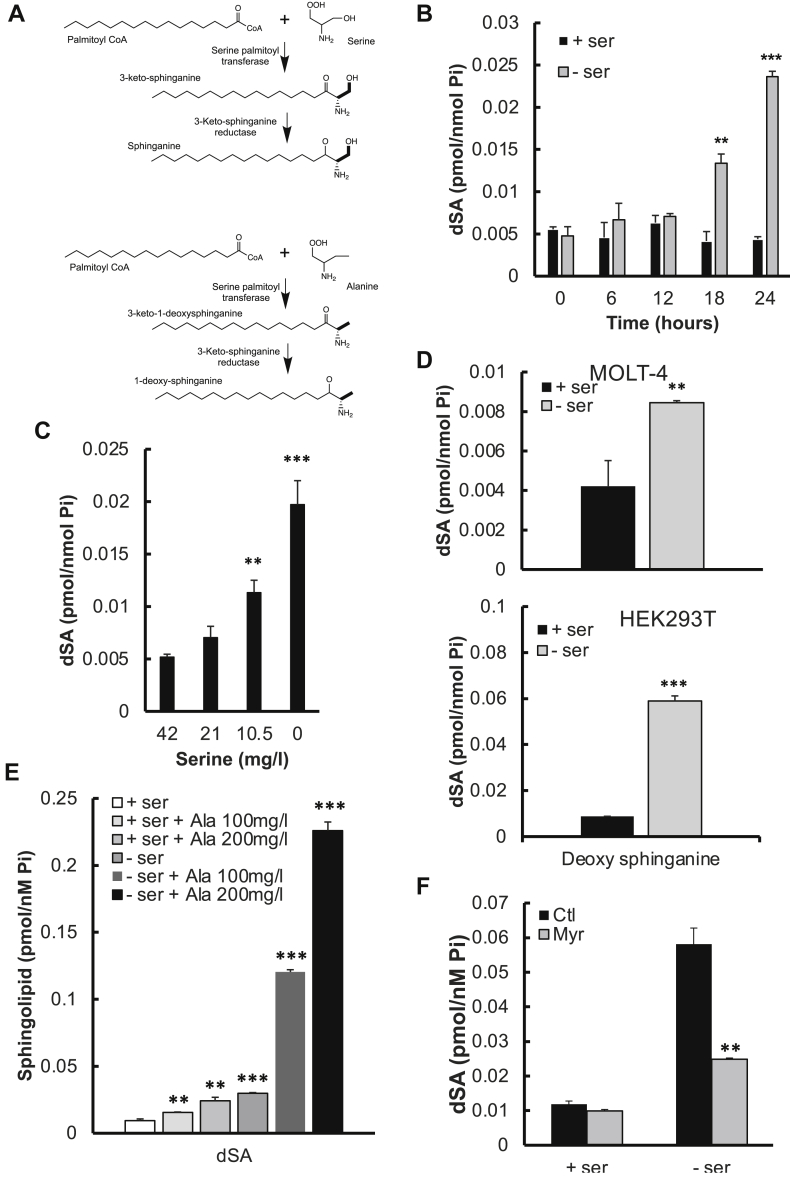
Cancer cells may depend on exogenous serine, depletion of which results in slower growth and activation of adaptive metabolic changes. We previously demonstrated that serine and glycine (SG) deprivation causes loss of sphingosine kinase 1 (SK1) in cancer cells, thereby increasing the levels of its lipid substrate, sphingosine (Sph), which mediates several adaptive biological responses. However, the signaling molecules regulating SK1 and Sph levels in response to SG deprivation have yet to be defined. Here, we identify 1-deoxysphinganine (dSA), a noncanonical sphingoid base generated in the absence of serine from the alternative condensation of alanine and palmitoyl CoA by serine palmitoyl transferase, as a proximal mediator of SG deprivation in SK1 loss and Sph level elevation upon SG deprivation in cancer cells. SG starvation increased dSA levels in vitro and in vivo and in turn induced SK1 degradation through a serine palmitoyl transferase-dependent mechanism, thereby increasing Sph levels. Addition of exogenous dSA caused a moderate increase in intracellular reactive oxygen species, which in turn decreased pyruvate kinase PKM2 activity while increasing phosphoglycerate dehydrogenase levels, and thereby promoted serine synthesis. We further showed that increased dSA induces the adaptive cellular and metabolic functions in the response of cells to decreased availability of serine likely by increasing Sph levels. Thus, we conclude that dSA functions as an initial sensor of serine loss, SK1 functions as its direct target, and Sph functions as a downstream effector of cellular and metabolic adaptations. These studies define a previously unrecognized "physiological" nontoxic function for dSA.
癌细胞可能依赖于外源性丝氨酸,其消耗会导致生长速度减慢,并激活适应性代谢变化。我们之前的研究表明,丝氨酸和甘氨酸(SG)缺乏会导致癌症细胞中鞘氨醇激酶 1(SK1)的丧失,从而增加其脂质底物鞘氨醇(Sph)的水平,从而介导几种适应性生物学反应。然而,调节 SK1 和 Sph 水平以响应 SG 缺乏的信号分子尚未确定。在这里,我们鉴定出 1-脱氧鞘氨醇(dSA),一种非典型的鞘氨醇碱基,在没有丝氨酸的情况下,由丝氨酸棕榈酰转移酶通过丙氨酸和棕榈酰辅酶 A 的替代缩合产生,作为 SG 剥夺在 SK1 丧失和 Sph 水平升高中的近端介质SG 剥夺在癌症细胞中。SG 饥饿在体外和体内增加了 dSA 水平,并通过丝氨酸棕榈酰转移酶依赖性机制反过来诱导 SK1 降解,从而增加 Sph 水平。添加外源性 dSA 会导致细胞内活性氧适度增加,从而降低丙酮酸激酶 PKM2 的活性,同时增加磷酸甘油酸脱氢酶的水平,从而促进丝氨酸合成。我们进一步表明,增加的 dSA 通过增加 Sph 水平,诱导细胞对丝氨酸可用性降低的适应性细胞和代谢功能。因此,我们得出结论,dSA 作为丝氨酸缺失的初始传感器发挥作用,SK1 作为其直接靶标,Sph 作为细胞和代谢适应的下游效应物发挥作用。这些研究定义了 dSA 的先前未被认识到的“生理”无毒功能。