Seres Gyula, Balleyer Anna, Cerutti Nicola, Friedrichsen Jana, Süer Müge
Humboldt-Universität zu Berlin, Germany.
University of Groningen, Netherlands.
J Econ Behav Organ. 2021 Dec;192:765-781. doi: 10.1016/j.jebo.2021.10.032. Epub 2021 Nov 20.
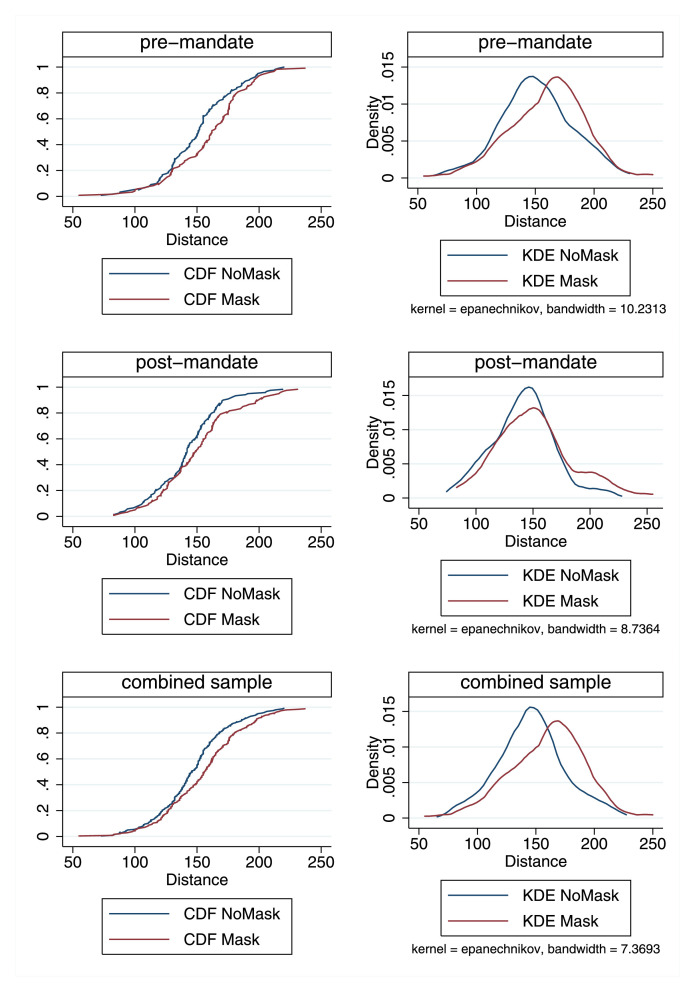
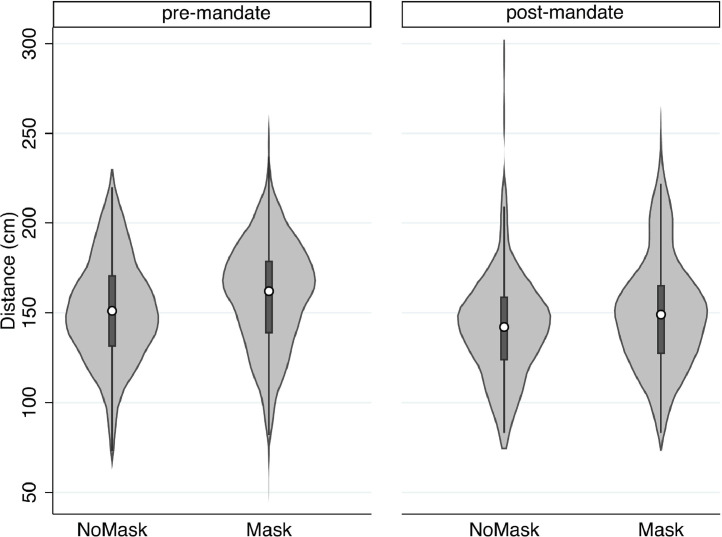
During the COVID-19 pandemic, the introduction of mandatory face mask usage triggered a heated debate. A major point of controversy is whether community use of masks creates a false sense of security that would diminish physical distancing, counteracting any potential direct benefit from masking. We conducted a randomized field experiment in Berlin, Germany, to investigate how masks affect distancing and whether the mask effect interacts with the introduction of an indoor mask mandate. Joining waiting lines in front of stores, we measured distances kept from the experimenter in two treatment conditions - the experimenter wore a mask in one and no face covering in the other - in two time spans - before and after mask use becoming mandatory in stores. We find no evidence that mandatory masking has a negative effect on distance kept toward a masked person. To the contrary, masks significantly increase distancing and the effect does not differ between the two periods. However, we show that after the mandate distances are shorter in locations where more non-essential stores, which were closed before the mandate, had reopened. We argue that the relaxations in general restrictions that coincided with the mask mandate led individuals to reduce other precautions, like keeping a safe distance.
在新冠疫情期间,强制佩戴口罩的规定引发了激烈的争论。一个主要的争议点在于,在社区中佩戴口罩是否会营造一种虚假的安全感,从而削弱保持社交距离的意识,抵消佩戴口罩可能带来的直接益处。我们在德国柏林进行了一项随机实地实验,以研究口罩如何影响社交距离,以及口罩的作用是否会与室内口罩强制令的实施产生相互作用。我们在商店前排队时,在两种处理条件下测量了与实验者保持的距离:一种条件下实验者佩戴口罩,另一种条件下实验者不戴面罩;同时设置了两个时间段——商店强制要求佩戴口罩之前和之后。我们没有发现证据表明强制佩戴口罩会对与佩戴口罩的人保持的距离产生负面影响。相反,口罩显著增加了社交距离,而且在两个时间段内这种效果并无差异。然而,我们发现,在强制令实施后,那些在强制令实施前关闭的更多非必需商店重新开业的地方,人们保持的距离更短。我们认为,与口罩强制令同时出现的总体限制的放松,导致人们减少了其他预防措施,比如保持安全距离。