Vaishnav Manas, Elhence Anshuman, Biswas Sagnik, Pathak Piysuh, Anand Abhinav, Sheikh Sabreena, Singh Vishwajeet, Maitra Souvik, Goel Amit
Department of Gastroenterology, All India Institute of Medical Sciences, New Delhi, India.
Department of Biostatistics, All India Institute of Medical Sciences, New Delhi, India.
J Clin Exp Hepatol. 2022 May-Jun;12(3):830-840. doi: 10.1016/j.jceh.2021.11.009. Epub 2021 Nov 24.
Patients with cirrhosis and coronavirus disease-2019 (COVID-19) have high in-hospital mortality. The information on the outcome of cirrhosis patients in the posthospitalization period is limited.
We aimed to study the outcome of cirrhosis patients with COVID-19 after hospital discharge.
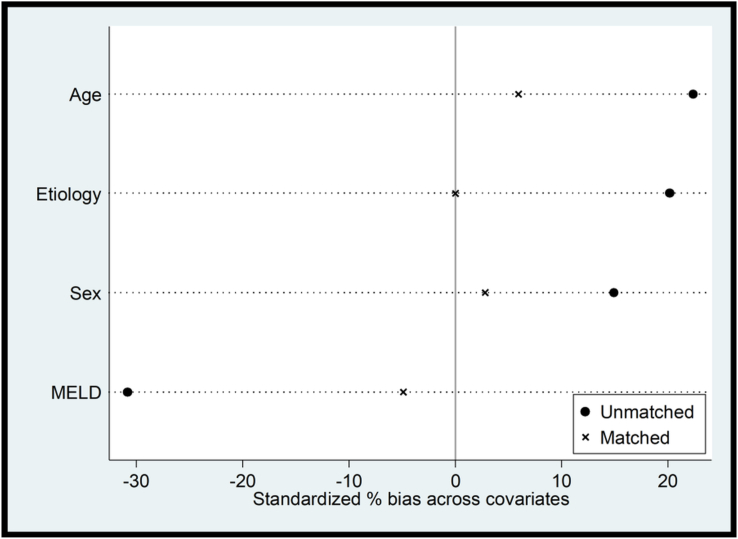
The records of the cirrhosis patients discharged after COVID-19 were reviewed. Their data were compared with a similar number of cirrhosis patients without COVID-19 after propensity score matching for age, sex, etiology of cirrhosis, and model for end-stage liver disease (MELD) score.
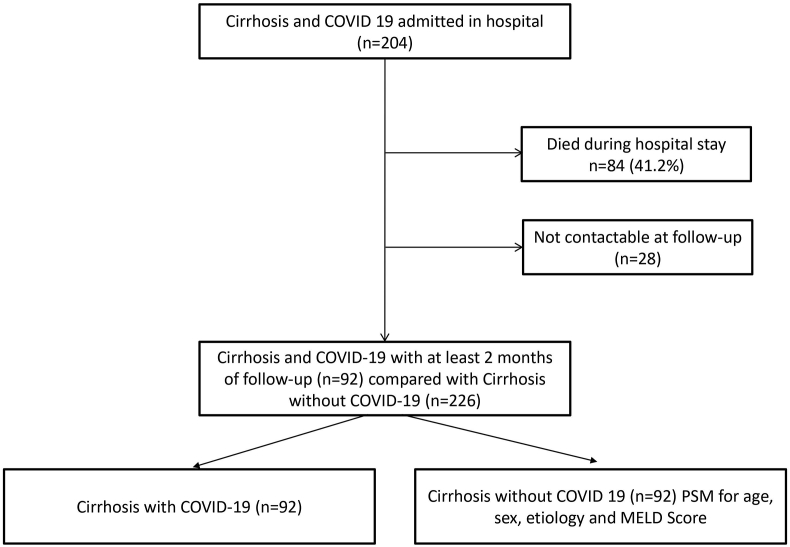
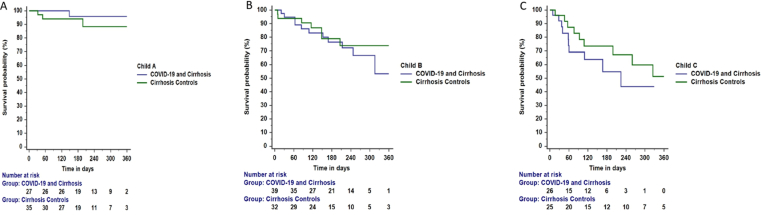
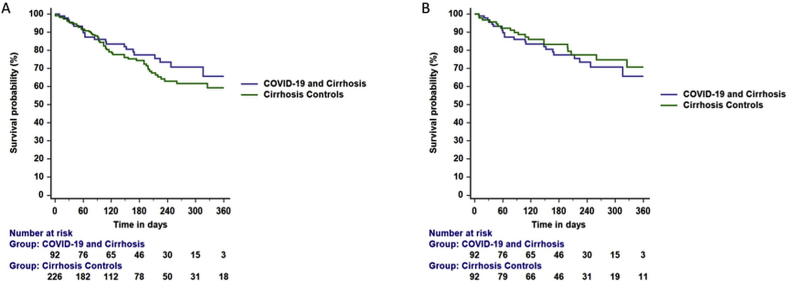
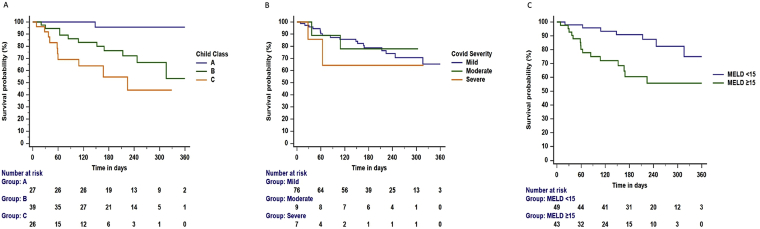
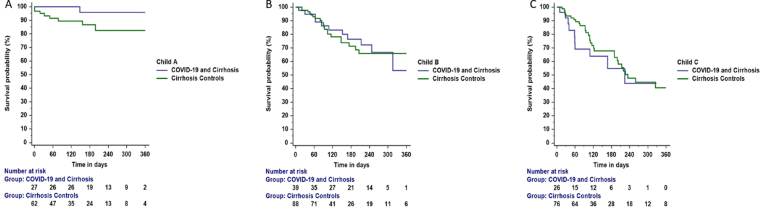
Cirrhosis patients with (n = 92) or without (n = 92) COVID-19 were included in 1:1 ratio. The mortality among COVID-19 (22; 23.9%) and non-COVID-19 (19; 20.7%) were comparable (HR 1.224; 95% CI 0.663-2.263, = 0.520), over a similar duration of follow-up [186 (86-271) vs. 183 (103-274)]. Among COVID-19 patients, 45; 48.9% developed a new acute decompensation-increased ascites (40; 43.5%), hepatic encephalopathy (20; 21.7%), or variceal bleeding (8; 8.7%) whereas 25 (27.2%) patients needed rehospitalization. A proportion of participants continued to have either fatigue/weakness (24/80; 30.0%), sleep disturbances (11/80; 13.7%), or joint pains (16/80; 20.0%). The most common causes of death in patients of both groups were end-stage liver disease: 16 (72.7%) vs. 9 (47.4%), followed by multiorgan dysfunction: 4 (18.2%) vs. 6 (31.6%), GI bleeding: 2 (9.1%) vs. 4 (21.0%), = 0.484. A lower albumin level, higher international normalized ratio, bilirubin, Child-Turcotte-Pugh, and MELD scores at discharge predicted mortality in the COVID-19 group.
Short-term outcomes of patients with cirrhosis who survive the initial insult of COVID-19 are not different from patients without COVID-19, and survival is determined by the severity of liver disease at discharge.
肝硬化合并2019冠状病毒病(COVID-19)患者的院内死亡率很高。关于肝硬化患者出院后转归的信息有限。
我们旨在研究COVID-19肝硬化患者出院后的转归。
回顾COVID-19后出院的肝硬化患者的记录。在对年龄、性别、肝硬化病因和终末期肝病模型(MELD)评分进行倾向评分匹配后,将他们的数据与相同数量的未患COVID-19的肝硬化患者进行比较。
患(n = 92)或未患(n = 92)COVID-19的肝硬化患者按1:1比例纳入。在相似的随访期内[186(86 - 271)天对183(103 - 274)天],COVID-19组(22例;23.9%)和非COVID-19组(19例;20.7%)的死亡率相当(风险比1.224;95%置信区间0.663 - 2.263,P = 0.520)。在COVID-19患者中,45例(48.9%)出现了新的急性失代偿——腹水增加(40例;43.5%)、肝性脑病(20例;21.7%)或静脉曲张出血(8例;8.7%),而25例(27.2%)患者需要再次住院。一部分参与者持续存在疲劳/虚弱(24/80;30.0%)、睡眠障碍(11/80;13.7%)或关节疼痛(16/80;20.0%)。两组患者最常见的死亡原因都是终末期肝病:分别为16例(72.7%)对9例(47.4%);其次是多器官功能障碍:分别为4例(18.2%)对6例(31.6%);消化道出血:分别为2例(9.1%)对4例(21.0%),P = 0.484。出院时较低的白蛋白水平、较高的国际标准化比值、胆红素、Child-Turcotte-Pugh评分和MELD评分可预测COVID-19组的死亡率。
在COVID-19初始感染中存活下来的肝硬化患者的短期转归与未患COVID-19的患者无异,生存率取决于出院时肝病的严重程度。