Elhence Anshuman, Vaishnav Manas, Biswas Sagnik, Anand Abhinav, Gunjan Deepak, Kedia Saurabh, Mahapatra Soumya J, Nayak Baibaswata, Sheikh Sabreena, Soni Kapil D, Trikha Anjan, Goel Amit
Department of Gastroenterology, All India Institute of Medical Sciences, New Delhi, India.
Department of Anaesthesiology, Pain Medicine and Critical Care. All India Institute of Medical Sciences, New Delhi, India.
J Clin Exp Hepatol. 2022 May-Jun;12(3):876-886. doi: 10.1016/j.jceh.2021.10.014. Epub 2021 Oct 29.
Coronavirus disease-2019 (COVID-19) cases continue to increase globally. Poor outcomes in patients with COVID-19 and cirrhosis have been reported; predictors of outcome are unclear. The existing data is from the early part of the pandemic when variants of concern (VOC) were not reported.
We aimed to assess the outcomes and predictors in patients with cirrhosis and COVID-19. We also compared the differences in outcomes between the first wave of pandemic and the second wave.
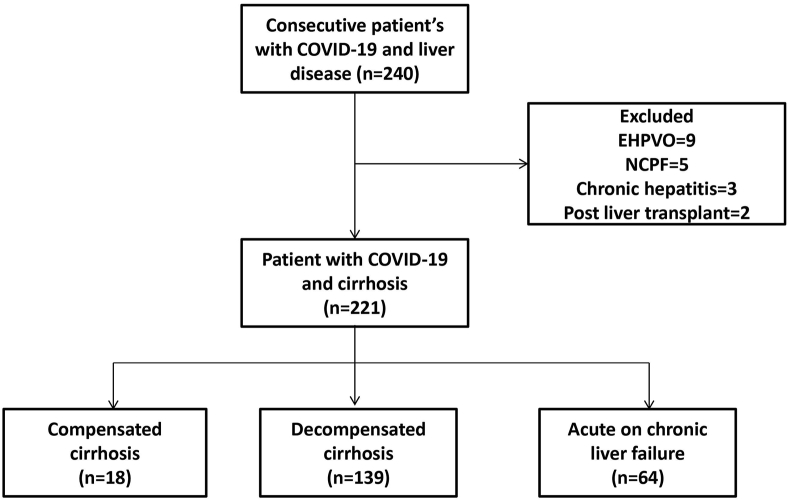
In this retrospective analysis of a prospectively maintained database, data on consecutive cirrhosis patients (n = 221) admitted to the COVID-19 care facility of a tertiary care center in India were evaluated for presentation, the severity of liver disease, the severity of COVID-19, and outcomes.
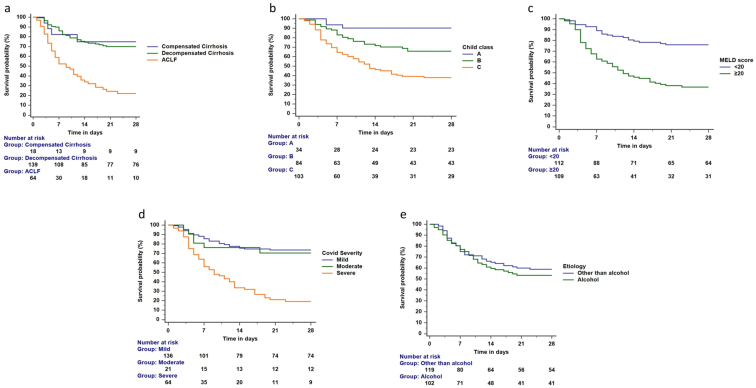
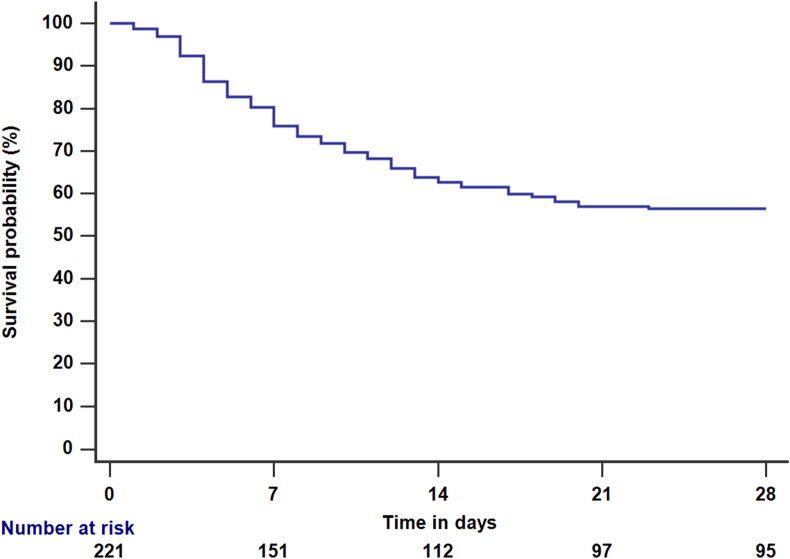
The clinical presentation included: 18 (8.1%) patients had compensated cirrhosis, 139 (62.9%) acute decompensation (AD), and 64 (29.0%) had an acute-on-chronic liver failure (ACLF). Patients with ACLF had more severe COVID-19 infection than those with compensated cirrhosis and AD (54.7% vs. 16.5% and 33.3%, < 0.001). The overall mortality was 90 (40.7%), the highest among ACLF (72.0%). On multivariate analysis, independent predictors of mortality were high leukocyte count, alkaline phosphatase, creatinine, child class, model for end-stage liver disease (MELD) score, and COVID-19 severity. The second wave had more cases of severe COVID-19 as compared to the first wave, with a similar MELD score and Child score. The overall mortality was similar between the two waves.
Patients with COVID-19 and cirrhosis have high mortality (40%), particularly those with ACLF (72%). A higher leukocyte count, creatinine, alkaline phosphatase, Child class, and MELD score are predictors of mortality.
2019冠状病毒病(COVID-19)病例在全球持续增加。有报道称COVID-19合并肝硬化患者预后较差;但预后的预测因素尚不清楚。现有数据来自疫情早期,当时尚未报告受关注的变异株(VOC)。
我们旨在评估肝硬化合并COVID-19患者的预后及预测因素。我们还比较了疫情第一波和第二波之间预后的差异。
在对一个前瞻性维护数据库的回顾性分析中,对印度一家三级医疗中心COVID-19护理机构收治的连续肝硬化患者(n = 221)的数据进行了评估,包括临床表现、肝病严重程度、COVID-19严重程度和预后。
临床表现包括:18例(8.1%)患者为代偿期肝硬化,139例(62.9%)急性失代偿(AD),64例(29.0%)为慢加急性肝衰竭(ACLF)。ACLF患者的COVID-19感染比代偿期肝硬化和AD患者更严重(54.7%对16.5%和33.3%,P<0.001)。总死亡率为90例(40.7%),其中ACLF患者死亡率最高(72.0%)。多因素分析显示,死亡率的独立预测因素为白细胞计数高、碱性磷酸酶、肌酐、Child分级、终末期肝病模型(MELD)评分和COVID-19严重程度。与第一波相比,第二波COVID-19重症病例更多,MELD评分和Child评分相似。两波的总死亡率相似。
COVID-19合并肝硬化患者死亡率高(40%),尤其是ACLF患者(72%)。白细胞计数、肌酐、碱性磷酸酶、Child分级和MELD评分升高是死亡率的预测因素。