Schimming Bruno Cesar, Martins Leandro Luis, de Oliveira Fabrício Singaretti, Pinheiro Patrícia Fernanda Felipe, Domeniconi Raquel Fantin
Departamento de Anatomia, Universidade Estadual Paulista, Botucatu, São Paulo, Brasil.
Departamento de Anatomia, Universidade Estadual de Londrina, Londrina, PR, Brasil.
Anim Reprod. 2021 Nov 4;18(3):e20210070. doi: 10.1590/1984-3143-AR2021-0070. eCollection 2021.
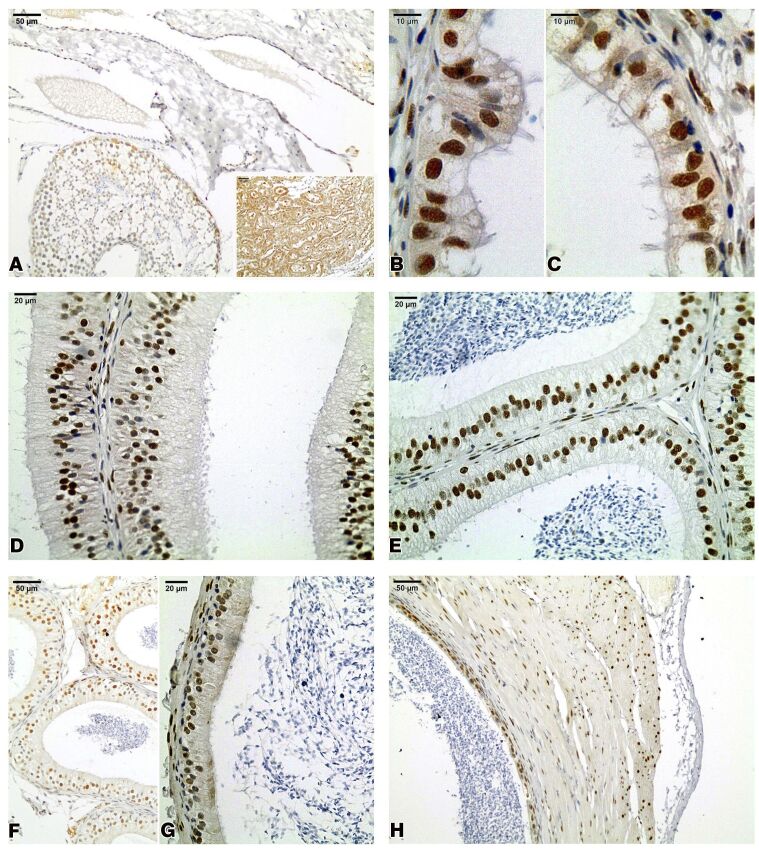
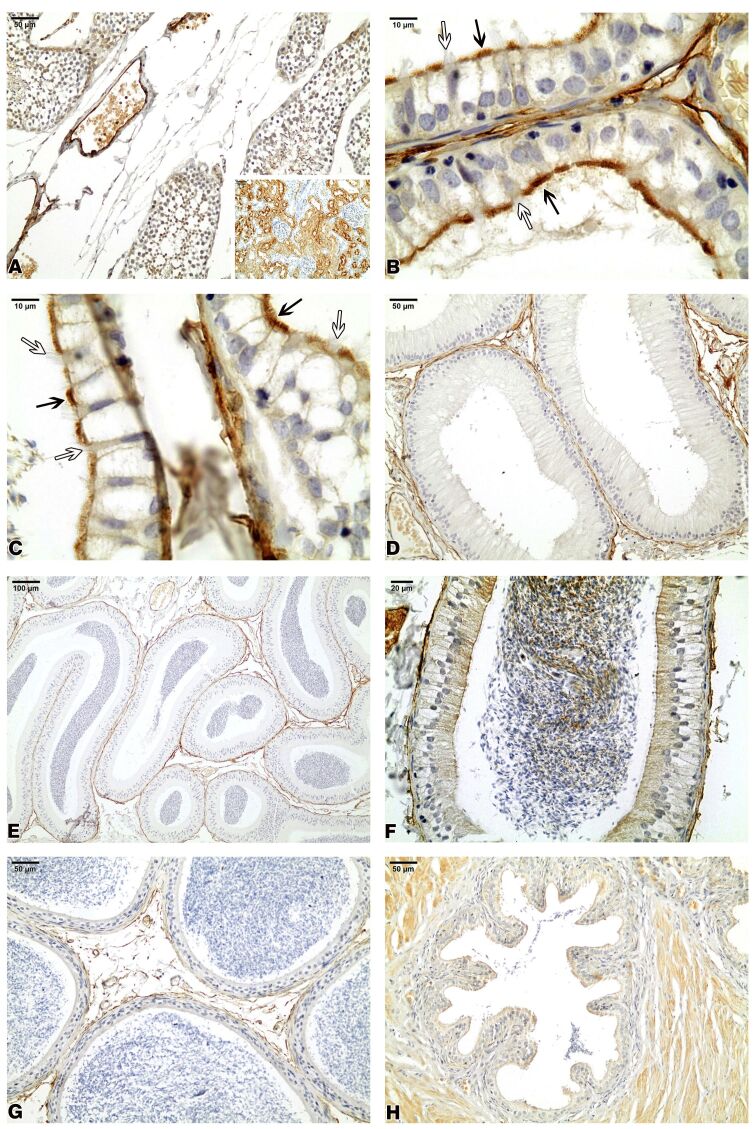
This study investigated the morphology and immunoexpression of aquaporins (AQPs) 1 and 9 in the rete testis, efferent ducts, epididymis, and vas deferens in the Azara's agouti (). For this purpose, ten adult sexually mature animals were used in histologic and immunohistochemical analyses. The Azara's agouti rete testis was labyrinthine and lined with simple cubic epithelium. Ciliated and non-ciliated cells were observed in the epithelium of the efferent ducts. The epididymal cellular population was composed of principal, basal, apical, clear, narrow, and halo cells. The epithelium lining of vas deferens was composed of the principal and basal cells. AQPs 1 and 9 were not expressed in the rete testis. Positive reaction to AQP1 was observed at the luminal border of non-ciliated cells of the efferent ducts, and in the peritubular stroma and blood vessels in the epididymis, and vas deferens. AQP9 was immunolocalized in the epithelial cells in the efferent ducts, epididymis and vas deferens. The morphology of Azara's agouti testis excurrent ducts is similar to that reported for other rodents such as . The immunolocalization results of the AQPs suggest that the expression of AQPs is species-specific due to differences in localization and expression when compared to studies in other mammals species. The knowledge about the expression of AQPs in Azara's agouti testis excurrent ducts is essential to support future reproductive studies on this animal, since previous studies show that AQPs may be biomarkers of male fertility and infertility.
本研究调查了阿扎拉刺豚鼠睾丸网、输出小管、附睾和输精管中水通道蛋白(AQPs)1和9的形态及免疫表达情况。为此,选用了10只成年性成熟动物进行组织学和免疫组织化学分析。阿扎拉刺豚鼠的睾丸网呈迷宫状,内衬单层立方上皮。在输出小管的上皮中观察到了纤毛细胞和非纤毛细胞。附睾细胞群由主细胞、基底细胞、顶细胞、透明细胞、窄细胞和晕细胞组成。输精管的内衬上皮由主细胞和基底细胞组成。AQPs 1和9在睾丸网中未表达。在输出小管非纤毛细胞的管腔边界、附睾和输精管的管周基质及血管中观察到了对AQP1的阳性反应。AQP9免疫定位在输出小管、附睾和输精管的上皮细胞中。阿扎拉刺豚鼠睾丸输出小管的形态与其他啮齿动物(如……)报道的相似。AQPs的免疫定位结果表明,与其他哺乳动物物种的研究相比,由于定位和表达的差异,AQPs的表达具有物种特异性。了解AQPs在阿扎拉刺豚鼠睾丸输出小管中的表达情况对于支持该动物未来的生殖研究至关重要,因为先前的研究表明AQPs可能是男性生育力和不育症的生物标志物。