Adams Jamie L, Dinesh Karthik, Snyder Christopher W, Xiong Mulin, Tarolli Christopher G, Sharma Saloni, Dorsey E Ray, Sharma Gaurav
Department of Neurology, University of Rochester Medical Center, Rochester, NY, USA.
Center for Health + Technology, University of Rochester Medical Center, Rochester, NY, USA.
NPJ Parkinsons Dis. 2021 Nov 29;7(1):106. doi: 10.1038/s41531-021-00248-w.
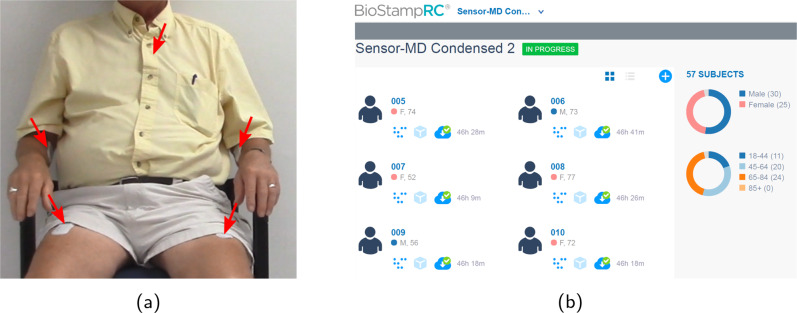
Most wearable sensor studies in Parkinson's disease have been conducted in the clinic and thus may not be a true representation of everyday symptoms and symptom variation. Our goal was to measure activity, gait, and tremor using wearable sensors inside and outside the clinic. In this observational study, we assessed motor features using wearable sensors developed by MC10, Inc. Participants wore five sensors, one on each limb and on the trunk, during an in-person clinic visit and for two days thereafter. Using the accelerometer data from the sensors, activity states (lying, sitting, standing, walking) were determined and steps per day were also computed by aggregating over 2 s walking intervals. For non-walking periods, tremor durations were identified that had a characteristic frequency between 3 and 10 Hz. We analyzed data from 17 individuals with Parkinson's disease and 17 age-matched controls over an average 45.4 h of sensor wear. Individuals with Parkinson's walked significantly less (median [inter-quartile range]: 4980 [2835-7163] steps/day) than controls (7367 [5106-8928] steps/day; P = 0.04). Tremor was present for 1.6 [0.4-5.9] hours (median [range]) per day in most-affected hands (MDS-UPDRS 3.17a or 3.17b = 1-4) of individuals with Parkinson's, which was significantly higher than the 0.5 [0.3-2.3] hours per day in less-affected hands (MDS-UPDRS 3.17a or 3.17b = 0). These results, which require replication in larger cohorts, advance our understanding of the manifestations of Parkinson's in real-world settings.
大多数关于帕金森病的可穿戴传感器研究都是在诊所进行的,因此可能无法真实反映日常症状及症状变化。我们的目标是使用可穿戴传感器在诊所内外测量活动、步态和震颤。在这项观察性研究中,我们使用MC10公司开发的可穿戴传感器评估运动特征。参与者在门诊就诊时以及之后的两天内佩戴五个传感器,每个肢体和躯干各一个。利用传感器的加速度计数据确定活动状态(躺、坐、站、行走),并通过汇总2秒的行走间隔来计算每日步数。对于非行走时段,识别出特征频率在3至10赫兹之间的震颤持续时间。我们分析了17名帕金森病患者和17名年龄匹配的对照者平均45.4小时的传感器佩戴数据。帕金森病患者的行走步数明显少于对照组(中位数[四分位间距]:4980[2835 - 7163]步/天),而对照组为7367[5106 - 8928]步/天;P = 0.04)。帕金森病患者受影响最严重的手(MDS - UPDRS 3.17a或3.17b = 1 - 4)每天震颤时间为1.6[0.4 - 5.9]小时(中位数[范围]),显著高于受影响较轻的手(MDS - UPDRS 3.17a或3.17b = 0)每天0.5[0.3 - 2.3]小时的震颤时间。这些结果需要在更大的队列中进行重复验证,有助于我们进一步了解帕金森病在现实环境中的表现。