UOC Neurologia - Dipartimento Scienze dell'Invecchiamento, Neurologiche, Ortopediche e della Testa-Collo, Fondazione Policlinico Universitario A. Gemelli IRCCS, Rome, Italy.
Department of Computer Science, University of Verona, Strada Le Grazie 15, 37134, Verona, Italy.
Sci Rep. 2021 Nov 29;11(1):23097. doi: 10.1038/s41598-021-02458-x.
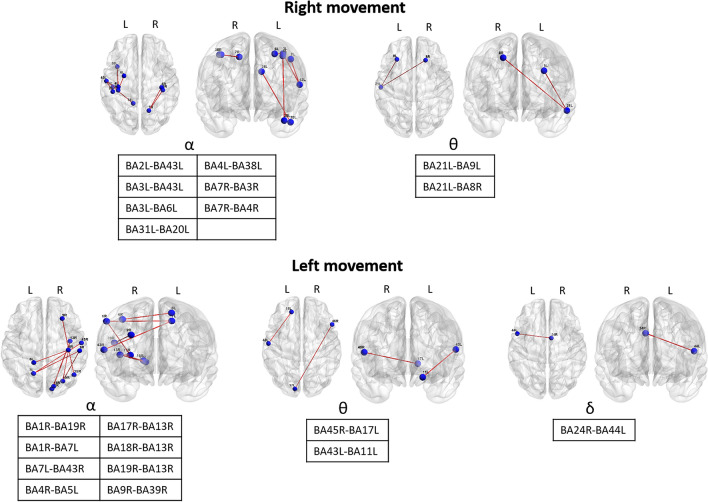
Reach&grasp requires highly coordinated activation of different brain areas. We investigated whether reach&grasp kinematics is associated to EEG-based networks changes. We enrolled 10 healthy subjects. We analyzed the reach&grasp kinematics of 15 reach&grasp movements performed with each upper limb. Simultaneously, we obtained a 64-channel EEG, synchronized with the reach&grasp movement time points. We elaborated EEG signals with EEGLAB 12 in order to obtain event related synchronization/desynchronization (ERS/ERD) and lagged linear coherence between Brodmann areas. Finally, we evaluated network topology via sLORETA software, measuring network local and global efficiency (clustering and path length) and the overall balance (small-worldness). We observed a widespread ERD in α and β bands during reach&grasp, especially in the centro-parietal regions of the hemisphere contralateral to the movement. Regarding functional connectivity, we observed an α lagged linear coherence reduction among Brodmann areas contralateral to the arm involved in the reach&grasp movement. Interestingly, left arm movement determined widespread changes of α lagged linear coherence, specifically among right occipital regions, insular cortex and somatosensory cortex, while the right arm movement exerted a restricted contralateral sensory-motor cortex modulation. Finally, no change between rest and movement was found for clustering, path length and small-worldness. Through a synchronized acquisition, we explored the cortical correlates of the reach&grasp movement. Despite EEG perturbations, suggesting that the non-dominant reach&grasp network has a complex architecture probably linked to the necessity of a higher visual control, the pivotal topological measures of network local and global efficiency remained unaffected.
伸手抓握需要不同脑区的高度协调激活。我们研究了伸手抓握运动学是否与基于 EEG 的网络变化有关。我们招募了 10 名健康受试者。我们分析了 15 次使用每个上肢进行的伸手抓握运动的伸手抓握运动学。同时,我们获得了与伸手抓握运动时间点同步的 64 通道 EEG。我们使用 EEGLAB 12 对 EEG 信号进行了分析,以获得事件相关同步/去同步(ERS/ERD)和 Brodmann 区域之间的滞后线性相干性。最后,我们通过 sLORETA 软件评估了网络拓扑结构,测量了网络的局部和全局效率(聚类和路径长度)以及整体平衡(小世界性)。我们观察到在伸手抓握过程中 α 和 β 波段广泛的 ERD,尤其是在与运动相对侧的半球的中央 - 顶叶区域。关于功能连接,我们观察到在涉及伸手抓握运动的手臂对侧的 Brodmann 区域之间的α滞后线性相干性降低。有趣的是,左手臂运动导致广泛的α滞后线性相干性变化,特别是在右侧枕叶区域、岛叶和躯体感觉皮层,而右手臂运动仅对感觉运动皮层产生了局部的对侧调制。最后,在聚类、路径长度和小世界性方面,休息和运动之间没有发现变化。通过同步采集,我们探索了伸手抓握运动的皮质相关性。尽管 EEG 存在干扰,表明非主导的伸手抓握网络具有复杂的结构,可能与更高视觉控制的必要性有关,但网络局部和全局效率的关键拓扑度量仍然不受影响。