Department of Statistics, College of Natural and Computational Science, Mizan-Tepi University, Tepi, Ethiopia.
BMC Infect Dis. 2021 Nov 30;21(1):1203. doi: 10.1186/s12879-021-06864-4.
In low- and middle-income nations, acute respiratory infection (ARI) is the primary cause of morbidity and mortality. According to some studies, Ethiopia has a higher prevalence of childhood acute respiratory infection, ranging from 16 to 33.5%. The goal of this study was to determine the risk factors for acute respiratory infection in children under the age of five in rural Ethiopia.
A cross-sectional study involving 7911 children under the age of five from rural Ethiopia was carried out from January 18 to June 27, 2016. A two stage cluster sampling technique was used recruit study subjects and SPSS version 20 was used to extract and analyze data. A binary logistic regression model was used to identify factors associated with a childhood acute respiratory infection. The multivariable logistic regression analysis includes variables with a p-value less than 0.2 during the bivariate logistic regression analysis. Adjusted odds ratios were used as measures of effect with a 95% confidence interval (CI) and variables with a p-value less than 0.05 were considered as significantly associated with an acute respiratory infection.
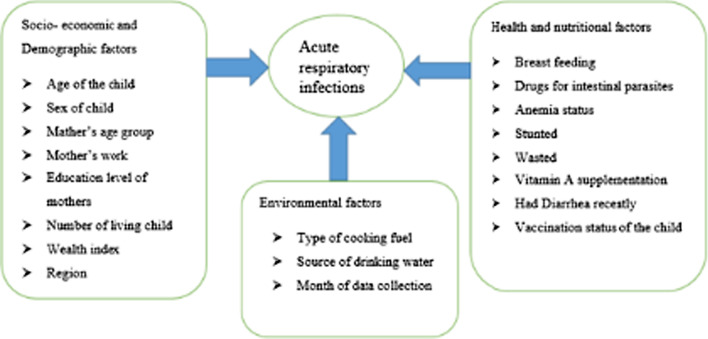
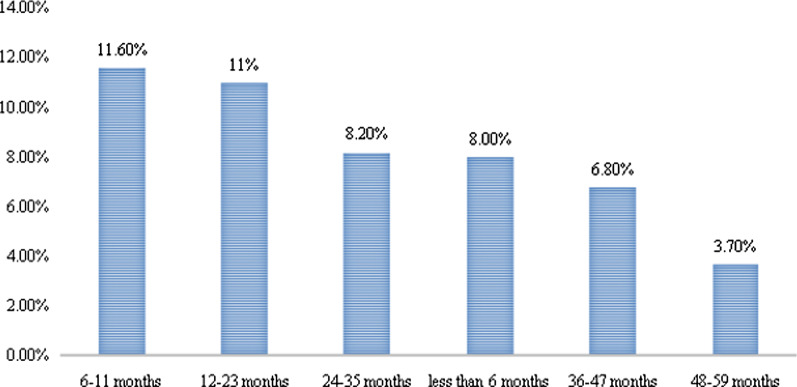
The total ARI prevalence rate among 7911 under-five children from rural Ethiopia was 7.8%, according to the findings of the study. The highest prevalence of ARI was found in Oromia (12.8%), followed by Tigray (12.7%), with the lowest frequency found in Benishangul Gumuz (2.4%). A multivariable logistic regression model revealed that child from Poor household (AOR = 2.170, 95% CI: 1.631-2.887), mother's no education (AOR = 2.050,95% CI: 1.017-4.133), mother's Primary education (AOR = 2.387, 95% CI:1.176-4.845), child had not received vitamin A (AOR = 1.926, 95% CI:1.578-2.351), child had no diarrhea (AOR = 0.257, 95% CI: 0.210-0.314), mothers not working (AOR = 0.773, 95% CI:0.630-0.948), not stunted (AOR = 0.663, 95% CI: 0.552-0.796), and not improved water source (AOR = 1.715, 95% CI: 1.395-2.109). Similarly, among under-five children, the age of the child, the month of data collection, anemia status, and the province were all substantially linked to ARI.
Childhood ARI morbidity is a serious health challenge in rural Ethiopia, according to this study, with demographic, socioeconomic, nutritional, health, and environmental factors all having a role. As a result, regional governments, healthcare staff, and concerned groups should place a priority on reducing ARI, and attempts to solve the issue should take these variables into account.
在中低收入国家,急性呼吸道感染(ARI)是导致发病和死亡的主要原因。根据一些研究,埃塞俄比亚儿童急性呼吸道感染的患病率较高,范围在 16%至 33.5%之间。本研究旨在确定埃塞俄比亚农村地区 5 岁以下儿童急性呼吸道感染的危险因素。
2016 年 1 月 18 日至 6 月 27 日,在埃塞俄比亚农村地区进行了一项涉及 7911 名 5 岁以下儿童的横断面研究。采用两阶段聚类抽样技术招募研究对象,使用 SPSS 版本 20 提取和分析数据。采用二元逻辑回归模型确定与儿童急性呼吸道感染相关的因素。多变量逻辑回归分析包括在双变量逻辑回归分析中 p 值小于 0.2 的变量。使用调整后的优势比作为效应的度量,95%置信区间(CI)和 p 值小于 0.05 的变量被认为与急性呼吸道感染显著相关。
根据研究结果,来自埃塞俄比亚农村地区的 7911 名 5 岁以下儿童的总 ARI 患病率为 7.8%。ARI 的最高患病率出现在奥罗莫(12.8%),其次是提格雷(12.7%),而在本尚古勒-古马兹(Benishangul Gumuz)地区患病率最低(2.4%)。多变量逻辑回归模型显示,来自贫困家庭的儿童(AOR=2.170,95%CI:1.631-2.887)、母亲未接受教育(AOR=2.050,95%CI:1.017-4.133)、母亲接受小学教育(AOR=2.387,95%CI:1.176-4.845)、儿童未接受维生素 A 补充(AOR=1.926,95%CI:1.578-2.351)、儿童无腹泻(AOR=0.257,95%CI:0.210-0.314)、母亲不工作(AOR=0.773,95%CI:0.630-0.948)、未发育迟缓(AOR=0.663,95%CI:0.552-0.796)和未改善水源(AOR=1.715,95%CI:1.395-2.109)的儿童。同样,在 5 岁以下儿童中,儿童年龄、数据收集月份、贫血状况和省份与 ARI 均有显著关联。
根据本研究,急性呼吸道感染在埃塞俄比亚农村地区是一个严重的健康挑战,人口统计学、社会经济、营养、健康和环境因素都有一定的作用。因此,地区政府、医疗保健人员和有关团体应优先考虑减少急性呼吸道感染,解决这一问题的努力应考虑到这些变量。