Department of Endocrinology and Metabolism, Affiliated Hospital of Guizhou Medical University, No. 28 Guiyi Road, Yunyan District, Guiyang, 550001, China.
Department of Endocrinology and Metabolism, Guizhou Provincial People's Hospital, Guiyang, 550001, China.
BMC Cardiovasc Disord. 2021 Nov 30;21(1):570. doi: 10.1186/s12872-021-02380-0.
Irisin is a novel myokine associated with obesity, which is a traditional cardiovascular risk factor (CVRF). The present study aimed to investigate the association between serum irisin and a single CVRF as well as the clustering of CVRFs among Chinese overweight/obese population.
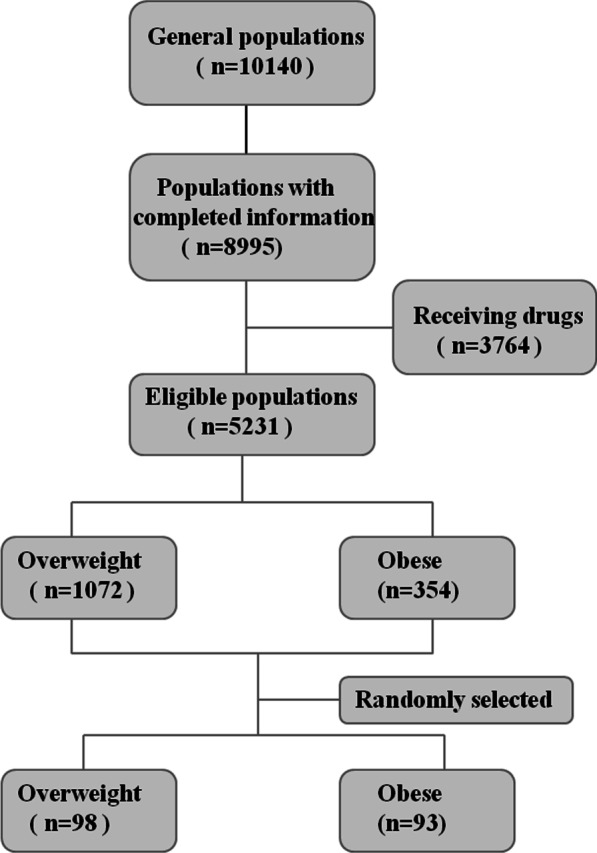
A total of 98 overweight and 93 obese subjects without clinical treatments were enrolled in this study. Subjects were then divided into two groups, based on the serum irisin level: a low irisin group (1.10-13.44 ng/ml) and a high irisin group (13.49-29.9 ng/ml). The clustering of CVRFs, smoking, diabetes mellitus, dyslipidemia and hypertension, was classified as 0, 1, 2 and ≥ 3 CVRFs. The demographic and baseline clinical characteristics of all participants were collected and serum irisin was measured.
The high serum irisin group had significantly higher high-density lipoprotein cholesterol but lower fasting plasma glucose than the low serum irisin group. Additionally, the high serum irisin group had a significantly lower prevalence of smoking, diabetes mellitus and dyslipidemia than the low serum irisin group. Increased serum irisin was significantly associated with a reduced risk of smoking and dyslipidemia in both the unadjusted and adjusted models. Furthermore, high serum irisin significantly reduced the risk of the prevalence of 1, 2 and ≥ 3 CVRFs.
among the Chinese overweight/obese populations, high serum irisin is negatively associated with smoking, dyslipidemia and the clustering of CVRFs. Thus, high serum irisin is potentially associated with a low risk of cardiovascular diseases in the Chinese overweight/obese population.
鸢尾素是一种与肥胖相关的新型肌因子,而肥胖是心血管疾病的传统风险因素(CVRF)之一。本研究旨在探讨血清鸢尾素与单一 CVRF 之间的关系,以及中国超重/肥胖人群中 CVRF 的聚类情况。
本研究共纳入 98 名超重和 93 名肥胖患者,这些患者均未接受临床治疗。然后,根据血清鸢尾素水平将患者分为低鸢尾素组(1.10-13.44ng/ml)和高鸢尾素组(13.49-29.9ng/ml)。将吸烟、糖尿病、血脂异常和高血压这 4 种 CVRF 的聚类情况定义为 0、1、2 和≥3 个 CVRF。收集所有参与者的人口统计学和基线临床特征,并测量血清鸢尾素。
高血清鸢尾素组的高密度脂蛋白胆固醇显著高于低血清鸢尾素组,而空腹血糖显著低于低血清鸢尾素组。此外,与低血清鸢尾素组相比,高血清鸢尾素组的吸烟、糖尿病和血脂异常发生率显著更低。在未调整和调整模型中,较高的血清鸢尾素水平与降低吸烟和血脂异常的风险显著相关。此外,高血清鸢尾素水平还显著降低了 1、2 和≥3 个 CVRF 发生率的风险。
在超重/肥胖的中国人群中,高血清鸢尾素与吸烟、血脂异常和 CVRF 的聚类呈负相关。因此,高血清鸢尾素可能与中国超重/肥胖人群患心血管疾病的风险较低有关。