Mayo-Wilson Evan, Phillips Meredith L, Connor Avonne E, Vander Ley Kelly J, Naaman Kevin, Helfand Mark
Department of Epidemiology and Biostatistics, Indiana University School of Public Health-Bloomington, 1025 E. 7th Street, PH 179D, Bloomington, Indiana, 47405, USA.
Department of Epidemiology, Johns Hopkins Bloomberg School of Public Health, Baltimore, MD, USA.
Res Integr Peer Rev. 2021 Dec 1;6(1):16. doi: 10.1186/s41073-021-00119-1.
The Patient-Centered Outcomes Research Institute (PCORI) is obligated to peer review and to post publicly "Final Research Reports" of all funded projects. PCORI peer review emphasizes adherence to PCORI's Methodology Standards and principles of ethical scientific communication. During the peer review process, reviewers and editors seek to ensure that results are presented objectively and interpreted appropriately, e.g., free of spin.
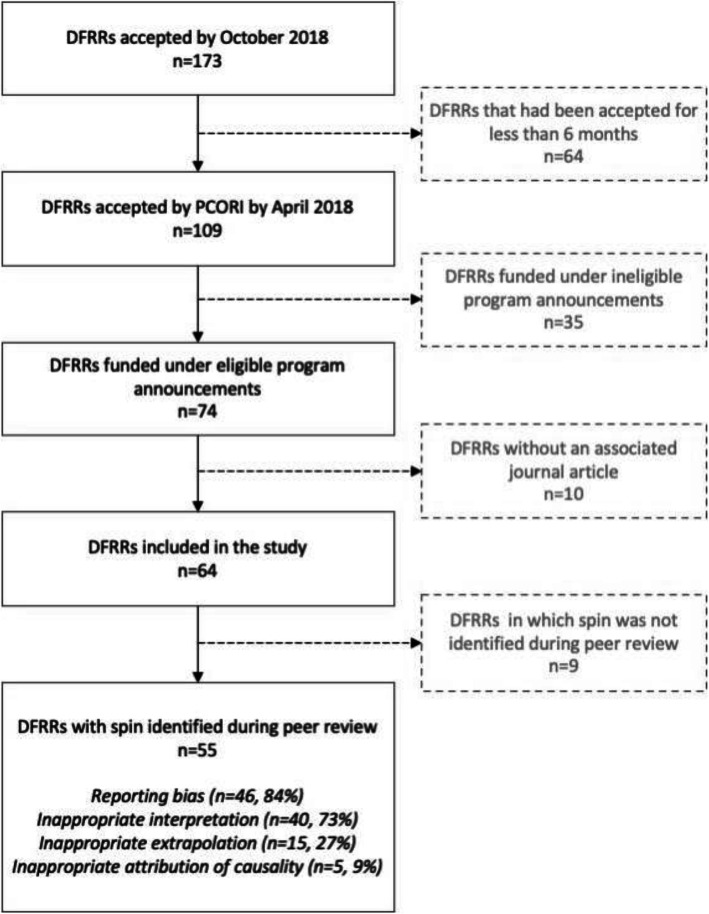
Two independent raters assessed PCORI peer review feedback sent to authors. We calculated the proportion of reports in which spin was identified during peer review, and the types of spin identified. We included reports submitted by April 2018 with at least one associated journal article. The same raters then assessed whether authors addressed reviewers' comments about spin. The raters also assessed whether spin identified during PCORI peer review was present in related journal articles.
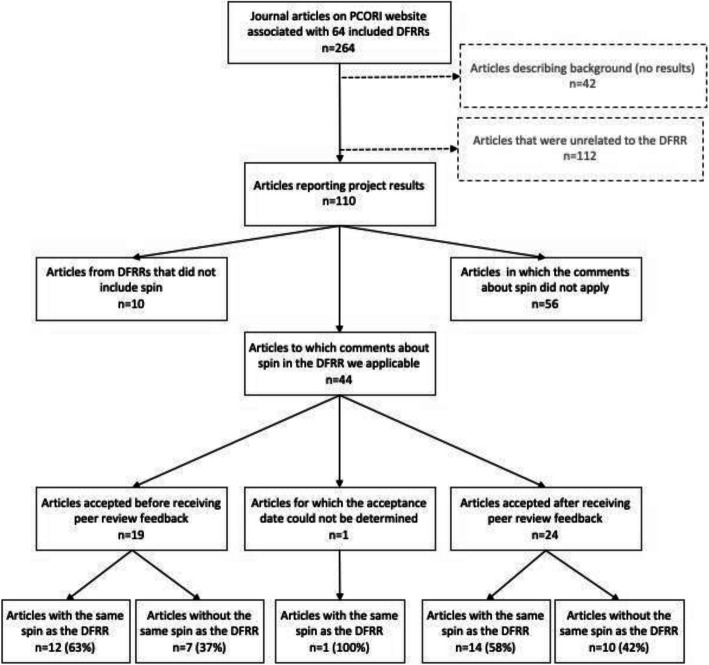
We included 64 PCORI-funded projects. Peer reviewers or editors identified spin in 55/64 (86%) submitted research reports. Types of spin included reporting bias (46/55; 84%), inappropriate interpretation (40/55; 73%), inappropriate extrapolation of results (15/55; 27%), and inappropriate attribution of causality (5/55; 9%). Authors addressed comments about spin related to 47/55 (85%) of the reports. Of 110 associated journal articles, PCORI comments about spin were potentially applicable to 44/110 (40%) articles, of which 27/44 (61%) contained the same spin that was identified in the PCORI research report. The proportion of articles with spin was similar for articles accepted before and after PCORI peer review (63% vs 58%).
Just as spin is common in journal articles and press releases, we found that most reports submitted to PCORI included spin. While most spin was mitigated during the funder's peer review process, we found no evidence that review of PCORI reports influenced spin in journal articles. Funders could explore interventions aimed at reducing spin in published articles of studies they support.
以患者为中心的结果研究机构(PCORI)有义务对所有资助项目进行同行评审并公开“最终研究报告”。PCORI同行评审强调遵守PCORI的方法标准和道德科学交流原则。在同行评审过程中,评审人员和编辑力求确保结果得到客观呈现和恰当解读,例如避免夸大。
两名独立评估人员评估了发送给作者的PCORI同行评审反馈。我们计算了在同行评审期间发现存在夸大情况的报告比例以及所发现的夸大类型。我们纳入了截至2018年4月提交的、至少有一篇相关期刊文章的报告。然后,同样的评估人员评估作者是否回应了评审人员关于夸大的评论。评估人员还评估了在PCORI同行评审期间发现的夸大情况是否存在于相关期刊文章中。
我们纳入了64个由PCORI资助的项目。同行评审人员或编辑在55/64(86%)份提交的研究报告中发现了夸大情况。夸大类型包括报告偏倚(46/55;84%)、不当解读(40/55;73%)、结果的不当外推(15/55;27%)以及因果关系的不当归因(5/55;9%)。作者回应了与47/55(85%)份报告相关的关于夸大的评论。在110篇相关期刊文章中,PCORI关于夸大的评论可能适用于44/110(40%)篇文章,其中27/44(61%)篇文章包含了在PCORI研究报告中所发现同样的夸大情况。在PCORI同行评审之前和之后被接受的文章中,存在夸大情况的文章比例相似(63%对58%)。
正如夸大在期刊文章和新闻稿中很常见一样,我们发现提交给PCORI的大多数报告都存在夸大情况。虽然在资助者的同行评审过程中,大多数夸大情况得到了缓解,但我们没有发现证据表明对PCORI报告的评审会影响期刊文章中的夸大情况。资助者可以探索旨在减少其支持的研究在已发表文章中夸大情况的干预措施。