Service de Médecine Intensive Réanimation, Centre Hospitalier Universitaire Hôtel-Dieu, 30 Bd. Jean Monnet, 44093, Nantes Cedex 1, France.
Médecine Intensive Réanimation, Hôpital Henri Mondor, Assistance Publique des Hôpitaux de Paris, Créteil, France.
Sci Rep. 2021 Nov 30;11(1):23132. doi: 10.1038/s41598-021-02437-2.
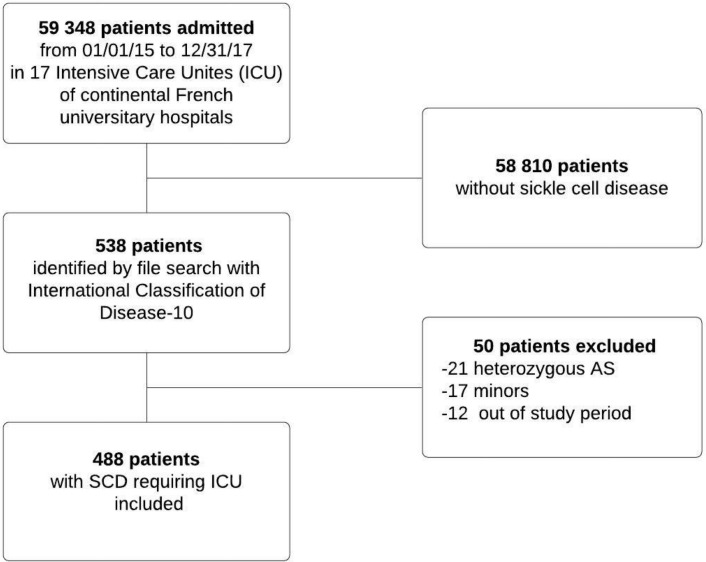
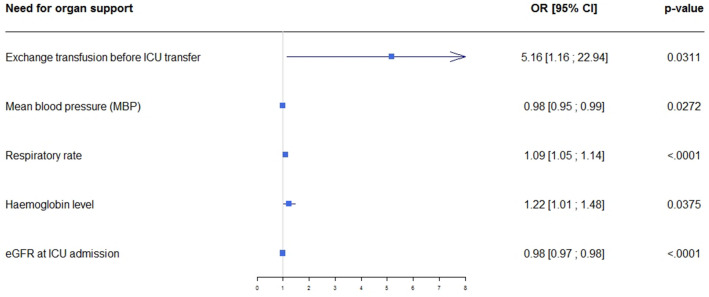
Little is known about patients with sickle cell disease (SCD) who require intensive care unit (ICU) admission. The goals of this study were to assess outcomes in patients admitted to the ICU for acute complications of SCD and to identify factors associated with adverse outcomes. This multicenter retrospective study included consecutive adults with SCD admitted to one of 17 participating ICUs. An adverse outcome was defined as death or a need for life-sustaining therapies (non-invasive or invasive ventilation, vasoactive drugs, renal replacement therapy, and/or extracorporeal membrane oxygenation). Factors associated with adverse outcomes were identified by mixed multivariable logistic regression. We included 488 patients admitted in 2015-2017. The main reasons for ICU admission were acute chest syndrome (47.5%) and severely painful vaso-occlusive event (21.3%). Sixteen (3.3%) patients died in the ICU, mainly of multi-organ failure following a painful vaso-occlusive event or sepsis. An adverse outcome occurred in 81 (16.6%; 95% confidence interval [95% CI], 13.3%-19.9%) patients. Independent factors associated with adverse outcomes were low mean arterial blood pressure (adjusted odds ratio [aOR], 0.98; 95% CI 0.95-0.99; p = 0.027), faster respiratory rate (aOR, 1.09; 95% CI 1.05-1.14; p < 0.0001), higher haemoglobin level (aOR, 1.22; 95% CI 1.01-1.48; p = 0.038), impaired creatinine clearance at ICU admission (aOR, 0.98; 95% CI 0.97-0.98; p < 0.0001), and red blood cell exchange before ICU admission (aOR, 5.16; 95% CI 1.16-22.94; p = 0.031). Patients with SCD have a substantial risk of adverse outcomes if they require ICU admission. Early ICU admission should be encouraged in patients who develop abnormal physiological parameters.
目前对于需要入住重症监护病房(ICU)的镰状细胞病(SCD)患者知之甚少。本研究的目的是评估因 SCD 急性并发症而入住 ICU 的患者的结局,并确定与不良结局相关的因素。这项多中心回顾性研究纳入了在 17 个参与 ICU 中的 1 个连续入住的成人 SCD 患者。不良结局定义为死亡或需要生命支持治疗(无创或有创通气、血管活性药物、肾脏替代治疗和/或体外膜氧合)。通过混合多变量逻辑回归确定与不良结局相关的因素。我们纳入了 2015 年至 2017 年期间入住的 488 例患者。入住 ICU 的主要原因是急性胸部综合征(47.5%)和严重疼痛性血管阻塞事件(21.3%)。16 例(3.3%)患者在 ICU 死亡,主要死于疼痛性血管阻塞事件或脓毒症后的多器官衰竭。81 例(16.6%;95%置信区间 [95%CI],13.3%-19.9%)患者发生不良结局。与不良结局相关的独立因素是平均动脉血压较低(调整后的优势比 [aOR],0.98;95%CI 0.95-0.99;p=0.027)、呼吸频率较快(aOR,1.09;95%CI 1.05-1.14;p<0.0001)、血红蛋白水平较高(aOR,1.22;95%CI 1.01-1.48;p=0.038)、入住 ICU 时肌酐清除率受损(aOR,0.98;95%CI 0.97-0.98;p<0.0001)和入住 ICU 前红细胞交换(aOR,5.16;95%CI 1.16-22.94;p=0.031)。如果需要入住 ICU,SCD 患者发生不良结局的风险很大。应鼓励出现异常生理参数的患者尽早入住 ICU。