Department of Vascular Medicine, Amsterdam UMC, University of Amsterdam, Meibergdreef 9, 1105 AZ, Amsterdam, The Netherlands.
Department of Cardiology, Amsterdam UMC, Vrije Universiteit Amsterdam, Boelelaan 1117, 1081 HV, Amsterdam, TheNetherlands.
Cardiovasc Res. 2022 Nov 10;118(14):2919-2931. doi: 10.1093/cvr/cvab350.
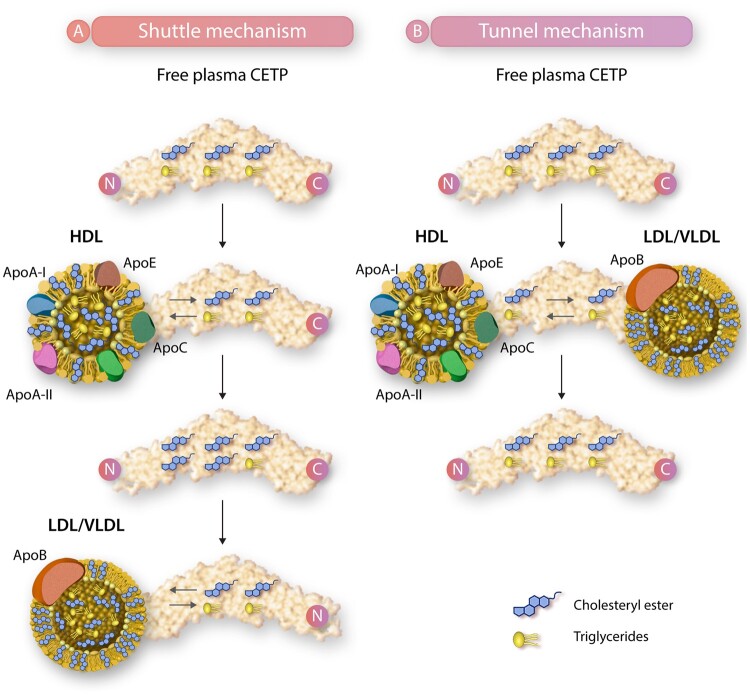
Cholesteryl ester transfer protein (CETP) is a liver-synthesized glycoprotein whose main functions are facilitating transfer of both cholesteryl esters from high-density lipoprotein (HDL) particles to apolipoprotein B (apoB)-containing particles as well as transfer of triglycerides from apoB-containing particles to HDL particles. Novel crystallographic data have shown that CETP exchanges lipids in the circulation by a dual molecular mechanism. Recently, it has been suggested that the atherosclerotic cardiovascular disease (ASCVD) benefit from CETP inhibition is the consequence of the achieved low-density lipoprotein cholesterol (LDL-C) and apoB reduction, rather than through the HDL cholesterol (HDL-C) increase. The use of CETP inhibitors is supported by genetic evidence from Mendelian randomization studies, showing that LDL-C lowering by CETP gene variants achieves equal ASCVD risk reduction as LDL-C lowering through gene proxies for statins, ezetimibe, and proprotein convertase subtilisin-kexin Type 9 inhibitors. Although first-generation CETP inhibitors (torcetrapib, dalcetrapib) were mainly raising HDL-C or had off-target effects, next generation CETP inhibitors (anacetrapib, evacetrapib) were also effective in reducing LDL-C and apoB and have been proven safe. Anacetrapib was the first CETP inhibitor to be proven effective in reducing ASCVD risk. In addition, CETP inhibitors have been shown to lower the risk of new-onset diabetes, improve glucose tolerance, and insulin sensitivity. The newest-generation CETP inhibitor obicetrapib, specifically designed to lower LDL-C and apoB, has achieved significant reductions of LDL-C up to 45%. Obicetrapib, about to enter phase III development, could become the first CETP inhibitor as add-on therapy for patients not reaching their guideline LDL-C targets.
胆固醇酯转移蛋白(CETP)是一种肝脏合成的糖蛋白,其主要功能是促进富含胆固醇的酯从高密度脂蛋白(HDL)颗粒转移到载脂蛋白 B(apoB)颗粒,以及将甘油三酯从载 apoB 颗粒转移到 HDL 颗粒。新的晶体学数据表明,CETP 通过双重分子机制在循环中交换脂质。最近,有人提出,CETP 抑制可带来动脉粥样硬化性心血管疾病(ASCVD)获益,这是 LDL-C 和 apoB 降低的结果,而不是通过 HDL-C 升高。CETP 抑制剂的使用得到了孟德尔随机化研究的遗传证据的支持,该研究表明,CETP 基因变异降低 LDL-C 可实现与通过 LDL-C 降低的他汀类药物、依折麦布和前蛋白转化酶枯草溶菌素 9 抑制剂的基因替代物相同的 ASCVD 风险降低。虽然第一代 CETP 抑制剂(torcetrapib、dalcetrapib)主要是升高 HDL-C 或有脱靶效应,但下一代 CETP 抑制剂(anacetrapib、evacetrapib)也能有效降低 LDL-C 和 apoB,并已被证明是安全的。Anacetrapib 是第一个被证明能降低 ASCVD 风险的 CETP 抑制剂。此外,CETP 抑制剂还可降低新发糖尿病的风险,改善葡萄糖耐量和胰岛素敏感性。最新一代的 CETP 抑制剂 obicetrapib,专门设计用于降低 LDL-C 和 apoB,可使 LDL-C 降低高达 45%。Obicetrapib 即将进入 III 期开发,可能成为第一个作为附加治疗药物,用于不能达到指南 LDL-C 目标的患者的 CETP 抑制剂。