Department of Ecology, Evolution and Behavior, University of Minnesota-Twin Cities, Saint Paul, MN, United States of America.
Department of Plant and Microbial Biology, University of Minnesota-Twin Cities, Saint Paul, MN, United States of America.
PLoS One. 2021 Dec 1;16(12):e0259710. doi: 10.1371/journal.pone.0259710. eCollection 2021.
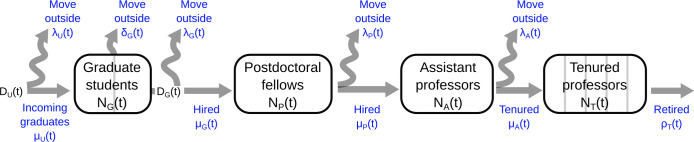
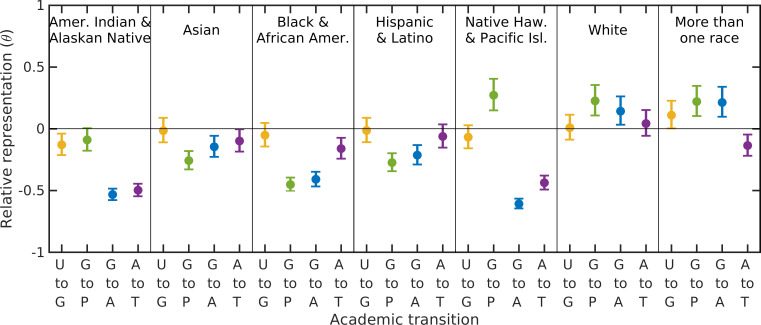
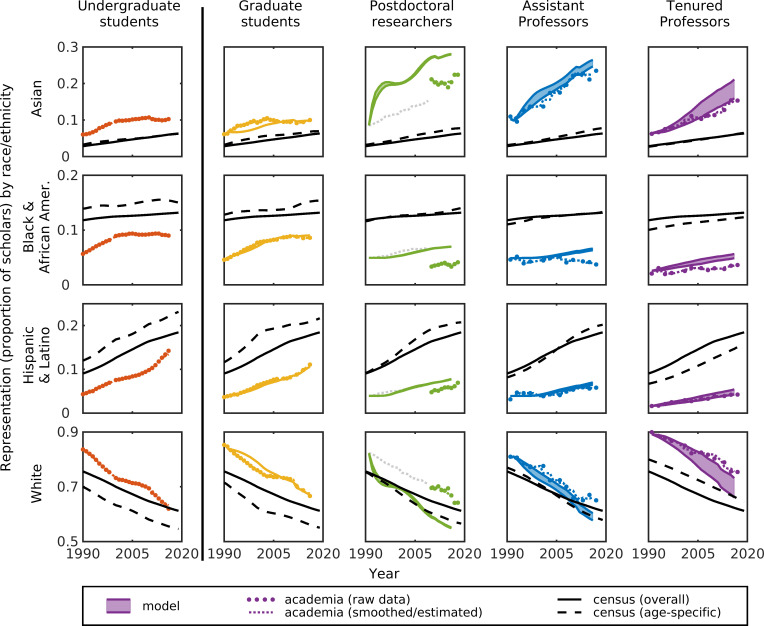
Several racial and ethnic identities are widely understood to be under-represented within academia, however, actual quantification of this under-representation is surprisingly limited. Challenges include data availability, demographic inertia and identifying comparison points. We use de-aggregated data from the U.S. National Science Foundation to construct a null model of ethnic and racial representation in one of the world's largest academic communities. Making comparisons between our model and actual representation in academia allows us to measure the effects of retention (while controlling for recruitment) at different academic stages. We find that, regardless of recruitment, failed retention contributes to mis-representation across academia and that the stages responsible for the largest disparities differ by race and ethnicity: for Black and Hispanic scholars this occurs at the transition from graduate student to postdoctoral researcher whereas for Native American/Alaskan Native and Native Hawaiian/Pacific Islander scholars this occurs at transitions to and within faculty stages. Even for Asian and Asian-Americans, often perceived as well represented, circumstances are complex and depend on choice of baseline. Our findings demonstrate that while recruitment continues to be important, retention is also a pervasive barrier to proportional representation. Therefore, strategies to reduce mis-representation in academia must address retention. Although our model does not directly suggest specific strategies, our framework could be used to project how representation in academia might change in the long-term under different scenarios.
几种种族和民族身份被广泛认为在学术界代表性不足,但对这种代表性不足的实际量化却惊人地有限。挑战包括数据可用性、人口惯性和确定比较点。我们使用美国国家科学基金会的分解数据,在世界上最大的学术社区之一中构建了一个种族和民族代表性的零模型。将我们的模型与学术界的实际代表性进行比较,可以衡量在不同学术阶段保留(同时控制招聘)的效果。我们发现,无论招聘情况如何,保留失败都会导致整个学术界的代表性不足,而且造成差异最大的阶段因种族和民族而异:对于黑人和西班牙裔学者来说,这种情况发生在从研究生到博士后研究员的过渡阶段,而对于美洲原住民/阿拉斯加原住民和夏威夷原住民/太平洋岛民学者来说,这种情况发生在教职阶段的过渡和内部。即使是对于亚裔和亚裔美国人,他们通常被认为代表人数众多,但情况也很复杂,取决于基准的选择。我们的研究结果表明,尽管招聘仍然很重要,但保留也是实现比例代表性的一个普遍障碍。因此,减少学术界代表性不足的策略必须解决保留问题。虽然我们的模型并没有直接提出具体的策略,但我们的框架可以用来预测在不同情况下,学术界的代表性在长期内可能会如何变化。