Estrada Mica, Woodcock Anna, Hernandez Paul R, Schultz P Wesley
Department of Psychology, California State University San Marcos.
J Educ Psychol. 2011 Feb 1;103(1):206-222. doi: 10.1037/a0020743.
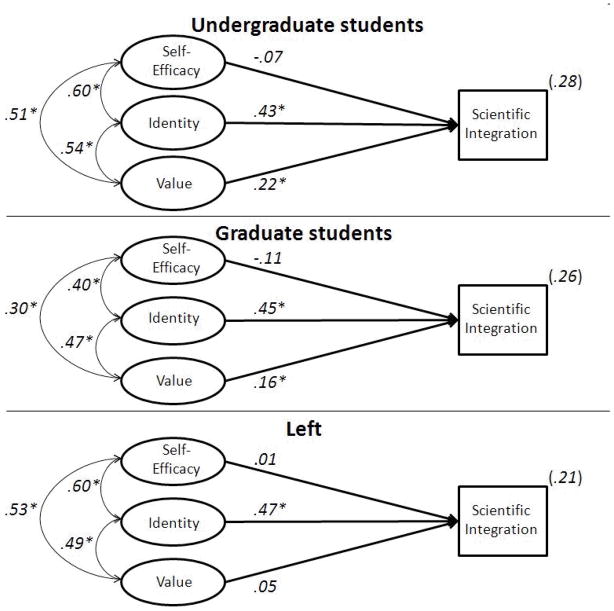
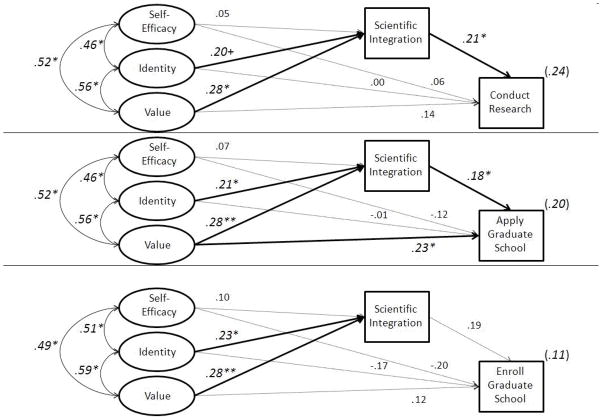
Students from several ethnic minority groups are underrepresented in the sciences, such that minority students more frequently drop out of the scientific career path than non-minority students. Viewed from a perspective of social influence, this pattern suggests that minority students do not integrate into the scientific community at the same rate as non-minority students. Kelman (1958, 2006) describes a tripartite integration model of social influence (TIMSI) by which a person orients to a social system. To test if this model predicts integration into the scientific community, we conducted analyses of data from a national panel of minority science students. A structural equation model framework showed that self-efficacy (operationalized consistent with Kelman's 'rule-orientation') predicted student intentions to pursue a scientific career. However, when identification as a scientist and internalization of values are added to the model, self-efficacy becomes a poorer predictor of intention. Additional mediation analyses support the conclusion that while having scientific self-efficacy is important, identifying with and endorsing the values of the social system reflect a deeper integration and more durable motivation to persist as a scientist.
来自几个少数民族群体的学生在科学界的代表性不足,以至于少数族裔学生比非少数族裔学生更频繁地退出科学职业道路。从社会影响的角度来看,这种模式表明少数族裔学生融入科学界的速度与非少数族裔学生不同。凯尔曼(1958年、2006年)描述了一种社会影响的三方整合模型(TIMSI),一个人通过该模型适应社会系统。为了检验该模型是否能预测融入科学界的情况,我们对一个全国性的少数族裔理科学生小组的数据进行了分析。一个结构方程模型框架表明,自我效能感(按照与凯尔曼的“规则导向”一致的方式进行操作化)预测了学生追求科学职业的意愿。然而,当将科学家身份认同和价值观内化加入模型时,自我效能感对意愿的预测能力就变弱了。额外的中介分析支持了这样的结论:虽然拥有科学自我效能感很重要,但认同并支持社会系统的价值观反映了更深入的融入以及作为科学家坚持下去的更持久动力。