Wang Jingfeng, Liu Jian, Gao Longfei, Li Guangqiao, Sun Yilin, Shi Bo
School of Medical Imaging, Bengbu Medical College, Bengbu, Anhui, 233030, People's Republic of China.
Anhui Key Laboratory of Computational Medicine and Intelligent Health, Bengbu Medical College, Bengbu, Anhui, 233030, People's Republic of China.
Cancer Manag Res. 2021 Nov 24;13:8821-8830. doi: 10.2147/CMAR.S336268. eCollection 2021.
Heart rate variability (HRV) has been reported as a useful biomarker for prognostic factors in a variety of cancers. The purpose of this study was to explore the predictive value of preoperative HRV for lymph node metastasis (LNM) in patients with cervical cancer (CC).
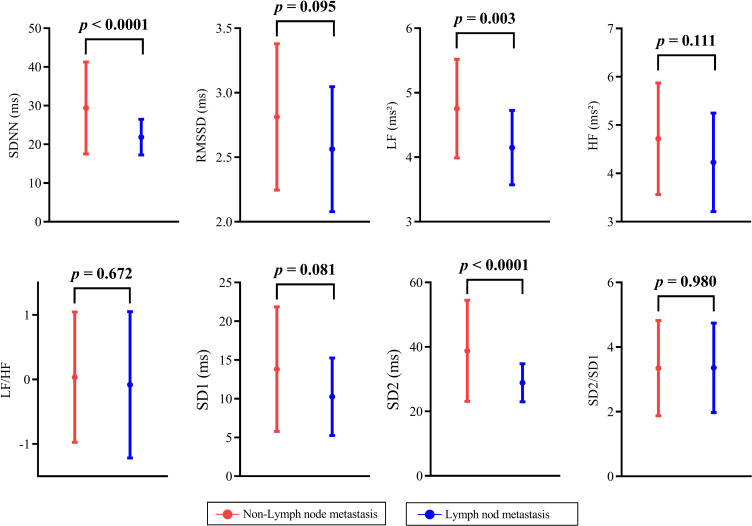
A total of 77 patients with CC were included, including 18 LNM and 59 non-LNM patients. A five-minute resting electrocardiogram (ECG) was collected before surgery for the analysis of HRV time domain, frequency domain and Poincaré plot parameters (ie, SDNN, RMSSD, LF, HF, LF/HF, SD1, SD2 and SD2/SD1). Student's -tests and logistic regression were performed to determine the relationship between HRV and LNM.
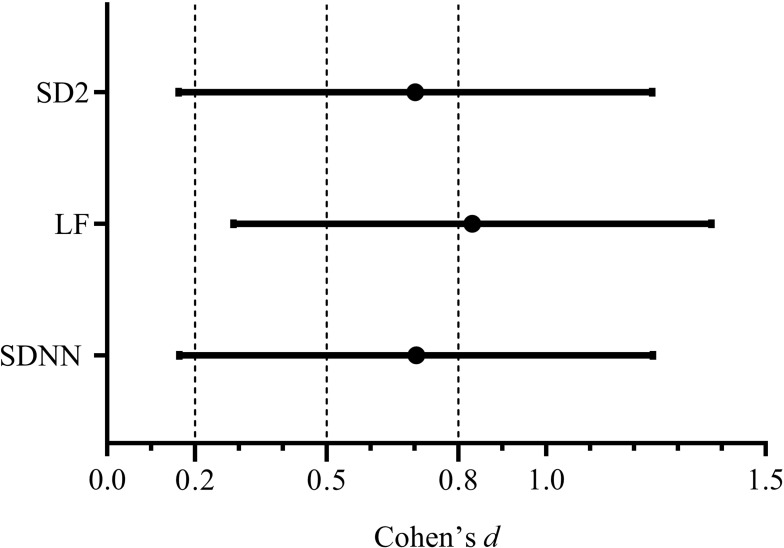
The LNM group had significantly lower SDNN, LF, and SD2 than the non-LNM group (all < 0.05; all Cohen's > 0.5). Binary logistic regression analysis indicated that SDNN, LF and SD2 were still significantly associated with LNM. Specifically, for each 1 ms decrease in SDNN and SD2 and each 1 logarithmic unit decrease in ln (LF), the odds of LNM increased by 12%, 9%, and 86%, respectively (all < 0.05).
These findings suggest an association between HRV and CC LNM, and HRV could be a potential noninvasive biomarker for the prediction of LNM in CC patients.
心率变异性(HRV)已被报道为多种癌症预后因素的有用生物标志物。本研究的目的是探讨术前HRV对宫颈癌(CC)患者淋巴结转移(LNM)的预测价值。
共纳入77例CC患者,包括18例LNM患者和59例非LNM患者。术前采集5分钟静息心电图(ECG),分析HRV时域、频域和庞加莱图参数(即SDNN、RMSSD、LF、HF、LF/HF、SD1、SD2和SD2/SD1)。采用学生t检验和逻辑回归分析来确定HRV与LNM之间的关系。
LNM组的SDNN、LF和SD2显著低于非LNM组(均P<0.05;所有Cohen's d>0.5)。二元逻辑回归分析表明,SDNN、LF和SD2仍与LNM显著相关。具体而言,SDNN和SD2每降低1 ms,ln(LF)每降低1个对数单位,LNM的几率分别增加12%、9%和86%(均P<0.05)。
这些发现提示HRV与CC LNM之间存在关联,HRV可能是预测CC患者LNM的潜在非侵入性生物标志物。