Case Western Reserve University, Cleveland, OH, USA.
J Prim Care Community Health. 2021 Jan-Dec;12:21501327211056186. doi: 10.1177/21501327211056186.
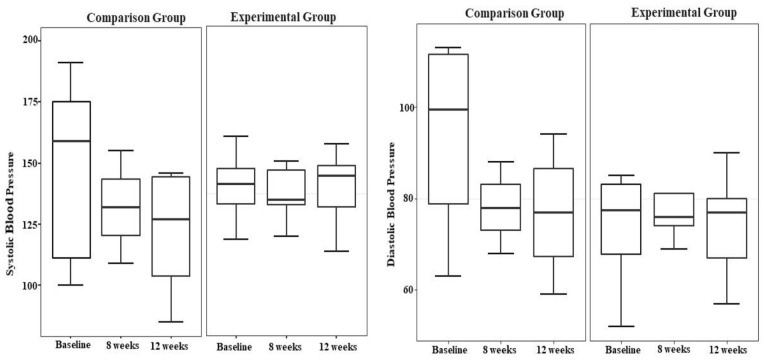
Behavioral interventions consolidating technology are underutilized and do not reach diverse populations such as African Americans with hypertension. This pilot study aimed to evaluate the effects of a theoretically derived, technology-based intervention in African Americans with hypertension. African Americans with hypertension (N = 18; age range 25-85; 72.22% females) were randomized to the technology-based plus positive psychological training (PPT) experimental group (n = 10) or the comparison group (n = 8) for 12 weeks. The technology-based intervention included analytic components (web-based education, self-monitoring of blood pressure [BP], and medication management using a commercially free app-Medisafe) and an emotional component (comprised of skills and behaviors directed at engaging 1 in positive activities to help build increasing healthy behaviors). The comparison group received the technology-based intervention alone. Demographic information, self-management cognitive processes, self-management behaviors, and health status outcomes were assessed. After completing the 12-week intervention, the groups did not significantly differ in health outcomes, health behavior outcomes, and technology utilization outcomes. Mean systolic BP decrease 6.02 mmHg (standard deviation [SD] = 22.75) in the comparison group and 1.1 mmHg (SD = 20.64; = .439) in the experimental group. Diastolic BP decreased 0.1 mmHg (SD = 11.78) in the comparison group and 1.5 mmHg (SD = 12.7; = .757) in the experimental group. Our findings suggest that behavioral interventions using technology have the potential to improve self-management outcomes among African American populations. Further research is warranted in a larger sample size and a longer time frame to identify the intervention's effectiveness.
行为干预整合技术的应用不足,无法覆盖到多样化的人群,例如患有高血压的非裔美国人。本研究旨在评估一种基于理论、利用技术的干预措施在患有高血压的非裔美国人中的效果。18 名患有高血压的非裔美国人(年龄范围 25-85 岁;72.22%为女性)被随机分为基于技术的外加积极心理训练(PPT)实验组(n=10)或对照组(n=8),接受为期 12 周的干预。基于技术的干预包括分析性成分(基于网络的教育、血压自我监测、使用免费商用应用程序 Medisafe 管理药物)和情感性成分(由旨在鼓励积极活动以帮助建立更多健康行为的技能和行为组成)。对照组仅接受基于技术的干预。评估人口统计学信息、自我管理认知过程、自我管理行为和健康状况结果。完成 12 周干预后,两组在健康结果、健康行为结果和技术利用结果方面没有显著差异。对照组收缩压平均下降 6.02mmHg(标准差 [SD] = 22.75),实验组下降 1.1mmHg(SD = 20.64; = .439)。对照组舒张压平均下降 0.1mmHg(SD = 11.78),实验组下降 1.5mmHg(SD = 12.7; = .757)。我们的发现表明,使用技术的行为干预有可能改善非裔美国人群的自我管理结果。需要在更大的样本量和更长的时间框架内进行进一步研究,以确定干预的有效性。