Department of Gastrointestinal Surgery, Capital Medical University Affiliated Beijing Shijitan Hospital, Beijing, China.
Department of Clinical Nutrition, Capital Medical University Affiliated Beijing Shijitan Hospital, Beijing, China.
Int J Cancer. 2022 Mar 15;150(6):1018-1028. doi: 10.1002/ijc.33891. Epub 2021 Dec 14.
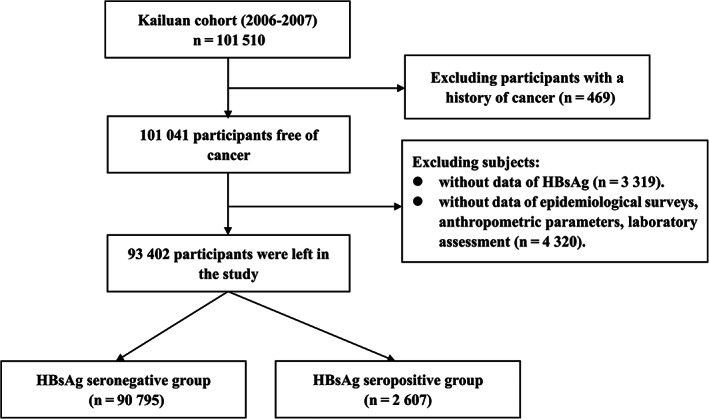
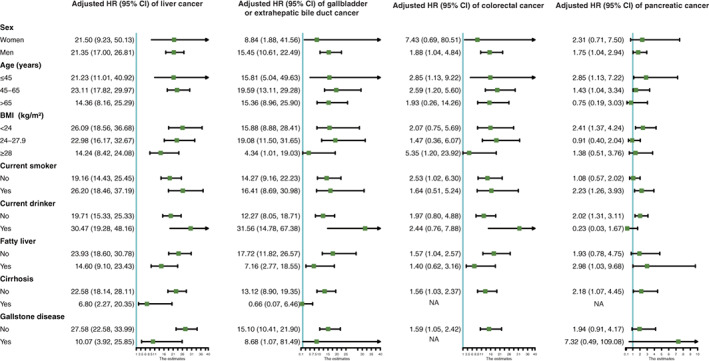
Our study aims to explore the relationship between chronic hepatitis B virus (HBV) infection and the risk of gastrointestinal (GI) cancers including liver, gastric, gallbladder or extrahepatic bile duct, pancreatic, small intestine, esophageal and colorectal cancer in the Kailuan Cohort study. We prospectively examined the relationship between HBV infection and new-onset GI cancers among 93 402 participants. Cox proportional hazards regression models, subgroup analyses and competing risk analyses were used to evaluate the association between HBV infection and the risk of new-onset GI cancers. During a median follow-up of 13.02 years, 1791 incident GI cancer cases were diagnosed. Compared to HBsAg seronegative participants, a significant positive association between HBV infection and GI cancers was observed in the multivariate-adjusted models (HR 5.59, 95% CI: 4.84-6.45). In the site-specific analyses, participants with HBsAg seropositive exhibited an increased risk of liver cancer (HR = 21.56, 95% CI: 17.32-26.85), gallbladder or extrahepatic bile duct cancer (HR = 14.89, 95% CI: 10.36-21.41), colorectal cancer (HR = 1.75, 95% CI: 1.15-2.96) and pancreatic cancer (HR = 1.86, 95% CI: 1.10-3.99). After taking death as the competing risk event, the associations of HBV infection with the risk of these cancers were attenuated but remained significant both in the cause-specific hazards models, the subdistribution proportional hazards models and sensitivity analyses. Our study suggests that HBV infection is associated with the elevated risk of liver cancer and extrahepatic cancer including gallbladder or extrahepatic bile duct, pancreatic and colorectal cancer among adults in Northern China.
本研究旨在探讨慢性乙型肝炎病毒(HBV)感染与胃肠道(GI)癌症(包括肝癌、胃癌、胆囊或肝外胆管癌、胰腺癌、小肠癌、食道癌和结直肠癌)风险之间的关系。我们前瞻性地检查了 93402 名参与者中 HBV 感染与新发 GI 癌症之间的关系。Cox 比例风险回归模型、亚组分析和竞争风险分析用于评估 HBV 感染与新发 GI 癌症风险之间的关系。在中位随访 13.02 年后,诊断出 1791 例新发 GI 癌症病例。与 HBsAg 阴性参与者相比,多变量调整模型显示 HBV 感染与 GI 癌症之间存在显著正相关(HR 5.59,95%CI:4.84-6.45)。在部位特异性分析中,HBsAg 阳性的参与者肝癌(HR=21.56,95%CI:17.32-26.85)、胆囊或肝外胆管癌(HR=14.89,95%CI:10.36-21.41)、结直肠癌(HR=1.75,95%CI:1.15-2.96)和胰腺癌(HR=1.86,95%CI:1.10-3.99)的风险增加。在将死亡作为竞争风险事件后,HBV 感染与这些癌症风险的关联在病因特异性风险模型、亚分布比例风险模型和敏感性分析中均减弱,但仍具有统计学意义。本研究表明,HBV 感染与中国北方成年人肝癌和肝外癌(包括胆囊或肝外胆管癌、胰腺癌和结直肠癌)风险增加相关。