Department of Epidemiology and Biostatistics, Jiangsu Key Lab of Cancer Biomarkers, Prevention and Treatment, Collaborative Innovation Center for Cancer Personalized Medicine, School of Public Health, Nanjing Medical University, Nanjing, China.
Department of Epidemiology and Biostatistics, School of Public Health, Peking University Health Science Center, Beijing, China.
JAMA Netw Open. 2019 Jun 5;2(6):e195718. doi: 10.1001/jamanetworkopen.2019.5718.
Hepatitis B virus (HBV) has been identified as a major risk factor for hepatocellular carcinoma. However, the associations between HBV infection and other cancer types are not well understood.
To assess the associations between chronic HBV infection and risk of all cancer types.
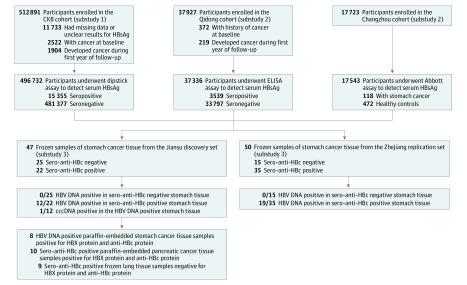
DESIGN, SETTING, AND PARTICIPANTS: This population-based study involved 3 cohorts in China. The China Kadoorie Biobank (CKB) prospective cohort study, conducted between June 2004 and July 2008, used a dipstick assay for detection of serum hepatitis B surface antigen (HBsAg) among 496 732 participants to determine the association between HBV infection and risk of all cancer types. Two cohort studies were used to validate the associations by applying more precise serum HBsAg detection assays: the Qidong cohort (37 336 participants enrolled from November 2007 to April 2011) and the Changzhou nested case-control study (17 723 participants enrolled from June 2004 to September 2005). A total of 97 samples of stomach cancer tissues, 10 samples of pancreatic cancer tissues, and 9 samples of lung cancer tissues were included to assess the presence of HBV replication and expression. Statistical analysis was performed from December 2016 to October 2018.
Serum HBsAg status in the population-based stage and HBV DNA status, the expression of hepatitis B X protein, and hepatitis B core antibody (anti-HBc) in the tissue-based stage.
Incidence of all cancer types during follow-up.
In the CKB cohort, the mean (SD) age of the 496 732 participants was 51.5 (10.7) years; 59.0% of the participants were women. After 4.4 million person-years of follow-up, participants who were HBsAg seropositive (n = 15 355) had a higher risk of hepatocellular carcinoma (hazard ratio [HR], 15.77; 95% CI, 14.15-17.57), stomach cancer (HR, 1.41; 95% CI, 1.11-1.80), colorectal cancer (HR, 1.42; 95% CI, 1.12-1.81), oral cancer (HR, 1.58; 95% CI, 1.01-2.49), pancreatic cancer (HR, 1.65; 95% CI, 1.03-2.65), and lymphoma (HR, 2.10; 95% CI, 1.34-3.31) when compared with participants who were HBsAg seronegative (n = 481 377). Because of the limitation of sample size, only associations of HBV infection with hepatocellular carcinoma and stomach cancer were validated in the Qidong cohort (hepatocellular carcinoma: HR, 17.51; 95% CI, 13.86-22.11; stomach cancer: HR, 2.02; 95% CI, 1.24-3.29); the Changzhou nested case-control study validated only an association between HBV infection and stomach cancer (odds ratio, 1.76; 95% CI, 1.04-2.98). Moreover, among 22 participants with stomach cancer from the Qidong cohort who were anti-HBc seropositive, 12 samples (54.5%) of cancer tissues were HBV DNA positive, while among 25 participants with stomach cancer who were anti-HBc seronegative, no HBV DNA was detected. The same negative and positive rate was observed in the validation set from Zhejiang Tumor Hospital (19 of 35 samples [54.3%] were HBV DNA positive). Moreover, among the 8 patients with stomach cancer from the Qidong cohort who were anti-HBc seropositive, anti-HBc and hepatitis B X protein were expressed in all of their stomach cancer tissue samples. The same phenomenon was observed in the patients with pancreatic cancer but not in the patients with lung cancer, which was consistent with the population-based results of the CKB cohort.
This study found that HBV infection was also associated with the risk of nonliver cancer, especially digestive system cancers among adults in China.
乙型肝炎病毒(HBV)已被确定为肝细胞癌的主要危险因素。然而,HBV 感染与其他癌症类型之间的关联尚不清楚。
评估慢性 HBV 感染与所有癌症类型风险之间的关联。
设计、地点和参与者:本基于人群的研究涉及中国的 3 个队列。中国慢性病前瞻性研究(CKB)前瞻性队列研究于 2004 年 6 月至 2008 年 7 月期间进行,通过检测 496732 名参与者血清乙型肝炎表面抗原(HBsAg)的检测棒试验,确定 HBV 感染与所有癌症类型风险之间的关联。两个队列研究通过应用更精确的血清 HBsAg 检测试验来验证关联:启东队列(2007 年 11 月至 2011 年 4 月期间招募的 37336 名参与者)和常州巢式病例对照研究(2004 年 6 月至 2005 年 9 月期间招募的 17723 名参与者)。共纳入 97 份胃癌组织、10 份胰腺癌组织和 9 份肺癌组织样本,以评估 HBV 复制和表达的存在情况。统计分析于 2016 年 12 月至 2018 年 10 月进行。
基于人群阶段的血清 HBsAg 状态和组织阶段的 HBV DNA 状态、乙型肝炎 X 蛋白的表达和乙型肝炎核心抗体(抗-HBc)。
随访期间所有癌症类型的发病率。
在 CKB 队列中,496732 名参与者的平均(SD)年龄为 51.5(10.7)岁,其中 59.0%为女性。经过 440 万人年的随访,HBsAg 阳性(n=15355)的参与者发生肝细胞癌(风险比[HR],15.77;95%置信区间[CI],14.15-17.57)、胃癌(HR,1.41;95%CI,1.11-1.80)、结直肠癌(HR,1.42;95%CI,1.12-1.81)、口腔癌(HR,1.58;95%CI,1.01-2.49)、胰腺癌(HR,1.65;95%CI,1.03-2.65)和淋巴瘤(HR,2.10;95%CI,1.34-3.31)的风险高于 HBsAg 阴性(n=481377)的参与者。由于样本量有限,仅在启东队列中验证了 HBV 感染与肝细胞癌和胃癌的关联(肝细胞癌:HR,17.51;95%CI,13.86-22.11;胃癌:HR,2.02;95%CI,1.24-3.29);常州巢式病例对照研究仅验证了 HBV 感染与胃癌之间的关联(比值比,1.76;95%CI,1.04-2.98)。此外,在启东队列中 22 名抗-HBc 阳性的胃癌患者中,12 份(54.5%)癌症组织的 HBV DNA 呈阳性,而在 25 名抗-HBc 阴性的胃癌患者中,未检测到 HBV DNA。在浙江肿瘤医院的验证组中观察到相同的阴性和阳性率(35 个样本中有 19 个[54.3%]HBV DNA 呈阳性)。此外,在启东队列中 8 名抗-HBc 阳性的胃癌患者中,所有胃癌组织样本中均表达了抗-HBc 和乙型肝炎 X 蛋白。同样的现象也出现在胰腺癌患者中,但在肺癌患者中没有出现,这与 CKB 队列的基于人群的结果一致。
本研究发现,HBV 感染也与中国成年人的非肝癌风险相关,尤其是消化系统癌症。